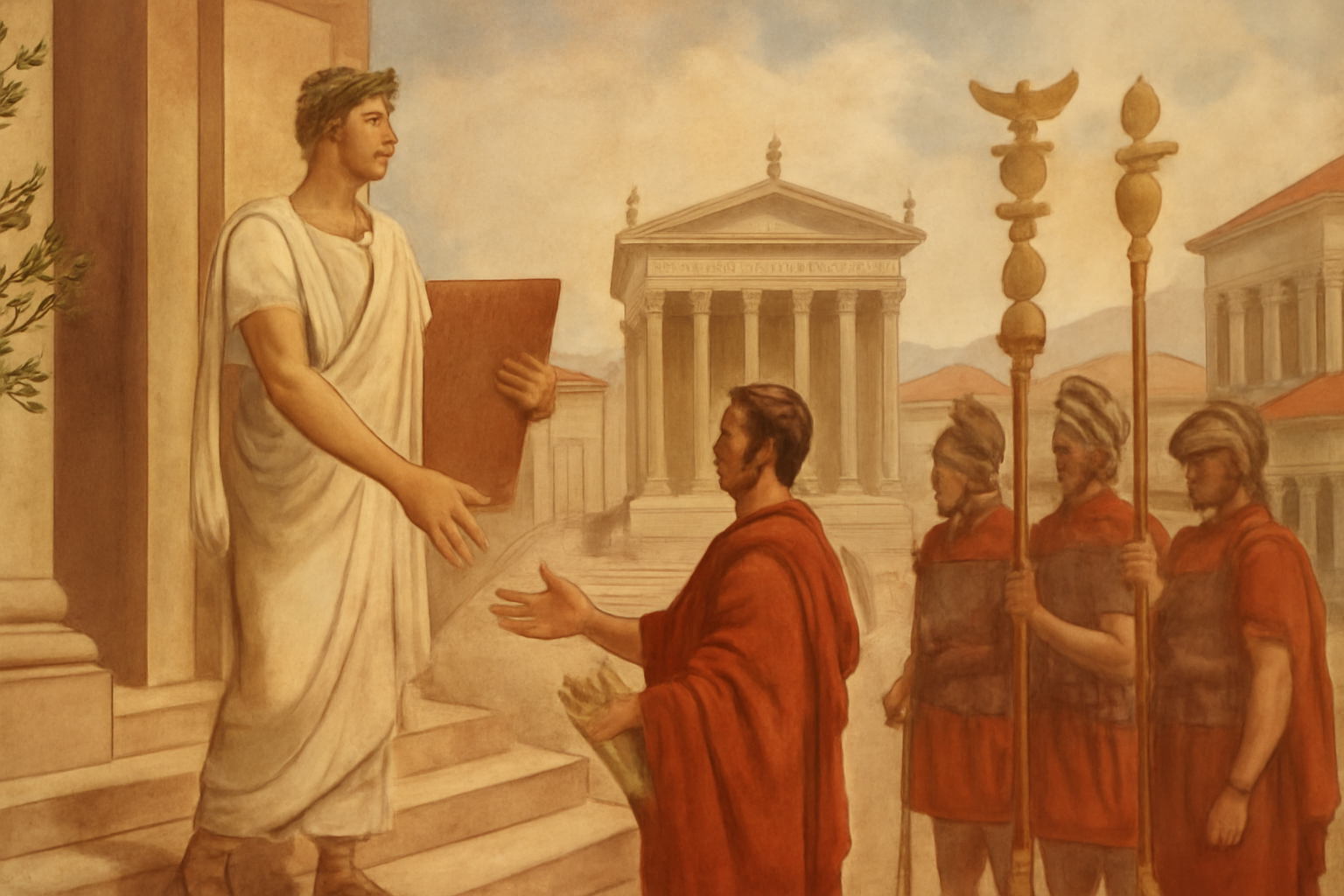
Historical Role
Julius Caesar belongs at the hinge between republican competition and imperial rule. His career shows how military command, debt, popular politics, senatorial fear, and personal ambition could collapse into civil war. He was not the only Roman to test the limits of the republic, but his dictatorship made the problem impossible to ignore.
The concrete scenes matter. Caesar crossed the Rubicon with an army in 49 BCE, accepted honors that made many senators fear monarchy, and entered the Senate on the Ides of March in 44 BCE into a conspiracy led by men who claimed they were saving liberty. Those moments make the constitutional crisis visible: law, oath, military loyalty, public honor, and fear were no longer pulling in the same direction.
Caesar's assassination and Augustus's later settlement form one sequence. One shows an attempt to stop personal rule by killing the ruler; the other shows how Augustus learned from that failure and built a more durable settlement around offices, ceremony, armies, and public legitimacy.
Caesar's importance is easier to see when his military career is connected to political structure. Command in Gaul gave him soldiers, wealth, prestige, and an independent base of loyalty. Those advantages did not operate outside Roman politics; they entered a republic already strained by elite competition, popular legislation, provincial commands, debt, and the memory of earlier civil wars. Caesar's choices mattered, but the offices and incentives around him made extraordinary personal power increasingly imaginable.
The Senate gives Caesar's story its constitutional stakes. The assassins did not act because they hated success in general; they feared that dictatorship, honors, and military loyalty had made republican competition meaningless. Their action reveals a political culture that still valued liberty, offices, and ancestral custom, but had lost the trust and shared restraints needed to make those ideas governable. That is why the murder could be defended as liberation and still fail to restore the republic.
The strongest reading path treats Caesar as a test case for emergency power. He used legal titles, military victory, clemency, reform, spectacle, and personal networks to concentrate authority. Later rulers would learn that open domination was dangerous unless it was wrapped in institutions, rituals, and public language. Caesar therefore matters not only because he died dramatically, but because his career exposed the problem Augustus would solve more carefully.
This is also why the page belongs inside Ancient Empires rather than only Roman biography. Caesar helps readers see how a city-state republic that conquered widely could struggle to govern the political consequences of its own success. His story turns institutional vocabulary into a human-scale conflict: consulships, commands, debts, triumphs, dictatorship, senatorial honor, and street politics all become easier to understand when they are attached to choices made by people under pressure.
The military layer begins before the dictatorship. Caesar's campaigns in Gaul gave him victories, money, captives, clients, veterans, and a reputation that could be used in Roman politics. Those campaigns were brutal as well as career-making, and strategic success cannot hide violence against communities beyond Italy. For Roman elites, command abroad had long been a path to honor. Caesar showed how that path could become dangerous when an army's loyalty, a commander's debts, and factional conflict at Rome began to reinforce one another.
The institutional layer is just as important as personality. The republic relied on annual offices, aristocratic competition, legal procedure, and a public language of liberty. It also relied on informal restraint: ambitious men were expected to compete without making competition impossible for everyone else. By Caesar's lifetime, earlier civil wars, extraordinary commands, political violence, and fear of prosecution had weakened those restraints. Caesar exploited the weakness, but he did not create it alone. That distinction keeps the biography from becoming a simple morality play.
The assassination shows the limits of elite violence as a constitutional tool. Brutus, Cassius, and their allies could kill Caesar in the name of liberty, but they could not recreate the trust, military balance, and shared rules that had once made republican politics work. The murder removed a person while leaving the deeper problems in place. That is why the event belongs beside the founding of the Roman Empire: Augustus did not merely inherit Caesar's name; he inherited the lesson that power had to be made durable through offices, religious honors, military settlement, patronage, and careful public performance.
Caesar's memory also needs a critical layer. Later readers have used him as conqueror, tyrant, reformer, military genius, populist champion, destroyer of liberty, and model for ambition. Those labels reveal as much about later politics as they do about Caesar. A strong page lets readers ask why so many different regimes and writers found him useful. The answer lies in the uncomfortable combination of talent, violence, crisis, and institutional failure: Caesar is memorable because he makes it hard to separate achievement from damage.
Geography keeps the biography from shrinking into Senate drama. Gaul, the Rubicon, Spain, Alexandria, Rome, and the eastern Mediterranean all mattered because Caesar's power moved through armies, debts, veterans, provincial wealth, and symbolic crossings that turned distance into leverage.
The best ending is not the Ides of March. It is the question Caesar left behind. Could Rome remain a republic after decades of overseas conquest had made armies, wealth, provincial commands, and personal fame too large for older offices to contain? The answer was not decided in one murder or one law. It unfolded through veterans, heirs, senators, crowds, courts, temples, coins, and public memory. Caesar therefore leads readers onward to Augustus and 476: his life opens the route from republican crisis to imperial settlement and then to the much later problem of Roman survival.
A final reader lens is scale. Caesar is a person page, but his career keeps pointing beyond one person. The biography works when readers can move from a named actor to armies, law courts, provincial wealth, urban crowds, senatorial fear, and the long afterlife of Roman political language.
Caesar also opens the whole Ancient Empires cluster. A reader may arrive expecting a biography, but his life quickly leads into civil war, republican offices, provincial conquest, military loyalty, debt, public spectacle, and the later invention of a more durable imperial settlement under Augustus.
Julius Caesar also works as a navigation point. Open the linked event pages to see where the biography becomes chronology, then use the topic routes to test whether the same pattern appears beyond one life. That extra step matters because historical importance is rarely contained inside a single decision; it usually spreads through institutions, witnesses, opponents, imitators, and later arguments over memory.
Why This Person Matters
Caesar matters because he makes the Roman Republic easier to understand as a political system under stress. His story is not simply a biography of genius or ambition. It is a way into questions about armies loyal to commanders, elites unable to share power, reform promises used as political weapons, and the danger of believing that one violent act can restore an older order. For a reader moving through the Ancient Empires route, Caesar also helps compare Rome with other imperial systems. Qin and Han China raise questions about standardization and dynastic legitimacy; Achaemenid Persia raises questions about distance and administration; Caesar raises the specifically Roman question of how republican offices could be hollowed out while their language remained powerful.
His life is therefore a bridge between biography, constitutional crisis, military command, and imperial afterlife. The sharper question is not whether Caesar was good or bad. It is how a political community can win an empire abroad and lose its old rules at home, and why later rulers learned to preserve republican language after republican competition had become too dangerous to survive unchanged.
When does emergency power become a new constitution in practice, even before anyone admits it?
How to Read This Life
Julius Caesar is easiest to understand when the biography is read beside Assassination of Julius Caesar, Founding of the Roman Empire. Those events show the historical setting in motion: dates, places, institutions, conflict, and consequences give the life a structure that a short biography alone cannot provide.
The surrounding route crosses Classical Antiquity and locations such as Rome. That matters because influence rarely stays inside one person. It moves through offices, armies, movements, laws, texts, speeches, institutions, and later memory.
A useful reading path starts with the role labels, then opens the event pages to see what changed, and finally compares this person with other actors facing similar pressures.
For readers who arrive on a biography first, this page is meant to become a doorway rather than a stop. Read one paragraph for the answer, then use the turning points, topic routes, and event links to test whether the person's reputation matches the wider evidence.
Read Julius Caesar through the roles of Roman general, Dictator, Author rather than as reputation alone.
Place the biography inside Roman Republic and the wider events linked below.
Ask which choices were personal and which were constrained by institutions or crisis.
Follow how later memory simplified, contested, or reused this person's role.
Legacy, Limits, and Memory
A useful biography keeps scale in view. Julius Caesar mattered because individual choices met a wider structure: institutions, enemies, allies, audiences, technologies, beliefs, and inherited conflicts. The related event pages help separate personal agency from conditions that no single person controlled.
Memory is part of the biography too. Later readers often simplify a figure into a hero, villain, founder, reformer, conqueror, prophet, scientist, or symbol. Those labels can be helpful, but they become misleading when they hide conflict, compromise, exclusion, uncertainty, or the experiences of people outside the main biography.
For the next step, compare this life with a topic route rather than stopping at the name. If the same pattern appears across several figures, the reader has found a historical structure; if this person breaks the pattern, the contrast is usually where the most interesting question begins.
Caesar's page must stay alert to charisma as a historical trap. Personality mattered, but charisma became politically decisive only because armies, courts, crowds, provincial wealth, and senatorial competition gave it force.
Turning Points to Read Next
Assassination of Julius Caesar
A group of senators killed Julius Caesar during a meeting in Rome; their motives mixed republican language, elite fear, personal rivalry, and later interpretations after years of civil war and personal rule.
Founding of the Roman Empire
Octavian accepted the title Augustus and reorganized Roman power around a new imperial settlement that preserved republican language while concentrating authority.
Related Timeline
- March 15, 44 BCEAssassination of Julius Caesar
A group of senators killed Julius Caesar during a meeting in Rome; their motives mixed republican language, elite fear, personal rivalry, and later interpretations after years of civil war and personal rule.
- 27 BCEFounding of the Roman Empire
Octavian accepted the title Augustus and reorganized Roman power around a new imperial settlement that preserved republican language while concentrating authority.
References
Where to Check the Facts
- Primary Source: Plutarch on the Assassination of Julius CaesarPrimary-source excerpt for the conspiracy and assassination of Caesar.
- Primary Source: Plutarch, Life of Julius CaesarPrimary-source reference for Caesar's career, civil-war context, dictatorship, and later memory.
- Encyclopaedia Britannica: Julius CaesarBiographical reference for Caesar's offices, military career, dictatorship, and assassination.
- World History Encyclopedia: Julius CaesarNarrative reference for Caesar's political career, civil war setting, and later memory.