At a Glance
The shape of the event
- Date
- 313 CE
- Place
- Milan
- Type
- Religious Policy
The Edict of Milan recognized religious toleration for Christians within the Roman Empire, changing the relationship between imperial power and Christianity.
313 CE; place the event in Milan before comparing causes or consequences.
The policy helped Christianity move from persecuted movement to a public force within Roman imperial politics.
Constantine the Great / Licinius are the first names or groups to compare before widening the story.
Christian communities gained legal security and imperial favor in a transformed religious landscape.
Christian communities gained legal security and imperial favor in a transformed religious landscape.
The policy helped Christianity move from persecuted movement to a public force within Roman imperial politics.
Follow this thread to understand how legal recognition interacts with power.
Background
The Roman Empire of the early fourth century governed a vast Mediterranean world in which many gods, cults, and local practices coexisted alongside newer religious movements. Christianity by this time had grown beyond isolated groups; it had communities in cities and countryside, networks of leaders, and public practices that made its presence increasingly visible. That visibility brought both local tensions and opportunities. Imperial officials faced the practical problem of how to manage religious diversity across provinces with differing customs, loyalties, and levels of unrest. At the same time, emperors sought ways to secure authority and secure the loyalty of populations whose spiritual commitments mattered for public order.
These pressures—administrative, social, and political—created an environment in which a policy recognizing toleration for one set of believers could serve multiple ends: reducing local conflict, stabilizing imperial rule, and incorporating an influential social movement into the life of the state. Historians caution against a single-cause explanation: the Edict of Milan sits at the intersection of personal decisions by rulers and broader institutional needs within the Roman Empire. The Edict of Milan is often summarized as Constantine legalizing Christianity, but the context is wider. The Roman Empire had experienced persecution under Diocletian and later shifts toward toleration. Constantine and Licinius met in a world where imperial stability, military legitimacy, religious diversity, and public order were tightly connected.
The policy did not make Christianity the official religion of the empire. It granted toleration and restored confiscated property, changing the legal environment in which Christian communities could operate.
The Turning Point
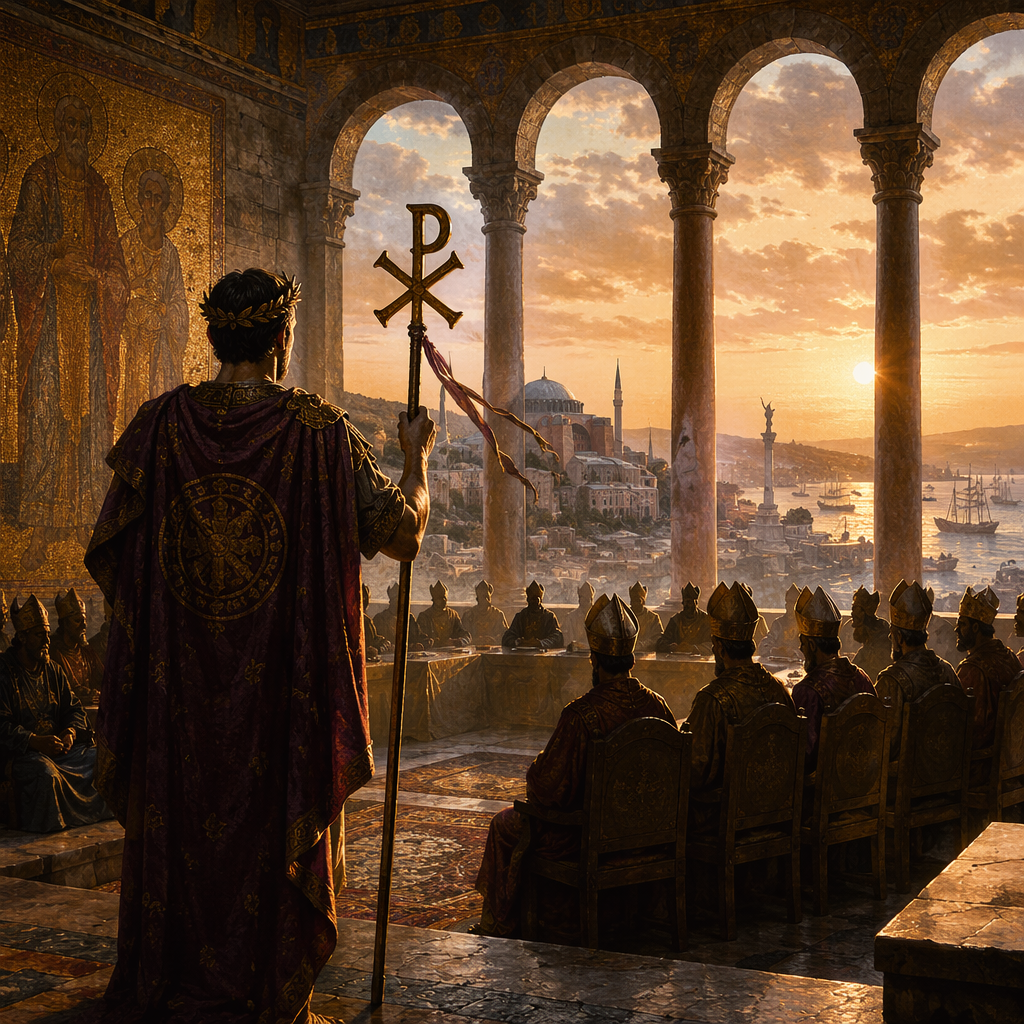
The change announced in Milan was not a vague promise but a deliberate policy choice by two emperors, Constantine the Great and Licinius, who held power across different parts of the empire. In 313 CE they agreed on a principle that recognized religious toleration for Christians within imperial jurisdiction. That decision involved concrete political calculation: it removed legal obstacles that had left Christian communities exposed to varying degrees of penalty, and it signaled that imperial authority could be used to guarantee religious space rather than always to suppress it.
For Christian leaders, the edict offered legal security and a safer public presence; for Constantine and Licinius, it provided an instrument for shaping provincial governance and for cultivating support among Christian populations. The moment in Milan therefore combined the agency of named rulers with existing social realities—organized congregations, episcopal leadership, and local patterns of accommodation or conflict. Crucially, the edict did not erase debate or competition over religion; it altered the terms on which those debates would be handled by law and by imperial favor, making religion a matter of public policy as well as private conviction. The turning point was the imperial decision to treat Christian worship as lawful rather than suspect.
That changed how bishops, churches, patrons, and local officials could act. A persecuted or precarious community could now own property, build institutions, and appeal to imperial favor. Constantine's patronage mattered, but the shift was not only personal belief. It was also a new model of imperial religious policy, one that could use toleration and support to build loyalty and stability.
Consequences
In the near term, Christian communities experienced a tangible change in their legal standing: they gained protections that reduced the risk of arbitrary punishment and allowed more open public worship. Imperial favor that followed—formal and informal—gave Christian leaders new leverage in urban and provincial life. Over the longer term, the Edict of Milan helped reconfigure the relationship between church and state. Christianity moved more clearly from a persecuted movement to a public actor within imperial politics, with new opportunities to influence policy, public institutions, and social welfare. That shift was neither linear nor uniform: different provinces and cities absorbed the change in varied ways, and other religious groups continued to negotiate their place under imperial rule.
Scholars remain attentive to the balance between the intentions of Constantine and Licinius as individuals and wider structural forces—administrative needs, demographic change, and social networks—that made a policy of toleration both possible and politically attractive. The edict did not settle the shape of Roman religious life once and for all, but it marked a decisive turning of the imperial compass toward accommodating Christianity as part of public governance. In the short term, Christian communities gained legal security and resources. In the longer term, the relationship between church and empire deepened, leading toward councils, doctrinal disputes, patronage, and eventually stronger imperial involvement in Christian life. The Edict was not the endpoint of paganism or the instant triumph of Christianity.
It was a legal and political opening that made later transformations possible.
Interpretation Notes
The memory of Edict of Milan often depends on who tells the story. A court, army, religious community, merchant network, or later nation can emphasize different causes and make Milan stand for different lessons.
Why Keep Reading
Follow this thread to understand how legal recognition interacts with power. Read on to trace Constantine’s subsequent political choices, Licinius’s later role, and how imperial law and local practice unfolded across the provinces. The Edict of Milan is a hinge: it explains how religious toleration became an instrument of governance, and it sets the stage for later debates over authority, orthodoxy, and the public role of religious leaders. Each of those developments deepens the question posed here—when does state recognition strengthen a movement, and when does it bind that movement to the priorities of rulers? Read next through Constantine, Council of Nicaea, late Roman religion, and Theodosius. The sequence shows how toleration, patronage, doctrine, and imperial authority became increasingly intertwined.
Reading Path
Follow the story without losing the thread
Before This
- Founding of the Roman Empire27 BCE
- Assassination of Julius CaesarMarch 15, 44 BCE
After This
- Gupta Empire Risesc. 320 CE
- Council of Nicaea325 CE
- Constantinople FoundedMay 11, 330 CE
Same Period
- Beginning of Muhammad's Revelationsc. 610 CE
- Hijra to Medina622 CE
- Battle of BadrMarch 624 CE
Wider Timeline
Mind Map
How to think about Edict of Milan
Imperial politics
Need to stabilize rule across diverse provinces encouraged policy of toleration
Map Layer
Where this event sits geographically
Gold pins mark the approximate locations of published event pages. This is a schematic locator map, not a historical border map.
Coordinates are approximate and are used to help readers orient themselves before opening a full event page.
References
Where to Check the Facts
- Encyclopaedia Britannica: Edict of MilanSpecific reference for the 313 agreement, religious toleration, Constantine, Licinius, and Christian legal status.
- Encyclopaedia BritannicaBackground reference for chronology, names, and historical context.
- WikidataStructured reference for dates, places, alternate names, and entity links.