At a Glance
The shape of the event
- Date
- 138 BCE
- Place
- Chang'an to Central Asia
- Type
- Diplomatic Mission
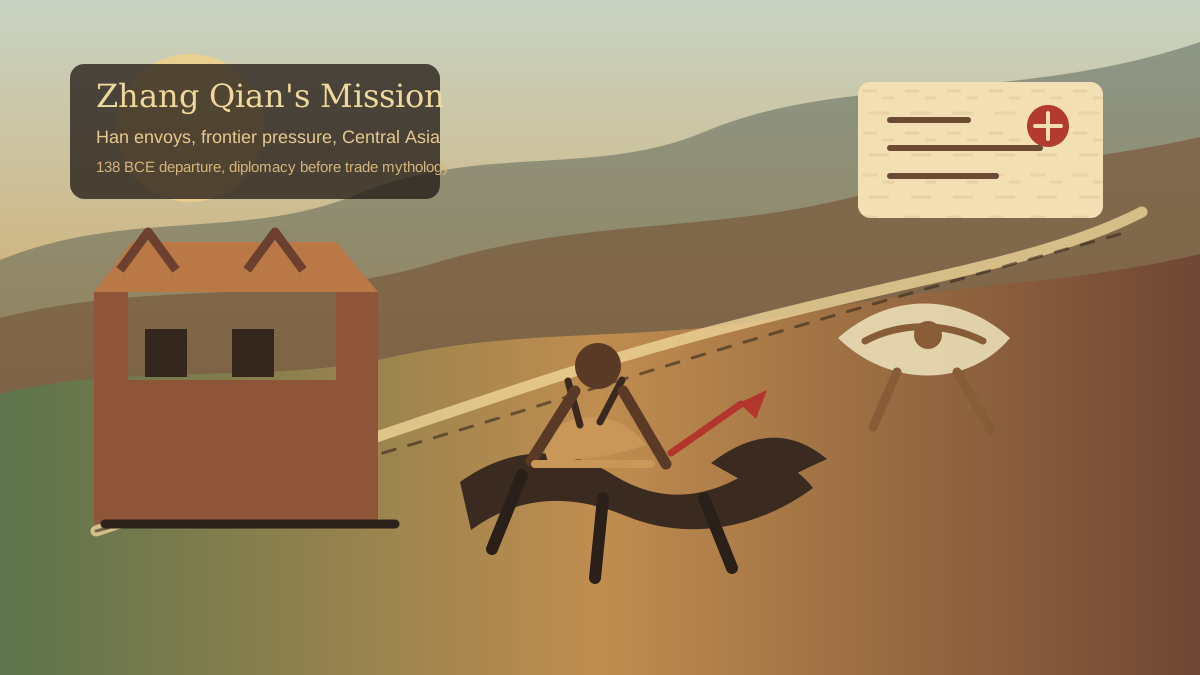
The Han court sent Zhang Qian westward to seek alliances and gather knowledge about Central Asian peoples and routes.
138 BCE; place the event in Chang'an to Central Asia before comparing causes or consequences.
Zhang Qian's reports helped open a wider Han understanding of Central Asia and later trade routes associated with the Silk Road.
Zhang Qian / Emperor Wu of Han are the first names or groups to compare before widening the story.
His mission brought new geographic and diplomatic information back to the Han court.
His mission brought new geographic and diplomatic information back to the Han court.
Zhang Qian's reports helped open a wider Han understanding of Central Asia and later trade routes associated with the Silk Road.
If Zhang Qian’s mission changed how the Han saw the world, the follow-up questions matter: How did Beijing and the societies to the west convert information into concrete alliances or commercial exchanges?
Background
By the mid-2nd century BCE the Han court faced questions that could not be answered from within palace walls. How secure were the empire’s frontiers? Where did the tracks and passes to the west actually lead? Who populated the lands between Chang'an and the distant pastures and cities beyond? Emperor Wu authorized an expedition designed less for immediate conquest than for knowledge: diplomatic contacts, reports on geography, and clearer maps of the peoples and routes lying outside the imperial administrative grid. The mission reflects overlapping motives—strategic caution, commercial curiosity, and a desire for diplomatic partnerships—but historians debate how much the effort owed to a single imperial calculation versus longer-term structural pressures such as population growth, trade potential, and frontier insecurity.
What is clear is the practical character of the assignment. The court wanted usable intelligence that could inform future decisions. Zhang Qian’s journey must be read against this complicated backdrop: a decisive imperial request, practical fieldwork on exposed roads, and the broader, slower transformation of interregional connections. Zhang Qian's mission should not be reduced to the idea that he opened a finished Silk Road. He was sent by Emperor Wu into a Central Asian world of Xiongnu power, Yuezhi movement, oasis routes, horses, diplomacy, and uncertain intelligence. The routes later called the Silk Road existed through many local exchanges; the mission changed what the Han court knew and wanted. The page needs to distinguish journey from network.
Zhang Qian's reports helped the Han imagine allies, horses, and western regions, but long-distance trade grew through soldiers, envoys, merchants, oasis rulers, nomads, translators, and later state campaigns.
The Turning Point
The turning point was not a single battle or treaty but an act of projection: the Han court sent Zhang Qian westward, and he returned with organized, practical information that the court had lacked. Emperor Wu’s choice to dispatch an envoy signaled a willingness to engage beyond the empire’s immediate orbit. Zhang Qian’s role was both narrow and consequential—he was specifically tasked to seek alliances and to gather reliable knowledge about Central Asian peoples and routes. What changed during the mission was the quality of the Han’s intelligence. Instead of relying on rumor or secondhand reports, the court received geographic descriptions, reports on local polities, and assessments of potential diplomatic partners.
Those first-hand returns altered the decision-making landscape in Chang'an: policymakers now confronted specific options rather than abstractions. Historians continue to argue about how much of the subsequent opening of networks was the result of this individual embassy versus deeper economic and political currents. Yet the immediate effect of Zhang Qian’s mission was unmistakable: the Han government had a clearer map of what lay to the west and a new sense of possible diplomatic pathways. The turning point was intelligence becoming policy. Reports from the west helped Han rulers link frontier security, diplomacy, horse supply, and trade ambitions into a larger Central Asian strategy.
Consequences
In the near term Zhang Qian’s reports supplied Emperor Wu and his advisers with concrete geographic and diplomatic information that could be acted on—new intelligence to guide future envoys, military dispositions, and trade contacts. That immediacy mattered: for the first time the Han court could make plans informed by on-the-ground observation rather than hearsay. Over the longer term the mission’s reports helped open a wider Han understanding of Central Asia. Those improved perceptions did not automatically create a bustling transcontinental trade network overnight, but they helped establish the informational foundation on which later exchanges grew.
Subsequent envoys, merchants, and local intermediaries made use of the routes and contacts Zhang Qian described, and later historians link those processes with the development of the trade corridors that scholars call the Silk Road. At the same time the story resists a tidy, single-cause explanation: the widening of interregional ties involved many actors, shifting local politics, and evolving economic incentives. Zhang Qian’s mission stands as a pivotal human contribution to a longer process—an episode that made possible further engagement between East Asia and Central Asia without dictating the precise shape that engagement would take. The afterlife includes Han expansion, Ferghana horses, oasis states, Buddhist transmission, caravan routes, and the later Silk Road idea.
The event matters because information changed the map of political possibility.
Interpretation Notes
Zhang Qian did not open the Silk Road as a single trade route in the modern sense. The debate is how to read an exploratory Han mission, Xiongnu frontier pressure, Central Asian diplomacy, horses, envoys, and later commercial networks without turning the story into a simple road-opening myth.
Why Keep Reading
If Zhang Qian’s mission changed how the Han saw the world, the follow-up questions matter: How did Beijing and the societies to the west convert information into concrete alliances or commercial exchanges? What routes proved most durable, and which partnerships faltered? Readers who move next to the sequence of later embassies, early trade expeditions, and evolving frontier policies will see how one envoy’s reports were used, adapted, and contested. The contested balance between individual initiative and structural change reappears across those stories, so tracing what came after Zhang Qian reveals both policy choices and the slow, contingent growth of interregional networks.
Read Zhang Qian with Han Dynasty, Xiongnu frontiers, Kushan Empire, Silk Road routes, and Tang Chang'an to follow how intelligence, diplomacy, and exchange became Eurasian history.
Reading Path
Follow the story without losing the thread
Before This
- Han Dynasty Founded202 BCE
- Battle of Cannae216 BCE
- Qin Unification of China221 BCE
After This
- Assassination of Julius CaesarMarch 15, 44 BCE
- Founding of the Roman Empire27 BCE
- Kushan Empire Risesc. 30 CE
Same Period
Wider Timeline
Mind Map
How to think about Zhang Qian's Western Mission
imperial curiosity
The Han court sought reliable intelligence about lands and peoples west of Chang'an
Map Layer
Where this event sits geographically
Gold pins mark the approximate locations of published event pages. This is a schematic locator map, not a historical border map.
Coordinates are approximate and are used to help readers orient themselves before opening a full event page.
References
Where to Check the Facts
- Encyclopaedia Britannica: Zhang QianSpecific reference for Zhang Qian's Han mission and Central Asian reports.
- Encyclopaedia Britannica: Silk RoadContext reference for the long-distance paths later associated with Silk Road exchange.
- UNESCO Silk Roads Programme: About the Silk RoadsContext reference for Silk Roads as changing networks of exchange, diplomacy, movement, goods, and ideas rather than one fixed road.