At a Glance
The shape of the event
- Date
- 431 BCE
- Place
- Greece
- Type
- War
Athens and Sparta entered a long war that drew in allied city-states and exposed the fragility of Greek interstate order.
431 BCE; place the event in Greece before comparing causes or consequences.
The war weakened Athens, elevated Sparta temporarily, and became a classic case for studying fear, alliance systems, and imperial overreach.
Pericles / Archidamus II are the first names or groups to compare before widening the story.
The conflict began decades of military, political, and social strain across the Greek world.
The conflict began decades of military, political, and social strain across the Greek world.
The war weakened Athens, elevated Sparta temporarily, and became a classic case for studying fear, alliance systems, and imperial overreach.
Follow the subsequent campaigns, sieges, and diplomatic maneuvers to see how initial choices hardened into long-term consequences.
Background
For decades before 431 BCE the Greek world had been a network of independent city-states linked by language, religion, and shifting alliances. Athens had grown into a maritime power with a broad network of allies across the Aegean; Sparta remained the pre-eminent land power in the Peloponnese. Those differences—naval strength vs. land strength, empire vs. traditional hegemony—created recurring friction. Trade and diplomacy intertwined with questions of prestige and security: small incidents could ripple outward because allied cities felt obliged to respond. The balance between personal leadership and structural pressures was already strained. Economic competition, rival treaty obligations, and mutual distrust made compromise more difficult. When crises occurred, the existing diplomatic mechanisms often proved inadequate.
Historians debate how much the war was the result of particular decisions by leaders and how much it reflected these deeper, systemic tensions; this account keeps both levels in view rather than choosing one neat explanation. A stronger opening for the Peloponnesian War has to slow down before the first invasion. Athens and Sparta did not suddenly discover that they disliked each other in 431 BCE. The decades after the Persian Wars had already turned the Delian League into an Athenian empire, tightened tribute payments, pushed Athenian garrisons and courts into allied communities, and made Corinth, Megara, Potidaea, Corcyra, and other smaller poleis matter far beyond their size.
The war is also a lesson in how alliance systems make local disputes dangerous. Corcyra's naval position, Potidaea's mixed loyalties, Corinthian pressure on Sparta, and Athenian sanctions such as the Megarian Decree all became tests of credibility. Smaller states were not passive pieces on a board; they lobbied, feared abandonment, and sometimes pulled larger powers toward choices those powers could not easily reverse. Thucydides' famous language of fear, honor, and interest works best when it is tied to institutions. Councils debated, assemblies voted, envoys argued, allies complained, generals calculated, and publics worried about reputation. The crisis became explosive because fear of future weakness began to feel more urgent than the visible costs of war.
The Turning Point
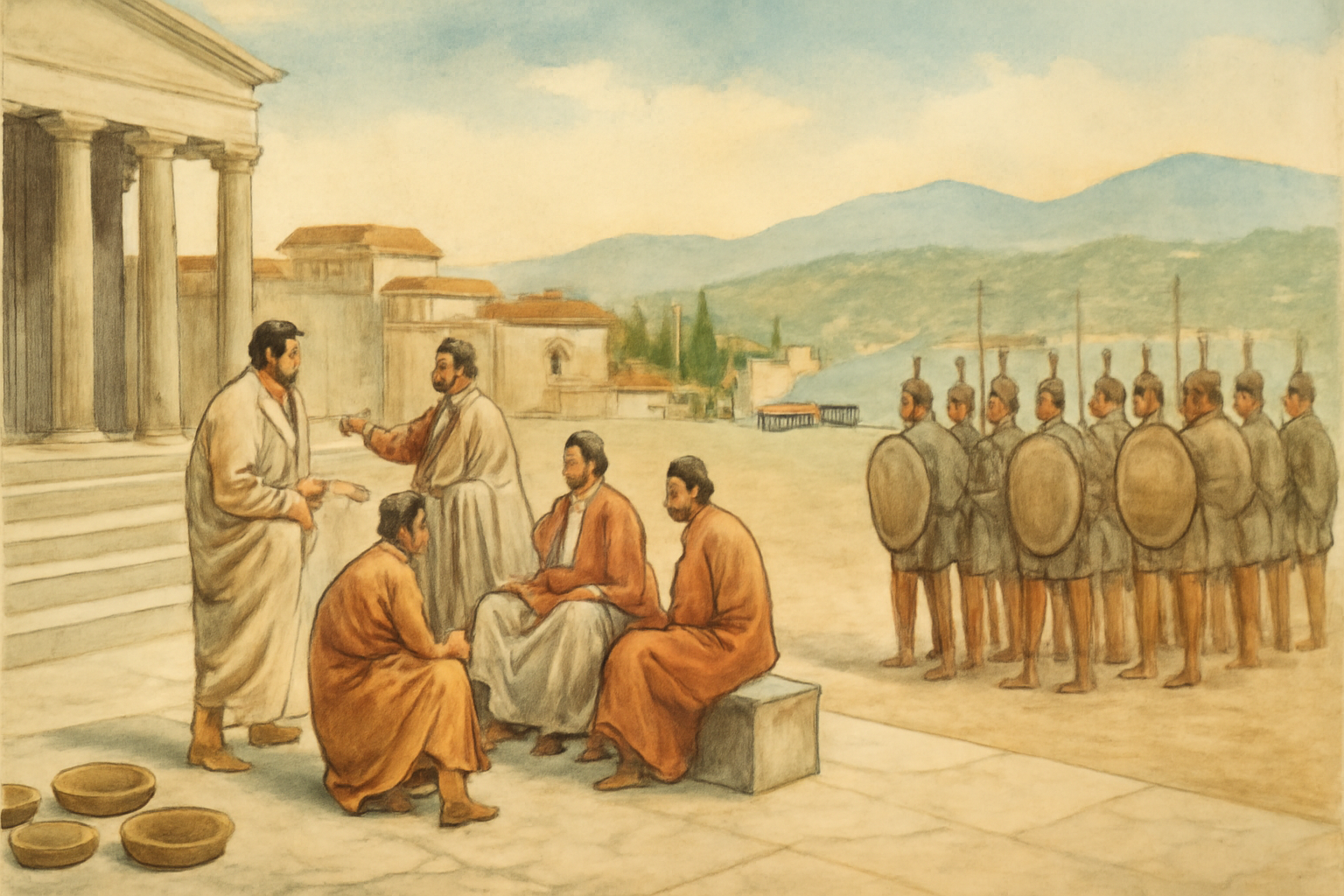
The immediate opening of hostilities in 431 BCE marked a decisive change in how Greek states resolved their disputes. Rather than isolated reprisals or negotiated settlements, Athens and Sparta committed their allied networks to sustained armed confrontation. Pericles, identified here as a central Athenian leader, and Archidamus II, associated with Sparta, personified the clash: their choices—whether to press advantages, mobilize allies, or accept risk—helped set the pattern for years to come. The war converted diplomatic ties into military obligations, dragging reluctant partners into campaigns they might otherwise have avoided. The Aegean and mainland theatres grew linked: naval resources, sieges, and land campaigns began to feed on each other. That conversion of political rivalry into protracted war changed expectations across Greece.
What had been episodic competition became an organized, multi-year struggle with cascading commitments, exposing how fragile the interstate order was when alliances hardened and fear of loss replaced hope of accommodation. The turning point was the passage from deterrent threats into recurring campaigns. The Spartan invasion of Attica, Athenian reliance on walls and ships, and the decision to protect imperial revenue rather than fight a decisive land battle gave the war its early shape. Strategy became a system for endurance, not a clean plan for quick victory. Plataea, Attica, the Piraeus, and the Aegean belonged to the same crisis.
A raid on a small Boeotian city, a rural population crowding inside Athenian walls, ships protecting grain and tribute routes, and Spartan pressure from land all reveal the same thing: war had become a networked crisis across farms, ports, allies, and civic assemblies.
Consequences
The outbreak of the Peloponnesian War initiated a period of military, political, and social strain that reshaped Greek life over decades. In the near term it disrupted peacetime commerce, forced city-states to divert manpower and resources into extended campaigns, and tested civic institutions under pressure. Politically, the war eroded Athens’ ability to govern its empire without constant military vigilance, while giving Sparta a chance to assert dominance on a broader stage. Over the longer term the conflict weakened the capacity of major powers to project stable leadership, leaving the Greek world more vulnerable to internal fragmentation and future upheavals. The war’s dynamics—fear-driven alliances, reciprocal reprisals, and imperial overstretch—became central themes for later observers and analysts.
Historians continue to dispute how much of this outcome was the direct result of particular leaders’ decisions and how much emerged from structural tensions; either way, the conflict left a decisive legacy in showing how quickly interstate norms can unravel under sustained pressure. The consequences reached beyond the first years. Plague in Athens, debates over harsh treatment of allies, the Sicilian Expedition, oligarchic coups, Persian funding, and eventual Spartan victory all grew from the fact that neither side could easily force a settlement. The war became a school of escalation. The page also needs to show why the conflict remained famous.
It gave later readers a vocabulary for alliance traps, imperial overreach, democratic wartime decision-making, civil strife, and the difficulty of ending a conflict once prestige and security have fused. That is why modern readers still meet Athens and Sparta in discussions of power transitions and great-power rivalry, even when the ancient setting is very different.
Interpretation Notes
Peloponnesian War Begins raises a debate about scale: did the decisive change come from the visible war, or from older pressures around Athens and Sparta that had already narrowed what people could do?
Why Keep Reading
Follow the subsequent campaigns, sieges, and diplomatic maneuvers to see how initial choices hardened into long-term consequences. The years after 431 BCE reveal how naval power and land power interacted, how allies could turn into burdens, and how domestic politics in Athens and Sparta shaped military strategy. Readers interested in the mechanics of alliance systems, the psychology of fear in international relations, or the limits of imperial control will find the unfolding decades especially instructive. Each episode that follows helps explain why this war became a touchstone for discussions of strategy, diplomacy, and the costs of prolonged conflict. Read this page before Pericles, the Athenian plague, the Sicilian Expedition, Greek democracy, Macedon's rise, and the wider ancient empires route.
That path shows how a war among poleis changed political imagination long before Rome or Macedon dominated the Mediterranean.
Reading Path
Follow the story without losing the thread
Before This
After This
- Battle of Gaugamela331 BCE
- Mauryan Empire Foundedc. 322 BCE
- Seleucid Empire Founded312 BCE
Same Period
Wider Timeline
Mind Map
How to think about Peloponnesian War Begins
Athenian naval reach
Expansion of Athenian alliances and sea power created tension with rivals
Map Layer
Where this event sits geographically
Gold pins mark the approximate locations of published event pages. This is a schematic locator map, not a historical border map.
Coordinates are approximate and are used to help readers orient themselves before opening a full event page.
References
Where to Check the Facts
- Encyclopaedia Britannica: Peloponnesian WarSpecific reference for dates, belligerents, and the Athens-Sparta war framework.
- Encyclopaedia Britannica: Ancient Greece, the Peloponnesian WarContext reference for causes, alliance systems, and Greek interstate politics.