At a Glance
The shape of the event
- Date
- 331 BCE
- Place
- Gaugamela
- Type
- Battle
Alexander the Great defeated Darius III at Gaugamela, breaking Persian imperial power and opening the way to Macedonian control over the empire.
331 BCE; place the event in Gaugamela before comparing causes or consequences.
The battle accelerated Hellenistic political and cultural change across the eastern Mediterranean and western Asia.
Alexander the Great / Darius III are the first names or groups to compare before widening the story.
The Achaemenid Empire lost its ability to resist Alexander's advance.
The Achaemenid Empire lost its ability to resist Alexander's advance.
The battle accelerated Hellenistic political and cultural change across the eastern Mediterranean and western Asia.
If this episode draws you in, follow the campaigns that turned victory at Gaugamela into rule across a continent: the sequence of sieges, the negotiations with local elites, and the evolving governance experiments tha...
Background
By 331 BCE the contest between Macedon and the Persian Empire had become both personal and structural. Macedon projected power outward through an energized ruling elite and an army built for projection; the Persian court held an imperial network of satrapies, capitals and resources that had governed a vast, multiethnic realm for generations. Pressure came from several directions: Macedonian ambition and mobility, the administrative reach and resilience of the Achaemenid center, the loyalties of subject peoples, and the logistics of campaigning across Mesopotamia. None of these factors alone explains Gaugamela. The choice to fight on that plain reflected immediate tactical calculations made by commanders and the long-running strain between centralized imperial rule and a rising, organized challenger.
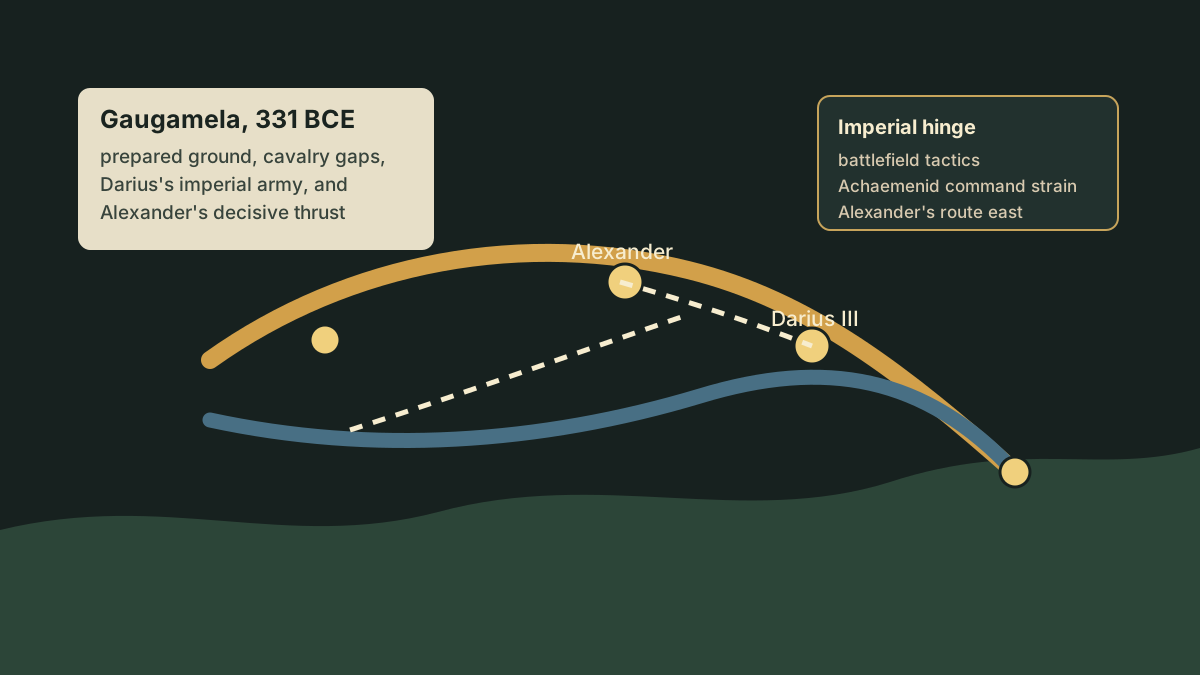
Historians debate whether the battle was mainly the product of individual leadership or the culmination of deeper transformations in military technology, state organization and regional politics. This account keeps that dispute visible: the battle was both an event shaped by actors and a moment in a larger structural shift. Gaugamela was more than Alexander defeating a larger Persian army. It was a collision between Macedonian operational daring and Achaemenid imperial scale. Darius III prepared ground for cavalry and chariots, gathered forces from across the empire, and tried to use numbers, space, and royal presence to stop Alexander's advance. The battlefield concentrated a larger question: could an old imperial system absorb a highly mobile challenger?
The Turning Point
What changed at Gaugamela was not only the position of two armies but the capacity of one empire to defend itself. On the field Alexander the Great achieved a victory that forced Darius III to abandon the field and with it the cohesion of Achaemenid military resistance. That abandonment broke the immediate power of the Persian centre to coordinate defence across its territories. Alexander’s personal command—his willingness to commit his forces to a decisive engagement—and Darius’s choice to withdraw from the battle were the clearest, most visible moves.
Yet those moves gained purchase because of broader conditions: Macedonian momentum, the ability to supply and maneuver forces deep in Mesopotamia, and strains within the Persian imperial system that made coordinated counteraction difficult once their central army faltered. In short, Gaugamela turned on choices by Alexander and Darius, but those choices were effective because structural advantages and vulnerabilities already existed. The result was not merely a battlefield rout; it was the collapse of effective imperial resistance that opened strategic space for Macedonian rule. The battle turned on movement and command. Alexander drew Persian forces out of alignment, then drove toward the center where Darius's position mattered symbolically and practically. When royal command became vulnerable, the army's cohesion weakened.
Persian numbers did not translate into unified pressure, while Macedonian discipline and Companion cavalry exploited gaps. The tactical breach became an imperial crisis because Darius's authority was tied to the visible stability of royal command.
Consequences
The immediate consequence was stark: the Achaemenid Empire lost its ability to resist Alexander’s advance as a coherent force. That loss allowed Macedonian armies to press into Persian territories with less coordinated opposition and put the machinery of empire within reach of conquest and reorganization. In the near term the battle cleared the way for Macedonian control over lands that had been under Achaemenid authority, unsettling local power structures and prompting new arrangements of governance. Over the longer term Gaugamela accelerated political and cultural changes across the eastern Mediterranean and western Asia.
Cities, elites and institutions encountered Macedonian rule and Hellenic practices; over decades these encounters produced hybrid forms of administration, art and public life often grouped under the label “Hellenistic. ” At the same time, interpretations differ about causation. Some scholars stress Alexander’s initiative and battlefield decisions as decisive; others underline administrative fractures, economic pressures and regional loyalties within the Persian Empire that made its collapse more likely. This account leaves those differences in view: the battle was crucial, but it acted on pre-existing conditions that shaped what followed. The consequences opened the road to Babylon, Susa, Persepolis, and the deeper dismantling of Achaemenid power. Alexander inherited not empty territory but an administrative world of cities, treasuries, roads, and local elites.
The victory therefore created a new problem: conquest had to become rule. Greek, Macedonian, Persian, and later Hellenistic memories all interpreted Gaugamela through different needs, making it a battlefield with a long political afterlife. For Persian elites, the defeat forced immediate choices about flight, negotiation, continued resistance, or accommodation with a conqueror who needed their administrative skills.
Interpretation Notes
Battle of Gaugamela raises a debate about scale: did the decisive change come from the visible battle, or from older pressures around Macedon and Persian Empire that had already narrowed what people could do?
Why Keep Reading
If this episode draws you in, follow the campaigns that turned victory at Gaugamela into rule across a continent: the sequence of sieges, the negotiations with local elites, and the evolving governance experiments that gave rise to Hellenistic monarchies. Tracing the next years shows how military success translated into political arrangements, how cities adapted to new rulers, and how cultural exchanges moved from immediate encounter to durable institutions. For anyone interested in the mechanics of imperial change, the aftermath of Gaugamela is where battlefield decision-making meets the slow work of administration and cultural adaptation. Read next into Alexander's empire, Persepolis, Achaemenid administration, and Hellenistic successor states. Gaugamela explains why one battle could transform access to an imperial system.
That sequence also separates battlefield victory from imperial government, a distinction that becomes essential once Alexander begins ruling conquered Persian territories.
Reading Path
Follow the story without losing the thread
Before This
After This
- Mauryan Empire Foundedc. 322 BCE
- Seleucid Empire Founded312 BCE
- First Punic War Begins264 BCE
Same Period
Wider Timeline
Mind Map
How to think about Battle of Gaugamela
Macedonian momentum
sustained military advance and logistical capacity that brought Alexander into Mesopotamia
Map Layer
Where this event sits geographically
Gold pins mark the approximate locations of published event pages. This is a schematic locator map, not a historical border map.
Coordinates are approximate and are used to help readers orient themselves before opening a full event page.
References
Where to Check the Facts
- Encyclopaedia Britannica: Battle of GaugamelaSpecific reference for Alexander's victory over Darius III and the collapse of Achaemenid resistance.
- World History Encyclopedia: Battle of GaugamelaNarrative reference for the battlefield sequence and Hellenistic consequences.