Central Question
What made the Maurya Empire a turning point in South Asian state formation, and why does Ashoka's memory change how readers understand conquest and rule?
Start With These Dates
- 331 BCEBattle of Gaugamela
Alexander the Great defeated Darius III at Gaugamela, breaking Persian imperial power and opening the way to Macedonian control over the empire.
- c. 322 BCEMauryan Empire Founded
Chandragupta Maurya founded the Mauryan Empire, creating one of South Asia's largest early imperial states after the decline of older kingdoms.
- c. 260 BCEAshoka Turns Toward Buddhism
After the Kalinga War, Ashoka promoted Buddhist ethics and imperial moral rule through inscriptions and public policy.
- c. 30 CEKushan Empire Rises
The Kushan ruling line emerged from Yuezhi groups in Bactria and built a state linking Central Asia, northern India, and long-distance trade routes.
- c. 320 CEGupta Empire Rises
The Gupta dynasty rose in northern India, building a durable imperial order from the Ganges heartland.
- 1526 CEFirst Battle of Panipat
Babur defeated Ibrahim Lodi at Panipat, ending Lodi control in Delhi and opening the way for Mughal rule in northern India.
- 1575 CEAkbar Founds the Ibadat Khana
Akbar founded the Ibadat Khana at Fatehpur Sikri as a space for religious and philosophical discussion, revealing how Mughal rule engaged questions of authority, diversity, and imperial ethics.
Sources Used Here
- The Metropolitan Museum of Art - Mauryan Empire (ca. 323-185 B.C.)
Used to verify Mauryan chronology, Magadha context, and the emergence of South Asia's first empire.
- Encyclopaedia Britannica - Mauryan Empire
Used to cross-check the Mauryan capital, date range, state formation, and succession frame.
- World History Encyclopedia - Mauryan Empire
Used to verify the broad narrative of Mauryan rise, expansion, and Ashoka's legacy.
The Maurya Empire hub gives South Asia a central place in the Ancient Empires route. It is not a side chapter after Persia, Greece, Rome, or Han China. The Mauryan story begins in the political world of Magadha and Pataliputra, where regional power, river geography, military opportunity, taxation, and court organization made large-scale rule possible. The empire's rise also belongs in the aftermath of Alexander's eastern campaigns, because the changing northwestern frontier created openings that Chandragupta Maurya could exploit.
The founding of the Maurya Empire matters because it shows imperial consolidation from a different regional base than the Mediterranean or East Asian examples. Pataliputra sat near river systems that helped connect people, crops, transport, and administration. The empire had to govern varied regions, negotiate local power, maintain armies, collect resources, and communicate authority across distance. Those problems are familiar across ancient empires, but the institutions, religious landscape, and political language were distinctively South Asian.
Ashoka gives the hub its strongest reader pull, but his story resists a simple morality tale. His memory is powerful because conquest, remorse, Buddhist patronage, inscriptions, public ethics, and imperial communication meet in one figure. Ashoka's turn after Kalinga does not erase the coercive foundations of empire. It forces readers to ask a harder question: can a ruler use imperial power to preach restraint, and what happens when moral language travels through the same administrative system that conquest helped build?
The hub also looks beyond the Mauryan dynasty. Kushan power and the Gupta rise are not Mauryan events, but they help readers see South Asian imperial memory as a route rather than a cliff edge. Later states worked in a landscape shaped by earlier experiments in court culture, regional integration, religious patronage, coinage, long-distance routes, and political imagination. Reading the afterlife prevents the Maurya Empire from becoming only a rise-and-fall entry.
Geography is essential here. The map makes the Ganges heartland, Pataliputra, northwestern routes, Kalinga, Central Asian contact zones, and later Gupta centers visible. Without geography, the story turns into abstract dynastic names. With geography, the reader can see why rivers, roads, frontier corridors, trade routes, and regional diversity made rule both possible and fragile.
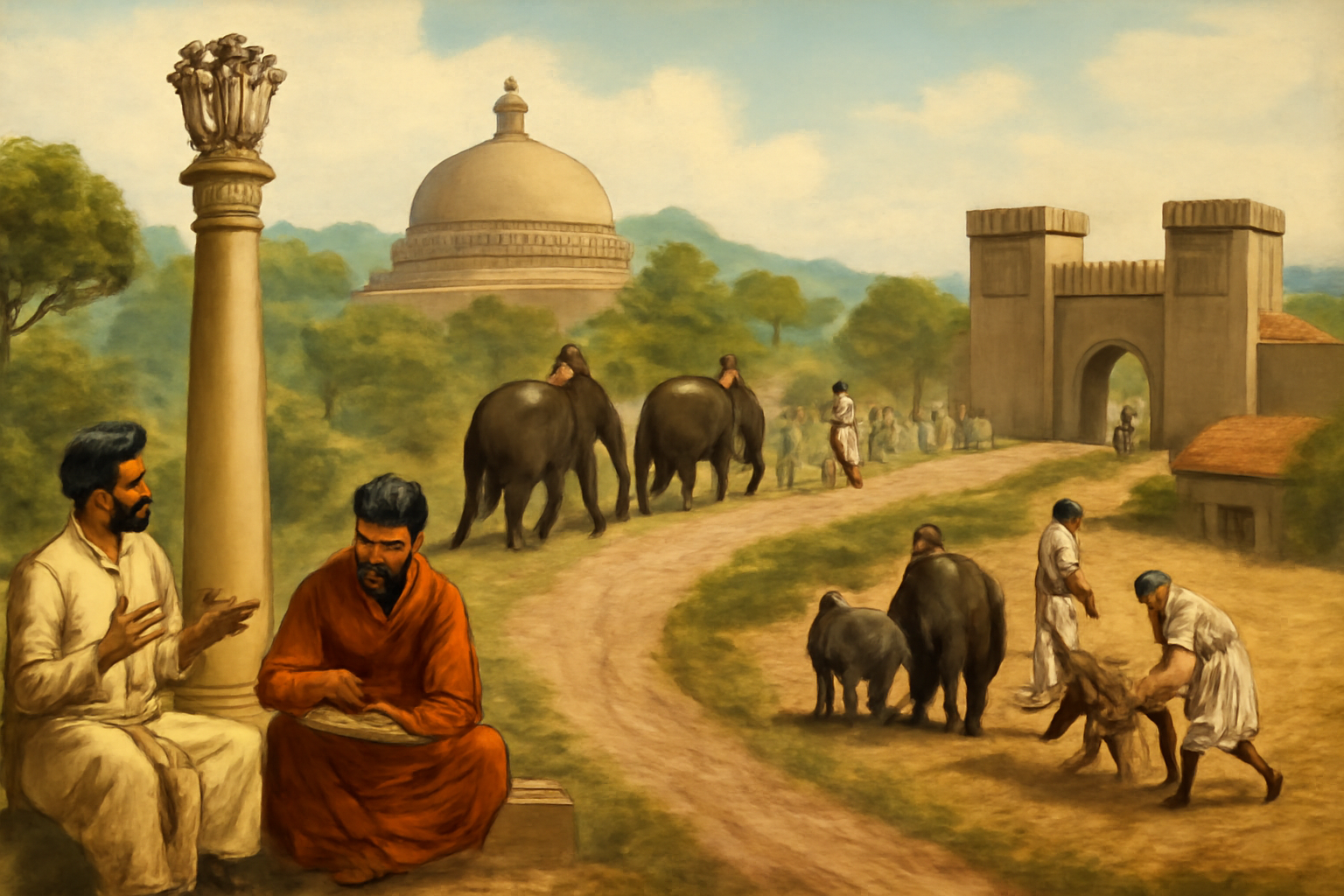
The page also needs ordinary people and institutions, not only famous rulers. Farmers supplied grain and taxes; officials translated royal priorities into local practice; monks and religious communities carried patronage into durable memory; soldiers guarded routes and frontiers; artisans, merchants, and urban residents lived inside the economic world that made court power visible. That human scale matters because imperial history can otherwise become a clean sequence of founders and conquerors. The Maurya route asks what imperial integration felt like at the level of villages, roads, monasteries, markets, and regional courts. It also asks how far royal messages actually traveled, and where local practice may have bent or ignored the ideals announced from the center.
A comparison across ancient empires makes the route larger: Persia governed through satrapies and royal roads, Han China through inherited Qin institutions and court learning, Rome through Mediterranean provinces and law, and the Maurya Empire through a South Asian mix of conquest, riverine geography, court power, inscriptions, and religious patronage. The comparison keeps world history from shrinking into one familiar center. It also creates better questions for students: what counts as unity in a region with many languages and religious communities, how do inscriptions turn authority into public speech, and why do later societies remember Ashoka differently from other conquerors? Those questions give the hub its reason to exist, not merely as a dynasty summary but as a bridge into South Asian state formation and later Indian Ocean, Buddhist, and imperial-memory routes.
A deeper Maurya route begins by making South Asia central rather than supplementary. The empire emerged from the political geography of Magadha, the Ganges plain, Pataliputra, northwestern frontier changes, and earlier regional state formation. Read beside Persia, Greek city-states, Rome, and Han China, it is not a copy of any of them. The Mauryan case asks how large-scale rule worked in a region of varied languages, landscapes, religious communities, trade routes, and local powers.
Periodization helps readers avoid turning the Maurya Empire into a single Ashoka story. The pre-Mauryan background includes Magadhan expansion and the conditions that made Pataliputra powerful. Chandragupta's rise belongs to the moment after Alexander's eastern campaigns and the weakening of older arrangements in the northwest. Bindusara's reign is less visible in popular memory but matters for continuity. Ashoka's reign changes the moral and documentary profile of the empire. The post-Mauryan afterlife asks what later states inherited, rejected, or remembered.
The political layer centers on consolidation. Chandragupta had to turn opportunity into an organized court, military structure, revenue system, provincial oversight, and alliances or controls over local rulers. Large-scale rule did not mean every region was governed identically. The court had to manage distance, transport, communication, military posts, local elites, and the practical limits of command. This makes the Maurya Empire useful for comparing how different ancient empires solved the same problem of ruling beyond the core.
The economic layer includes agriculture, river transport, taxation, roads, forests, trade routes, urban centers, craft production, and strategic resources. Pataliputra's location mattered because river systems could move people, goods, orders, and grain. Imperial power depended on extracting and protecting resources without destroying the networks that made those resources available. Economic history also helps readers see ordinary households, merchants, artisans, and officials rather than only court decisions.
The religious and moral layer is the strongest reader hook, but it needs nuance. Ashoka's inscriptions present a ruler concerned with dhamma, restraint, welfare, respect among communities, and moral communication. Yet those messages traveled through imperial media. Rock and pillar edicts were public statements backed by royal authority. The sharper question is not whether Ashoka was simply good or bad; it is how a conqueror used the tools of empire to speak about remorse, order, and moral duty.
Kalinga belongs near the center of interpretation even when it is not the only event. It forces readers to connect violence, memory, public speech, and policy. The horror associated with conquest becomes part of how Ashoka explained his rule. That does not erase earlier expansion or coercion. It reveals a contradiction that makes the page worth reading: empire can produce moral language, but that language may depend on the same scale and authority that conquest created.
The evidence layer stays visible. Inscriptions are not neutral windows into society. They are royal messages, placed in landscapes, written in languages and scripts that targeted different audiences, and preserved unevenly. They tell us what the ruler wanted projected. They also raise questions about reception: who heard, read, repeated, ignored, or reinterpreted these messages? A reader who understands that evidence problem will treat Ashoka's memory as historical material rather than as a simple quotation bank.
Geography is non-negotiable. The Ganges heartland, Pataliputra, the northwest, Kalinga, Deccan routes, Himalayan edges, and contact zones toward Central Asia and the Indian Ocean all shape the story. The map shows why rivers, roads, frontiers, and regional diversity mattered. Without geography, the Maurya Empire becomes an abstract blob. With geography, readers can ask how far commands traveled, where routes were dense, and where imperial presence may have been thinner.
The social layer includes farmers, laborers, soldiers, officials, religious communities, merchants, artisans, forest peoples, conquered groups, and regional elites. These groups experienced empire differently. Some gained from security, roads, patronage, or market access. Others carried taxes, labor demands, displacement, violence, or surveillance. The hub lets those experiences complicate the heroic story of founders and moral kings.
The before-and-after structure expands the route. Before the Mauryas, regional state formation and Magadhan power created a base for expansion. During Mauryan rule, the court experimented with governing scale through administration, military force, public messages, and moral language. After the Mauryas, later powers such as the Kushans and Guptas worked in a landscape where imperial memory, religious patronage, coinage, routes, and court culture remained important. That afterlife prevents the page from ending as a dynastic collapse summary.
Comparison sharpens the hub. Persia and Maurya both raise questions about roads, provinces, royal messages, and multi-regional rule. Han and Maurya both connect moral order to statecraft, though through very different intellectual and religious frameworks. Rome and Maurya both show conquest turning into law, memory, administration, and public architecture, but the geography and source base differ. These comparisons make the Maurya route one of the best guards against a Europe-centered ancient atlas.
The first screen invites readers into a problem: Ashoka is famous, but the empire is larger than Ashoka. Why did South Asian imperial rule emerge where it did? How did a court speak to diverse populations? What can inscriptions prove, and what do they hide? How did later religious and political memory transform a ruler into a symbol? These questions give the hub narrative pull and stop it from becoming a short dynasty note.
The practical stakes are local as well as imperial. Roads, officials, market routes, religious patronage, and military security changed the lives of people who never stood near the court. That local layer makes the Maurya page more than a ruler biography: it becomes a test of how far an imperial center could shape daily practice.
The administrative layer needs to stay concrete even where evidence is debated. Officials, provincial centers, revenue collection, military posts, roads, messengers, and court orders formed the practical skeleton of rule. The point is not to pretend every detail of Mauryan administration is equally certain. It is to show readers why governing from Pataliputra required repeatable systems and why those systems had to interact with local power rather than simply overwrite it.
The memory layer gives the page a final reason to keep reading. Ashoka was remembered, forgotten, rediscovered, and reinterpreted in different religious, political, and national settings. Modern readers often meet him as a symbol of moral kingship, Buddhist patronage, or Indian statecraft. The hub explains that those memories are historical facts too. They show how an ancient ruler can become useful for later arguments about violence, tolerance, unity, and public ethics.
The final Mauryan layer is comparison with later South Asian political imagination. The empire did not create a permanent unified state, but it gave later readers a vocabulary for thinking about scale, moral rule, public inscription, and the relationship between conquest and welfare. That vocabulary could be revived in very different contexts. The hub makes this afterlife explicit so readers understand why Mauryan history matters beyond a date range and why Ashoka's symbols could carry modern political meaning.
The reader route remains concrete: begin with Magadha and Pataliputra, connect the northwest to post-Alexander politics, read Ashoka through Kalinga and inscriptions, then continue into Kushan and Gupta pages. That sequence turns South Asian empire into an unfolding set of problems about geography, communication, religious patronage, and memory rather than a single famous ruler.
This also gives students a better essay frame: compare how conquest, evidence, ethics, and geography interact instead of asking whether Ashoka alone explains Mauryan significance.
The Maurya route becomes more readable when it starts with state capacity rather than only Ashoka's moral memory. Chandragupta, Magadha, imperial officers, roads, revenue, forts, spies, armies, and courtly political advice all belong in the story before the edicts. Ashoka's later inscriptions matter more when readers first see the machinery that made an imperial voice travel across distance.
Ashoka's turn toward dhamma after Kalinga remains complex. The edicts present remorse, moral instruction, concern for welfare, and a ruler's desire to speak across languages and regions, but they do not erase conquest, hierarchy, taxation, punishment, or the limits of central control. The page is stronger when dhamma appears as political communication and ethical ambition inside an empire, not as a simple conversion tale.
The Maurya hub also gives South Asia a comparative role inside ancient world history. It can sit beside Achaemenid roads, Qin standardization, Han bureaucracy, Greek city politics, and Roman provincial administration without being treated as a side case. The route asks how inscriptions, roads, officials, religious patronage, and regional elites helped a large empire hold together, and why that order fragmented after its strongest rulers.
Begin with geography. River systems, fertile regions, and court centers help explain why this empire could organize power from eastern India.
Ask how Chandragupta's state turned opportunity into administration, armies, revenue, and durable court authority.
Read Ashoka as a problem of power and ethics, not only as a converted ruler. Moral language still moved through imperial institutions.
Use inscriptions as public messages. They show what rulers wanted subjects to hear, but they do not automatically reveal everyday response.
Follow Kushan and Gupta pages to see how later power reused, transformed, or remembered earlier imperial possibilities.
Begin with Pataliputra, rivers, agriculture, and regional power. The empire's scale grew from a specific political geography.
Read Ashoka through conquest, remorse, inscriptions, welfare language, Buddhist patronage, and continuing imperial authority.
Treat edicts as public royal communication. They reveal projection and policy, but they also raise questions about reception.
Follow rivers, Kalinga, northwestern corridors, Deccan routes, Central Asian contact, and later Gupta centers.
Use Ashokan edicts as public communication: moral claim, administrative reach, local translation, and royal self-presentation.
Choose a Reading Path
Need the Short Version
Read Mauryan Empire Founded and Ashoka Turns Toward Buddhism first. They give the basic arc from consolidation to moral imperial memory.
Start with 331 BCE: Battle of GaugamelaWant the Wider Context
Start at Gaugamela, then move into Maurya. The sequence shows how eastern campaigns and regional opportunity shaped new state formation.
Start with c. 322 BCE: Mauryan Empire FoundedWant Religion and Power
Use Ashoka, Kushan power, and the trade timeline to connect Buddhism, routes, patronage, inscriptions, and political authority.
Start with c. 260 BCE: Ashoka Turns Toward BuddhismWant Comparison
Compare Maurya with Persia, Han, and Rome by asking how each empire solved distance, legitimacy, taxation, elite cooperation, and memory.
Start with c. 30 CE: Kushan Empire RisesFor the Founding Problem
Start with Gaugamela and Mauryan Empire Founded to connect wider Eurasian disruption with Magadhan consolidation.
Start with c. 320 CE: Gupta Empire RisesFor Ashoka
Read Ashoka Turns Toward Buddhism as a page about conquest, public remorse, inscriptions, and the politics of moral language.
Start with 1526 CE: First Battle of PanipatFor Evidence
Use source lists and inscription references to ask what royal edicts can and cannot tell us about everyday life.
Start with 1575 CE: Akbar Founds the Ibadat KhanaFor Afterlife
Continue into Kushan power and Gupta rise to see how South Asian imperial memory, routes, and patronage kept changing.
How the Story Builds
Gaugamela and the post-Alexander world set a broader Eurasian context in which northwestern India became politically unstable and open.
The Mauryan founding page shows Chandragupta building scale from Magadha and Pataliputra, not merely inheriting an already unified map.
Ashoka's turn toward Buddhism asks whether conquest can be followed by public moral rule without escaping the contradictions of empire.
Kushan power keeps South Asia connected to Central Asia, trade, coins, Buddhist patronage, and the wider ancient exchange system.
The Gupta rise extends the route into later memory, asking what later courts inherited from earlier imperial experiments.
Magadha, Pataliputra, river systems, and local state formation created a base from which larger imperial rule became possible.
Alexander's campaigns and successor politics changed the northwestern frontier, creating opportunities and pressures for new rule.
Ashoka's edicts turn the route toward public speech, moral claims, inscriptions, scripts, places, and audiences.
Taxes, labor, officials, soldiers, merchants, religious communities, and local elites show how empire entered everyday settings.
Kushan and Gupta pages extend the route into later South Asian power, patronage, coinage, religious movement, and court culture.
- What made Magadha and Pataliputra powerful starting points for imperial rule?
- How can readers balance Ashoka's moral memory with the violence and administration that made empire possible?
- Why are inscriptions useful evidence, and what do they leave unanswered?
- How does the Maurya Empire change a comparison usually dominated by Rome, Persia, and Han China?
- Which later South Asian developments make more sense after reading the Maurya route?
- How much can royal inscriptions tell us about people who did not write them?
- Where did moral kingship support imperial power, and where did it challenge conquest?
- Why does the Maurya Empire belong at the center of an ancient world route?
- What changes when South Asian geography leads the comparison instead of following Rome?
- What can inscriptions prove about Maurya rule, and what parts of imperial life do they leave silent?
- How can readers compare Ashoka's moral language with the coercive machinery of empire?
Interactive Timeline
Follow Maurya Empire by sequence
Battle of Gaugamela
Alexander the Great defeated Darius III at Gaugamela, breaking Persian imperial power and opening the way to Macedonian control over the empire.
Read the full event pageMap Layer
Maurya Empire geography
Gold pins mark the approximate locations of published event pages. This is a schematic locator map, not a historical border map.
Coordinates are approximate and are used to help readers orient themselves before opening a full event page.
Route Events
Events in This Topic
Battle of Gaugamela
Alexander the Great defeated Darius III at Gaugamela, breaking Persian imperial power and opening the way to Macedonian control over the empire.
Mauryan Empire Founded
Chandragupta Maurya founded the Mauryan Empire, creating one of South Asia's largest early imperial states after the decline of older kingdoms.
Ashoka Turns Toward Buddhism
After the Kalinga War, Ashoka promoted Buddhist ethics and imperial moral rule through inscriptions and public policy.
Kushan Empire Rises
The Kushan ruling line emerged from Yuezhi groups in Bactria and built a state linking Central Asia, northern India, and long-distance trade paths.
Gupta Empire Rises
The Gupta dynasty rose in northern India, building a durable imperial order from the Ganges heartland.
Delhi Sultanate Founded
The Delhi Sultanate emerged as a major Muslim-ruled state in northern India, reshaping South Asian politics, military organization, architecture, and cultural exchange.
First Battle of Panipat
Babur defeated Ibrahim Lodi at Panipat, ending Lodi control in Delhi and opening the way for Mughal rule in northern India.
Akbar Founds the Ibadat Khana
Akbar founded the Ibadat Khana at Fatehpur Sikri as a space for religious and philosophical discussion, revealing how Mughal rule engaged questions of authority, diversity, and imperial ethics.
References
Where to Check the Facts
- The Metropolitan Museum of Art - Mauryan Empire (ca. 323-185 B.C.)Used to verify Mauryan chronology, Magadha context, and the emergence of South Asia's first empire.
- Encyclopaedia Britannica - Mauryan EmpireUsed to cross-check the Mauryan capital, date range, state formation, and succession frame.
- World History Encyclopedia - Mauryan EmpireUsed to verify the broad narrative of Mauryan rise, expansion, and Ashoka's legacy.