At a Glance
The shape of the event
- Date
- c. 260 BCE
- Place
- Kalinga
- Type
- Religious and Political Change
After the Kalinga War, Ashoka promoted Buddhist ethics and imperial moral rule through inscriptions and public policy.
c. 260 BCE; place the event in Kalinga before comparing causes or consequences.
Ashoka's reign became central to Buddhist history and to debates over power, remorse, and moral kingship.
Ashoka are the first names or groups to compare before widening the story.
The Mauryan state used royal messages to encourage ethical conduct, restraint, and religious patronage.
The Mauryan state used royal messages to encourage ethical conduct, restraint, and religious patronage.
Ashoka's reign became central to Buddhist history and to debates over power, remorse, and moral kingship.
Follow this thread to see how an imperial language of moral rule travelled and was transformed.
Background
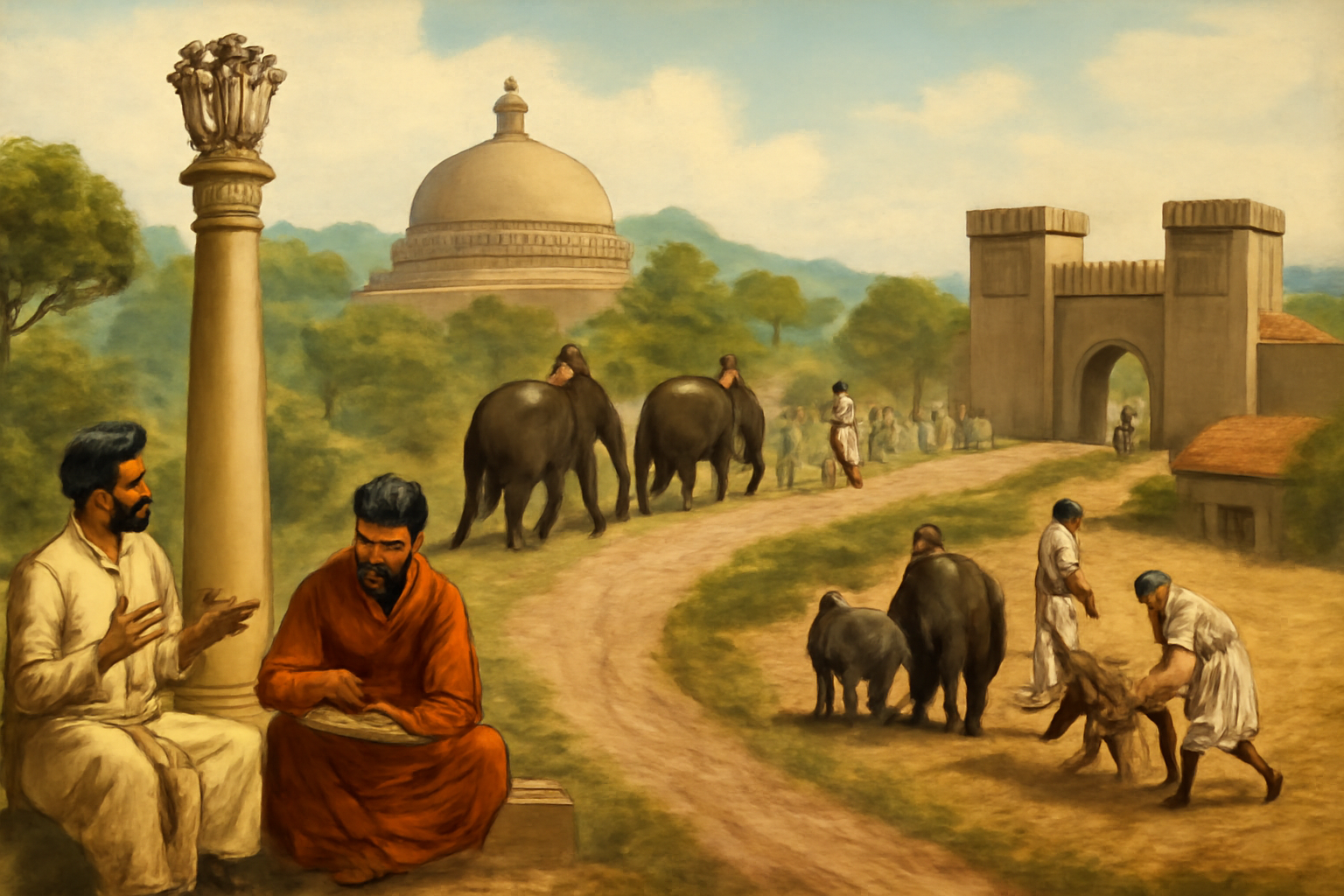
Ashoka inherited one of the largest imperial structures in early South Asia. The Mauryan state combined centralised bureaucracy, military capacity, and networks of communication that allowed royal commands to reach far beyond the capital. In this environment, military conquest was not only a means of expansion but an expectation of kingship. At the same time Buddhism was one of several religious currents circulating across the subcontinent; it offered a language of ethics, nonviolence, and moral duty that had political resonance. The Kalinga campaign—fought at the empire’s eastern edge—played out against these pressures: imperial ambition, logistical reach, and the social consequences of large-scale conflict.
Scholars debate how much of Ashoka’s subsequent turn reflected a single moral conversion and how much resulted from institutional considerations—managing a diverse empire, consolidating authority, and seeking religious legitimacy. This account keeps both possibilities visible rather than offering a definitive cause. The Ashoka page becomes stronger when Kalinga is treated as a political and moral problem rather than a simple conversion scene. The Mauryan Empire already had armies, provincial officers, road systems, revenue demands, and court routines before Ashoka's remorse entered the record. That matters because the famous turn toward dhamma did not float above government; it had to move through scribes, governors, messengers, judges, monks, and border officials who made imperial language visible in local places.
Dhamma also needs careful framing. It was Buddhist in association and deeply shaped by Ashoka's patronage, but the edicts often speak in a wider ethical vocabulary: respect for parents, restraint toward servants, kindness to living beings, moderation in ritual, and tolerance among religious communities. Read the moment as a ruler using moral language to hold together a diverse empire, not only a private believer announcing a new faith.
The Turning Point
The pivotal change was not a single speech but a set of concrete choices that redirected imperial practice. After Kalinga, Ashoka commissioned a series of inscriptions and public statements that emphasized ethical conduct, restraint, and concern for the welfare of subjects. These inscriptions were placed in public spaces, signaling a new mode of communicating royal intent: the ruler speaking not only as conqueror but as moral exemplar and administrator. Ashoka also backed religious patronage and policies aligned with Buddhist ethics—support for monastic communities, instructions to officials to practice compassion, and encouragement of moral education—while continuing to exercise the institutions of rule.
Those choices altered how authority was presented: force remained an option, but the king increasingly framed governance in terms of dharma, an ethical duty. Crucially, contemporaneous actors—courtiers, provincial administrators, religious communities—had to navigate these signals. Some likely saw opportunity in royal patronage; others adjusted to an official rhetoric that privileged restraint and ethical behaviour. The turning point thus combined personal decision and policy innovation, enacted through existing imperial mechanisms. The turning point was the decision to make remorse public and administrative. A ruler could regret conquest privately; Ashoka instead carved a political lesson into stone and placed it where officials, travelers, and local audiences could encounter it. The edicts turned memory of violence into a technology of rule.
That publicness changed the story. Kalinga became an imperial example: conquest could produce obedience, but it could also damage the ruler's own claim to moral authority. By sending dhamma-mahamattas and instructing officers to attend to welfare, punishment, and religious coexistence, Ashoka tried to make ethical government measurable through behavior.
Consequences
In the near term, the Mauryan state used royal messages to encourage ethical conduct across its territories. Inscriptions became a practical tool of governance: they communicated priorities, disciplined behaviour, and lent moral authority to administrative directives. Buddhist institutions received increased visibility and resources, creating durable links between a major religious movement and the apparatus of the state. Over the longer term, Ashoka’s reign acquired a central place in the history of Buddhism: his patronage and public emphasis on moral kingship became key reference points for later Buddhists and for historians assessing the relationship between religion and power. Yet the legacy is contested.
Some historians stress the role of Ashoka’s personal remorse and conversion; others highlight systemic reasons—imperial integration, the usefulness of ethical rhetoric in multi-religious rule, and the administrative benefits of promoting social restraint. Both readings matter for how we interpret the past: the episode shows that rulers can choose to reshape political language, but also that institutional structures and incentives channel those choices. The episode therefore remains a touchstone for debates about power, remorse, and what it means to govern ethically. The long result was not a pacifist empire without coercion. The Mauryan state still depended on hierarchy, taxation, punishment, and territorial command. The novelty was that royal legitimacy now had to answer to a language of compassion, restraint, and responsibility.
That tension gives the page its energy: Ashoka did not abolish power; he changed how power explained itself. Later memory made Ashoka larger than the immediate evidence. Buddhist traditions remembered him as a patron and model ruler, modern South Asian politics reused him as a symbol of ethical statecraft, and historians keep debating how much the edicts reveal inner conviction versus imperial strategy. The safest reading keeps both in view.
Interpretation Notes
The hardest question around Ashoka Turns Toward Buddhism is causation. The event had immediate actors, but its meaning also came from institutions, geography, resources, and expectations already present in South Asia.
Why Keep Reading
Follow this thread to see how an imperial language of moral rule travelled and was transformed. The next pages track the spread of Ashokan inscriptions, the responses of religious communities across the subcontinent, and how later rulers and traditions reused—sometimes sincerely, sometimes instrumentally—the idea of ethical kingship. If you want to understand how a ruler’s public pronouncements can endure as historical symbols, or how policy and belief intertwine in practice, the subsequent events and timelines show those processes in motion. Read Ashoka alongside the Mauryan Empire, the spread of Buddhism, Han and Persian imperial administration, and later debates over moral kingship. The comparison shows how large states tried to make obedience, welfare, belief, and public memory travel across distance.
Reading Path
Follow the story without losing the thread
Before This
- First Punic War Begins264 BCE
- Seleucid Empire Founded312 BCE
- Mauryan Empire Foundedc. 322 BCE
After This
- Qin Unification of China221 BCE
- Battle of Cannae216 BCE
- Han Dynasty Founded202 BCE
Same Period
Wider Timeline
Mind Map
How to think about Ashoka Turns Toward Buddhism
imperial structure
Centralised bureaucracy and communication networks made public inscriptions an effective tool for governance.
Map Layer
Where this event sits geographically
Gold pins mark the approximate locations of published event pages. This is a schematic locator map, not a historical border map.
Coordinates are approximate and are used to help readers orient themselves before opening a full event page.
References
Where to Check the Facts
- Encyclopaedia Britannica: AshokaBiographical reference for Ashoka's reign, Kalinga memory, Buddhist patronage, and inscriptions.
- World History Encyclopedia: Ashoka the GreatNarrative reference for Ashoka's political and religious legacy after conquest.