At a Glance
The shape of the event
- Date
- 1575 CE
- Place
- Fatehpur Sikri
- Type
- Imperial religious forum
Akbar founded the Ibadat Khana at Fatehpur Sikri as a space for religious and philosophical discussion, revealing how Mughal rule engaged questions of authority, diversity, and imperial ethics.
1575 CE; place the event in Fatehpur Sikri before comparing causes or consequences.
The episode helps readers see Mughal power as more than conquest: administration, court culture, religious policy, and political imagination were part of imperial durability.
Akbar are the first names or groups to compare before widening the story.
Akbar's court became associated with religious debate, translation, and policies that sought to widen imperial legitimacy.
Akbar's court became associated with religious debate, translation, and policies that sought to widen imperial legitimacy.
The episode helps readers see Mughal power as more than conquest: administration, court culture, religious policy, and political imagination were part of imperial durability.
Follow this story to see how a ruler’s experiments with religious discussion translated into concrete policy and court practices across the Mughal realm.
Background
By the 1570s the Mughal state under Akbar was consolidating territory, institutions, and a court culture that needed more than military success to endure. Rulers in this period faced the practical problem of governing populations with multiple faiths, legal traditions, and social hierarchies. Courts were sites of representation as well as administration; what happened inside the palace shaped expectations across the realm. Akbar’s founding of the Ibadat Khana carried out of this background: a ruler who sought to bind a diverse polity did so not only through tax systems and administrative reform but also through symbolic actions that addressed questions of religious legitimacy and moral authority.
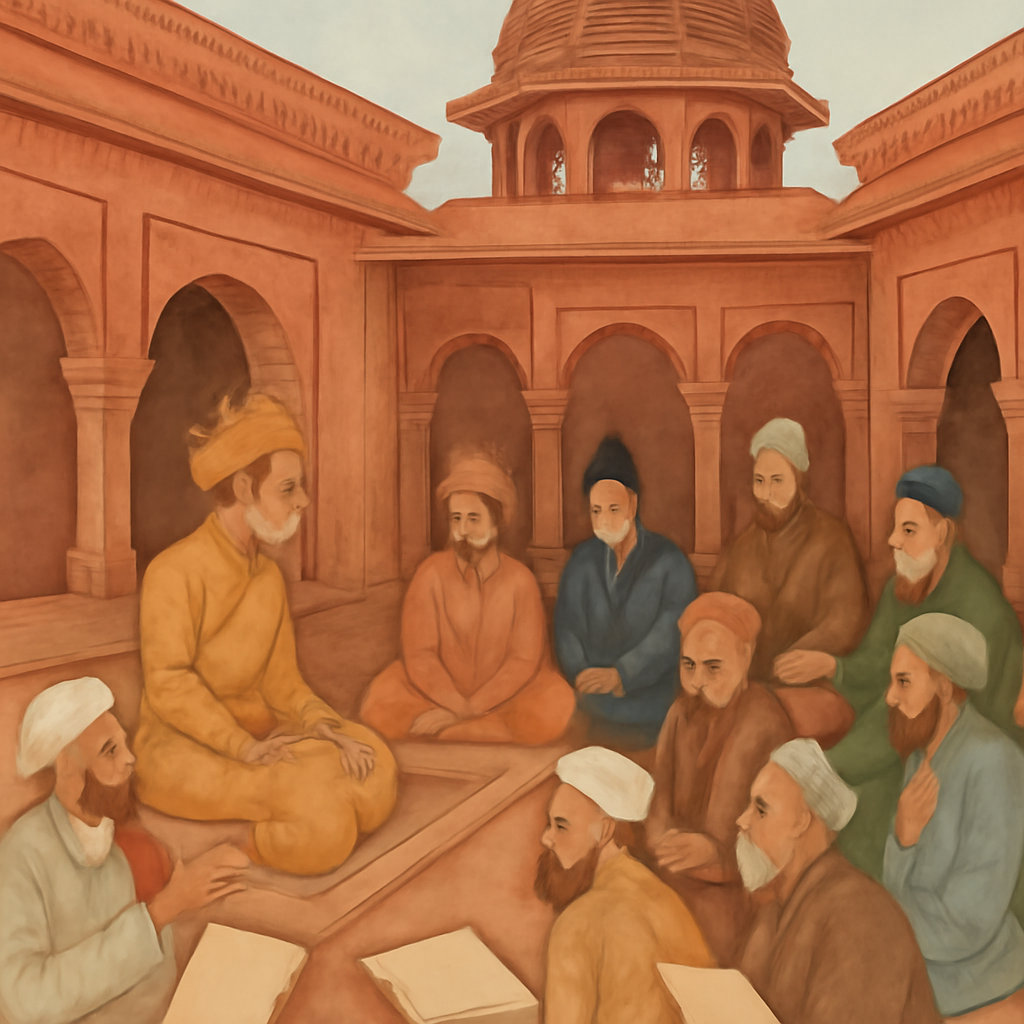
The Ibadat Khana thus emerged at an intersection of politics, belief, and imperial image-making — a space where governance and theology met without any single cause fully explaining the choice. The Ibadat Khana belongs inside Akbar's wider experiment with imperial rule. Mughal power had to govern Muslims, Hindus, Jains, Christians, Zoroastrians, regional warrior elites, revenue officials, merchants, and court intellectuals across a vast and diverse empire. Fatehpur Sikri became a stage where architecture, debate, ritual, and kingship met. Religious discussion was not a private hobby; it was part of the problem of making authority durable across difference.
The Turning Point
The opening of the Ibadat Khana marked a concrete change in how the Mughal court engaged religion. Rather than confining religious discussion to private devotion or ritual observance, Akbar transformed it into a forum where competing ideas were aired under imperial patronage. The important actors here were the emperor himself, his court, and the visitors he summoned into the chamber: religious thinkers, philosophers, and interpreters whose words were listened to by the sovereign and court officials. Choices mattered: the decision to sponsor translation work, to allow public disputation, and to record or transmit arguments placed interpretive authority closer to the throne. That closeness was double-edged.
It offered marginal space for debate and intelligibility across communities, but it also meant that openness depended on the emperor’s authority: the forum functioned because Akbar could convene, moderate, and reward the voices he wanted to hear. The turning point was thus both an expansion of conversation and a redefinition of who had the power to shape that conversation. The decisive turn was the movement from court-sponsored debate to a more ambitious language of sovereignty. Akbar invited scholars and religious figures into argument, but the debates also revealed how bitterly authority could be contested. When theologians disputed one another, the emperor gained room to present himself as a judge above faction.
The Ibadat Khana therefore turned disagreement into a political resource.
Consequences
In the near term, the Ibadat Khana made Akbar’s court a center for religious debate and for translation initiatives that sought to render diverse ideas intelligible to the imperial center. The result was an enlarged role for court culture in shaping policy and public language about faith. Over the longer arc, this episode invites us to see Mughal durability as a product not only of conquest but of administrative imagination: the empire invested in practices that aimed to legitimize rule across difference. At the same time, any celebration of openness must be tempered. The forum’s latitude rested on imperial prerogative; debates took place within a palace whose privileges and hierarchies were not dissolved by conversation.
Questions of who could speak, whose interpretations were amplified, and what counts as acceptable dissent remained bound to the mechanisms of authority. The Ibadat Khana therefore left a mixed legacy — one of widened intellectual exchange that nevertheless underscores how state power shaped the terms and limits of pluralism. The consequences reached into law, court culture, translation, and imperial memory. Akbar's experiments did not create modern tolerance, and they did not remove hierarchy, but they changed the public language of Mughal rule. Translation projects, debates over jizya, elite marriages, and court ritual all became part of the same governing style. Later rulers and critics remembered the project differently because it touched the sensitive boundary between faith and imperial authority.
The debates also reveal a larger Mughal pattern: authority depended on military success, but it also needed a public grammar for ranking knowledge, service, piety, and loyalty at court.
Interpretation Notes
Akbar's religious policies can be celebrated too easily; the page asks how much openness depended on imperial authority and court control.
Why Keep Reading
Follow this story to see how a ruler’s experiments with religious discussion translated into concrete policy and court practices across the Mughal realm. The Ibadat Khana was more than a single room: it was an early instance of the imperial attempt to manage diversity through language, translation, and ritual. Reading the subsequent episodes — debates, translations, and changes in legal and administrative practice — reveals how ideas tested in the court could influence governance, and how the balance between openness and control was continually renegotiated. If you wondered whether pluralism in early modern empires arose from goodwill or from calculation, the next chapters will show how both elements operated together.
Read next into Mughal India, Akbar's court, South Asian religious exchange, and later Aurangzeb debates. The route shows how a ruler used argument, ritual, and translation to make empire more governable. The same trail also connects to everyday governance: revenue language, court rank, marriage alliances, and translated texts all made diversity administratively visible.
Reading Path
Follow the story without losing the thread
Before This
- First Battle of Panipat1526 CE
- Timur Sacks Delhi1398 CE
- Delhi Sultanate Founded1206 CE
After This
- English Civil War Begins1642 CE
- Peace of Westphalia1648 CE
- Salt MarchMarch-April 1930
Same Period
- Beginning of Muhammad's Revelationsc. 610 CE
- English Civil War Begins1642 CE
- Indian Independence and PartitionAugust 1947
Wider Timeline
Mind Map
How to think about Akbar Founds the Ibadat Khana
imperial need
Akbar’s need to legitimate rule across diverse communities motivated an institutional forum for religious conversation.
Map Layer
Where this event sits geographically
Gold pins mark the approximate locations of published event pages. This is a schematic locator map, not a historical border map.
Coordinates are approximate and are used to help readers orient themselves before opening a full event page.
References
Where to Check the Facts
- Encyclopaedia Britannica: AkbarBiographical reference for Akbar's reign, court, religious policies, and Mughal imperial rule.
- Encyclopaedia Britannica: Mughal dynastyReference for Mughal political and cultural context.