At a Glance
The shape of the event
- Date
- 1526 CE
- Place
- Panipat
- Type
- Battle
Babur defeated Ibrahim Lodi at Panipat, ending Lodi control in Delhi and opening the way for Mughal rule in northern India.
1526 CE; place the event in Panipat before comparing causes or consequences.
The battle became a starting point for one of South Asia's most important early modern empires.
Babur / Ibrahim Lodi are the first names or groups to compare before widening the story.
The Lodi dynasty fell, and Babur established the foundation of Mughal power in India.
The Lodi dynasty fell, and Babur established the foundation of Mughal power in India.
The battle became a starting point for one of South Asia's most important early modern empires.
Follow what happens next and you see why Panipat matters beyond a single victory.
Background
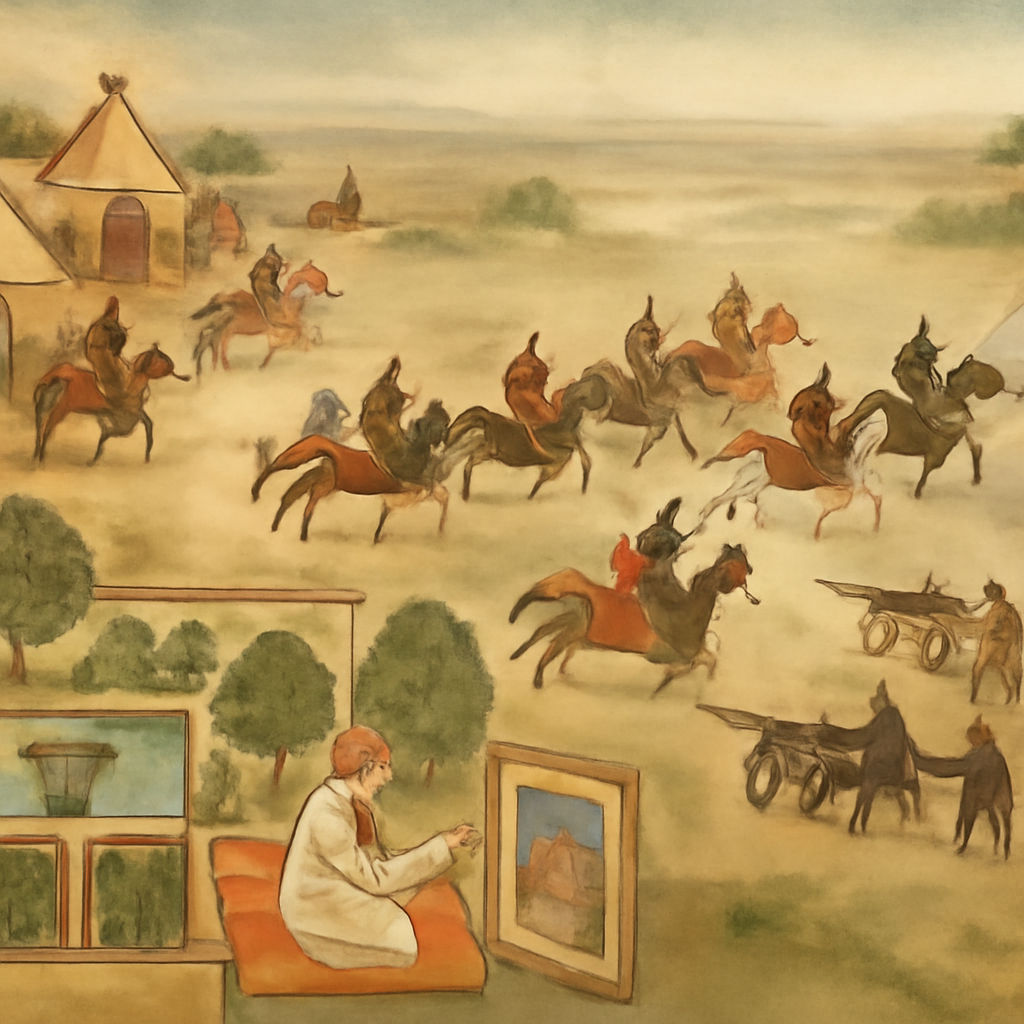
By the early 16th century the political map of northern India was not fixed. The Delhi Sultanate, long a central authority in the plains, had passed into the hands of the Lodi family; Ibrahim Lodi stood at its head in 1526. From beyond the northwestern frontiers, Babur—himself a descendant of Timur and a leader experienced in Central Asian politics—moved toward the subcontinent seeking opportunity and a new base. Their collision at Panipat must be seen against these overlapping pressures: dynastic claims to Delhi, the pull of rich agricultural regions, and the ambitions of rival rulers across South Asia and beyond.
Contemporary chroniclers later framed the clash as the decisive opening of Mughal presence in India, and modern historians often treat it as a key origin point. But that interpretation sits beside other continuities: local power struggles, shifting alliances, and the longer process of state-building across the region. Panipat was a hinge in a larger story, not the whole story. Cities like Delhi and the surrounding doab had symbolic weight; control of them conferred legitimacy and resources. The label 'Gunpowder Empires' highlights a wider pattern across Eurasia in which rulers who adopted new military technology and organization could remake states, a context that frames Panipat's later significance.
Yet political life in South Asia also rested on negotiated authority with local elites, religious institutions, and regional intermediaries. Any outcome at Panipat would therefore be measured not only by which banner flew over Delhi in 1526, but by how new rulers secured loyalties and administered the rich, diverse societies they sought to govern. The First Battle of Panipat marked Babur's victory over Ibrahim Lodi and the opening of Mughal power in North India. The battle joined Central Asian ambition, Delhi Sultanate weakness, artillery, field tactics, cavalry, and elite discontent. Babur's success was not only a matter of weapons.
He had to turn a battlefield victory into political authority in a region with powerful nobles, cities, agrarian systems, and rival claimants.
The Turning Point
When Babur and Ibrahim Lodi met at Panipat in 1526 the confrontation turned on choices by both men and on the consequences of their clash. Ibrahim Lodi represented the ruling house of the Delhi Sultanate; his loss at Panipat ended Lodi control of Delhi. Babur, crossing from the northwest, chose to press his claim into the plains rather than remain on the margins. His victory did not simply replace one ruler with another; it dismantled the immediate political structure that had given the Lodis authority and created the opening Babur needed to set a new center of power.
In practical terms the battle removed Ibrahim Lodi from the political stage and placed Babur in a position to proclaim a new order in northern India. But this moment was a turning point in the sense of potential rather than completion: it made Mughal rule possible by dislodging an established dynasty, yet it left many questions of governance, legitimacy, and local accommodation unresolved. Babur's success established the foundation of Mughal power in India, a foundation that later rulers would expand and adapt, most notably Akbar and his successors. The path from Panipat to a durable empire depended on what came next—the administrative, military, and political choices that successors would make in consolidating control.
Consequences
In the immediate aftermath of Panipat the most visible consequence was political: the Lodi dynasty fell and control of Delhi passed out of the family that had held it. That vacuum allowed Babur to establish the foundation of Mughal power in northern India. For contemporaries the change was dramatic; a longstanding dynasty had been broken and a new claimant occupied the central prize of the plains. Over time the significance of Panipat widened. Historians and public memory have often presented the battle as the origin point of Mughal India—a useful marker for the start of a new imperial chapter in South Asia. Yet this shorthand can overstate what a single battlefield accomplished.
The Mughal Empire that endured across centuries did so not only because of the victory at Panipat but through subsequent policies, administrative innovation, military adaptation, and alliances built by rulers who followed Babur. Akbar and later successors transformed the initial foothold into a durable imperial structure. In short, Panipat opened the door; later governance and statecraft determined how far, and for how long, that opening would be turned into lasting power. It marked a turning point in the region's early modern era and is remembered as the opening of a new phase of imperial competition across South Asia.
The consequences included the beginning of the Mughal Empire, new military-political arrangements, and a long imperial tradition later transformed by Akbar and his successors. Panipat matters because conquest became the first step in state-building.
Interpretation Notes
The event is sometimes treated as a single origin for Mughal India, but the empire became durable only through later adaptation, especially under Akbar and his successors.
Why Keep Reading
Follow what happens next and you see why Panipat matters beyond a single victory. The years after 1526 test how fragile gains are: Babur's foothold required consolidation, military campaigning, and political settlement. The most consequential developments followed under Akbar, whose reign shows how early military success could be turned into durable rule through administrative reform and coalition-building. If you want to understand how a battlefield produced an empire, trace the timelines of conquest, governance, and cultural exchange that link 1526 to the later Mughal court. Read on to explore those sequences—how leaders converted a moment of victory into institutions, negotiated local power, and reshaped South Asian politics for generations.
Read Panipat with Babur, Delhi Sultanate, Akbar, Mughal Empire, and South Asian empire routes.
Reading Path
Follow the story without losing the thread
Before This
- Battle of ChaldiranAugust 23, 1514
- Safavid Empire Founded1501 CE
- Timur Sacks Delhi1398 CE
After This
- Akbar Founds the Ibadat Khana1575 CE
- Salt MarchMarch-April 1930
- Indian Independence and PartitionAugust 1947
Same Period
- Indian Independence and PartitionAugust 1947
- Salt MarchMarch-April 1930
- Gupta Empire Risesc. 320 CE
Wider Timeline
Mind Map
How to think about First Battle of Panipat
contest for Delhi
Dynastic claims and control of the capital gave legitimacy and resources that rivals sought to capture
Map Layer
Where this event sits geographically
Gold pins mark the approximate locations of published event pages. This is a schematic locator map, not a historical border map.
Coordinates are approximate and are used to help readers orient themselves before opening a full event page.
References
Where to Check the Facts
- Encyclopaedia Britannica: First Battle of PanipatReference for the date, location, belligerents, and Mughal consequence of Panipat.
- Encyclopaedia Britannica: Mughal dynastyReference for Mughal chronology and the dynasty's early modern South Asian setting.