Historical Role
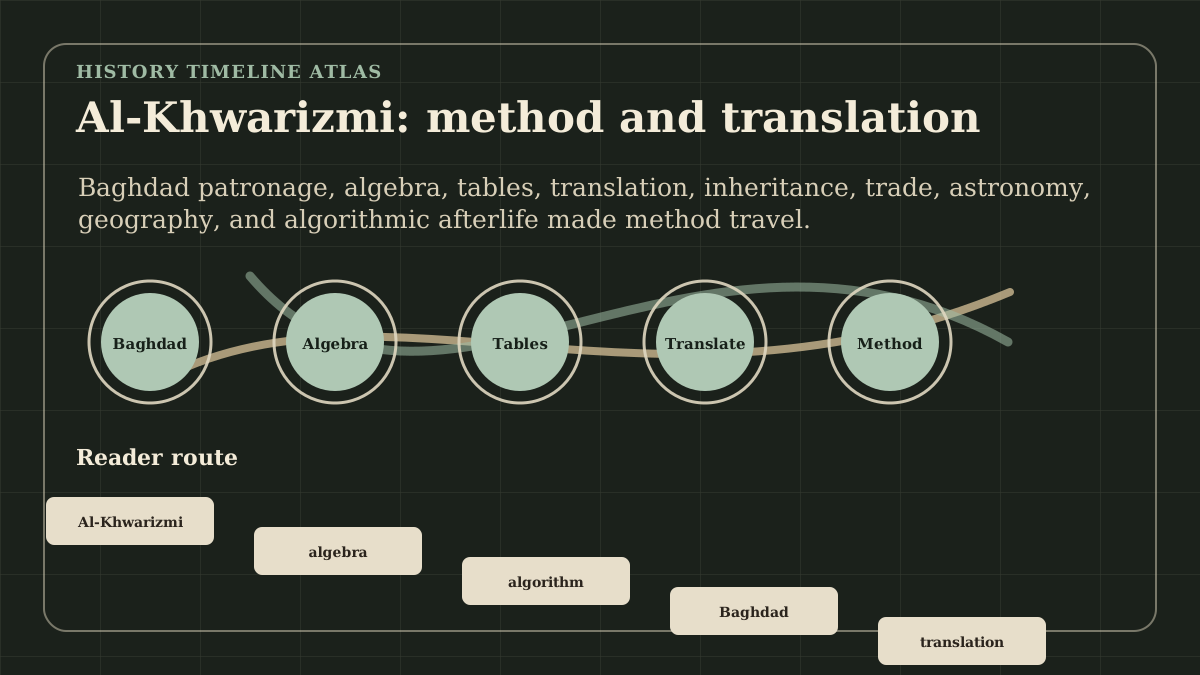
Al-Khwarizmi matters because he gives readers a human entry into Abbasid Baghdad's world of calculation, translation, astronomy, geography, administration, and scholarly exchange. His name is often remembered through algebra and algorithms, but that memory is richer when placed inside institutions that needed reliable methods for inheritance, trade, surveying, taxation, prayer times, calendars, and astronomical tables.
The House of Wisdom should not be imagined as a modern laboratory with one inventor at the center. It was part of a broader Abbasid environment where Arabic, Persian, Greek, Sanskrit, and other knowledge traditions moved through translators, patrons, scribes, astronomers, mathematicians, and officials. Al-Khwarizmi's achievement was to make calculation teachable and portable across settings.
His algebraic work is important because it organized problems into procedures. Instead of leaving mathematics as isolated tricks, it gave readers ways to set up and solve categories of equations. That practical clarity helps explain why later Latin readers found the work useful and why his name became attached to the idea of step-by-step calculation.
A strong biography keeps the Indian Ocean and Islamic world visible. Numerals, astronomical material, geography, administrative needs, and translation were connected by routes of trade, pilgrimage, scholarship, and empire. Al-Khwarizmi did not stand outside that world as a lone genius; he worked inside a connected Afro-Eurasian knowledge system.
The afterlife of his name can be misleading if it becomes only a modern computer-science anecdote. The modern word algorithm is a clue, not the whole story. It points backward to a medieval scholar whose work was copied, translated, adapted, and reused because it answered durable problems about number, order, and procedure.
The administrative world matters because mathematics had jobs to do. Inheritance shares, commercial calculation, land measurement, taxation, astronomical tables, and calendars all rewarded methods that could be taught reliably. Procedure was a practical technology.
Translation also involved judgment. Scholars did not simply carry Greek, Sanskrit, Persian, and Arabic material from one shelf to another. They selected, compared, reorganized, commented, and made knowledge useful for new readers. That is why transmission can be creative.
Algebra's later movement into Latin Europe helps the page connect Baghdad to global intellectual history without turning Europe into the destination of all knowledge. The important pattern is circulation: methods change as they cross language, school, court, and commercial settings.
A reader following this page into science and technology routes should see that durable knowledge often looks modest. Tables, procedures, examples, and terminology can change the world because they make complex action repeatable.
The page also answers a common search shortcut. Al-Khwarizmi is not important only because a modern word sounds like his name. He matters because his work shows how teaching, notation, examples, and translation let a method survive changes in language, empire, and school tradition.
That makes the biography a bridge between medieval Islamic scholarship and later global mathematics. Readers can move from Baghdad to Latin translation, commercial arithmetic, astronomy, navigation, and modern computing vocabulary without pretending those later worlds were already present in the ninth century.
Al-Khwarizmi helps connect individual action with wider historical change in Abbasid Caliphate. The biography works best when it keeps the surrounding world visible: authority, conflict, belief, reform, or discovery moved through decisions made under pressure.
The related events show how roles such as Mathematician, Astronomer, Scholar can be read through dates, places, institutions, and consequences rather than through reputation alone. The biography explains why this person matters, while the linked events explain what changed around them.
A richer reading starts with the limits around the person. Some figures acted through offices, armies, courts, laboratories, churches, parties, ships, trade networks, or protest movements; others became important because later communities turned their lives into symbols. The page therefore asks what this person could actually change, what was already moving before them, and which consequences later readers attached to the name.
Read the biography against absence as well. Many lives around Al-Khwarizmi are less visible in the record: opponents, collaborators, family members, workers, soldiers, students, subjects, victims, translators, scribes, or local communities. Keeping those surrounding people in view makes the page less like a name card and more like an entry point into historical systems.
Al-Khwarizmi also works as a navigation point. Open the linked event pages to see where the biography becomes chronology, then use the topic routes to test whether the same pattern appears beyond one life. That extra step matters because historical importance is rarely contained inside a single decision; it usually spreads through institutions, witnesses, opponents, imitators, and later arguments over memory.
Sources and Method
Source trail: the page uses the Abbasid Baghdad route, Islamic scholarship references, and biographical references for al-Khwarizmi to connect mathematical memory with institutions, translation, and practical calculation.
Method note: modern terms such as algorithm are treated as afterlife evidence. They do not mean al-Khwarizmi was doing modern computing; they show how his name traveled through later mathematical transmission.
Evidence Notes
How Sensitive Claims Are Sourced
- 1
Procedure, not lone-genius mythology
The page presents al-Khwarizmi through calculation methods, translation networks, and Abbasid patronage so algebra and algorithm memory stay historically grounded.
Why This Person Matters
Al-Khwarizmi matters because the connected events make a larger historical pattern easier to follow. The page links biography to consequences so readers can move from a life story into the wider atlas, compare the person with contemporaries, and understand why later memory kept returning to this figure. Al-Khwarizmi matters because his biography turns mathematics into a history of method, institution, translation, and use. The page links Abbasid Baghdad, algebra, astronomical tables, administrative calculation, textual transmission, and the long afterlife of procedure in global knowledge.
What changes when knowledge is written as a repeatable method that can travel across languages and institutions?
How to Read This Life
Al-Khwarizmi is easiest to understand when the biography is read beside House of Wisdom Flourishes. Those events show the historical setting in motion: dates, places, institutions, conflict, and consequences give the life a structure that a short biography alone cannot provide.
The surrounding route crosses Abbasid Caliphate and locations such as Baghdad. That matters because influence rarely stays inside one person. It moves through offices, armies, movements, laws, texts, speeches, institutions, and later memory.
A useful reading path starts with the role labels, then opens the event pages to see what changed, and finally compares this person with other actors facing similar pressures.
For readers who arrive on a biography first, this page is meant to become a doorway rather than a stop. Read one paragraph for the answer, then use the turning points, topic routes, and event links to test whether the person's reputation matches the wider evidence.
Read al-Khwarizmi beside Abbasid Baghdad, the House of Wisdom, and the spread of paper. That path explains why texts, calculation, and administration could reinforce one another.
Then move to science and technology routes. The comparison with Newton, Jenner, industrialization, and computing vocabulary helps readers see that scientific change often depends on institutions that preserve and transmit methods.
Read Al-Khwarizmi through the roles of Mathematician, Astronomer, Scholar rather than as reputation alone.
Place the biography inside Abbasid Caliphate and the wider events linked below.
Ask which choices were personal and which were constrained by institutions or crisis.
Follow how later memory simplified, contested, or reused this person's role.
Look for step-by-step procedure as a historical technology.
Track how Greek, Sanskrit, Persian, and Arabic knowledge moved through Abbasid institutions.
Use the word algorithm as a clue to transmission, not as a shortcut to modern computing.
Legacy, Limits, and Memory
A useful biography keeps scale in view. Al-Khwarizmi mattered because individual choices met a wider structure: institutions, enemies, allies, audiences, technologies, beliefs, and inherited conflicts. The related event pages help separate personal agency from conditions that no single person controlled.
Memory is part of the biography too. Later readers often simplify a figure into a hero, villain, founder, reformer, conqueror, prophet, scientist, or symbol. Those labels can be helpful, but they become misleading when they hide conflict, compromise, exclusion, uncertainty, or the experiences of people outside the main biography.
For the next step, compare this life with a topic route rather than stopping at the name. If the same pattern appears across several figures, the reader has found a historical structure; if this person breaks the pattern, the contrast is usually where the most interesting question begins.
Avoid the shortcut that treats medieval Islamic science as a storage room for Greek knowledge. Translation mattered, but scholars also reorganized, criticized, taught, and extended what they received.
The biography works best when mathematics is tied to use: inheritance, trade, astronomy, geography, administration, and teaching.
Modern algorithm language is useful only when it sends readers back to medieval transmission rather than pretending the ninth century was already digital.
Turning Points to Read Next
House of Wisdom Flourishes
The Abbasid court's Bayt al-Hikmah, or House of Wisdom, became a symbol of translation, scholarship, and mathematical and scientific work in Baghdad.
Related Timeline
- c. 830 CEHouse of Wisdom Flourishes
The Abbasid court's Bayt al-Hikmah, or House of Wisdom, became a symbol of translation, scholarship, and mathematical and scientific work in Baghdad.
References
Where to Check the Facts
- Encyclopaedia Britannica: Al-KhwarizmiBiographical reference for al-Khwarizmi's mathematics, astronomy, and Abbasid scholarly setting.
- Encyclopaedia Britannica: Bayt al-HikmahReference for Abbasid scholarship and the House of Wisdom setting.