At a Glance
The shape of the event
- Date
- March 1947
- Place
- Washington, D.C.
- Type
- Policy Doctrine
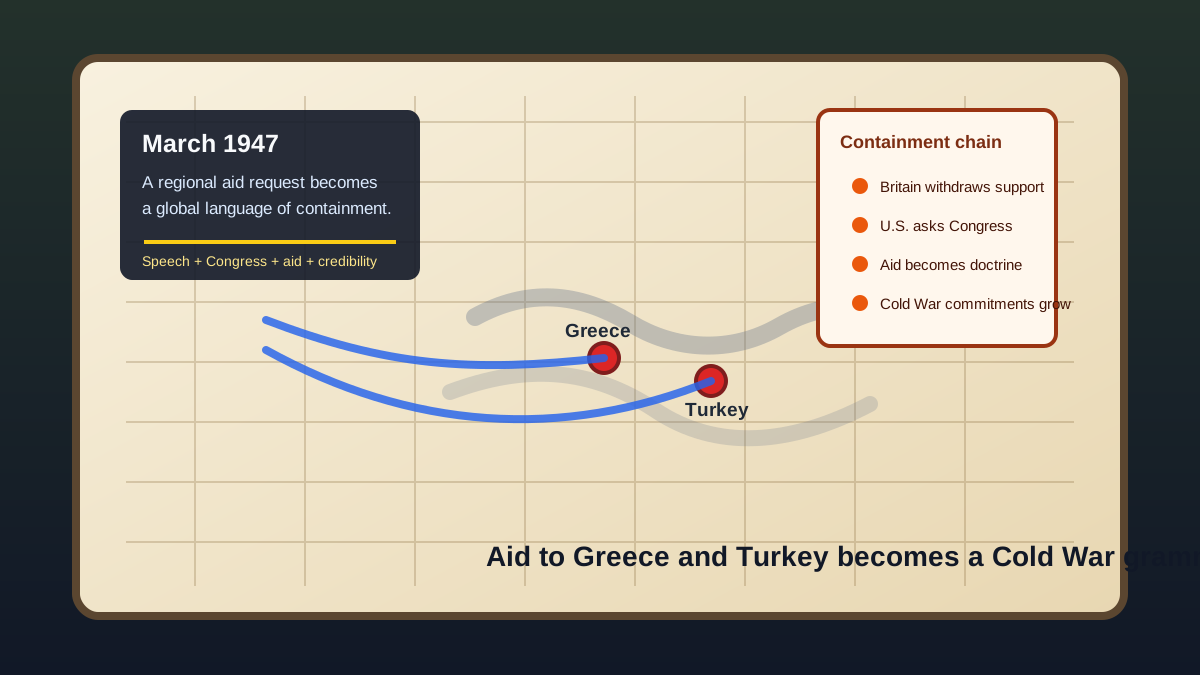
President Harry Truman asked Congress to support Greece and Turkey, framing American policy around containing communist expansion.
March 1947; place the event in Washington, D.C. before comparing causes or consequences.
The doctrine helped define containment as a central idea in early Cold War strategy and U.S. foreign policy.
Harry Truman are the first names or groups to compare before widening the story.
The United States committed economic and military support to states seen as vulnerable to Soviet pressure.
The United States committed economic and military support to states seen as vulnerable to Soviet pressure.
The doctrine helped define containment as a central idea in early Cold War strategy and U.S. foreign policy.
Follow this moment forward to see how a policy framed as emergency assistance became a principle of statecraft.
Background
In early 1947 the tense aftermath of the Second World War continued to reshape global politics. States in Europe and the eastern Mediterranean faced economic strain, political uncertainty and competing external pressures. In Washington, policymakers debated how the United States should respond to perceived Soviet influence and the political openings that followed wartime disruption. Those debates took place against a larger conversation about American identity after the war: whether the United States should return to isolationism or accept a more active role in containing rivals abroad. Truman’s presentation to Congress translated these strategic anxieties into a focused request: funding and support for Greece and Turkey. He presented those countries as immediate cases in which U. S.
assistance could prevent a shift in influence. Historians still debate how much of what followed was the result of the president's individual initiative, congressional politics, or broader structural pressures — economic dislocation, military redistribution, and an evolving international order — that pushed the United States toward sustained involvement overseas. The Truman Doctrine should be read as a speech that reorganized a policy problem into a global frame. The immediate setting was aid to Greece and Turkey after Britain could no longer carry the burden, but the language widened the issue into a struggle between free peoples and coercive pressure. That rhetorical enlargement is why the doctrine mattered beyond the eastern Mediterranean. It also marked a domestic bargain.
Truman needed Congress and the public to accept long-term commitments in peacetime, so the administration linked local crises to U. S. security, credibility, and a larger ideological contest. The doctrine was not yet a full blueprint for every Cold War intervention, but it gave later policymakers a durable vocabulary.
The Turning Point
What changed in March 1947 was not the existence of Soviet power or the presence of needy governments; it was the moment those realities were fused into an explicit American policy pledge. President Truman, addressing Congress in Washington, D. C. , articulated a principle: that the United States would support countries perceived as threatened by external pressure from the Soviet Union. By doing so he converted a set of policy options into a declared doctrine. That declaration performed several actions at once. It requested immediate material support for Greece and Turkey and set a precedent for treating similar cases through a common formula.
It reframed specific requests as elements of a general strategy — containment — giving American officials a rhetorical and political tool to seek assistance programs, military aid, and alliances. The decision also shifted responsibility into the open: Congress was asked to authorize and fund an outward-looking policy. Whether the doctrine followed a long-prepared plan or emerged from contingent choices in a charged moment remains disputed; what is clear is that Truman’s speech marked a decisive turn from ad hoc responses toward a named policy posture that other presidents and policymakers would invoke in the years that followed. The turning point was the move from ad hoc postwar aid to a standing idea of containment.
Greece and Turkey became test cases for a broader U. S. promise to resist perceived Soviet expansion through money, advice, diplomacy, and later military structures.
Consequences
In the near term the Truman Doctrine produced a concrete policy outcome: the United States committed economic and military support to states identified as vulnerable to Soviet pressure, beginning with Greece and Turkey. That commitment signaled to allies and rivals that Washington would act to prevent perceived expansion of Soviet influence. Over the medium and long term the doctrine shaped how policymakers defined problems and selected responses. Containment — the idea that the United States should check Soviet power where it threatened to expand — became a central organizing concept of early Cold War strategy and American foreign policy.
The doctrine also had political effects at home: it made overseas commitments a matter of public debate and congressional authority, embedding those choices in American democratic processes. Importantly, interpretations of these consequences are contested. Some historians emphasize the force of structural factors — geopolitical rivalry, economic dislocation, and the logistics of power after 1945 — as the engine behind U. S. policy. Others stress the role of individual agency: presidential leadership, congressional bargaining and public rhetoric that shaped priorities. This account keeps both lines of explanation in view rather than treating one as definitive. The afterlife includes the Marshall Plan, NATO, covert operations, proxy wars, and arguments over whether containment protected sovereignty or justified intervention.
Readers should keep both the immediate crisis and the later doctrine in view.
Interpretation Notes
The hard question is whether the Truman Doctrine defended vulnerable states or turned local conflicts into global Cold War tests. Greece and Turkey were immediate cases, but the speech created a vocabulary later used for aid, alliances, covert action, and intervention.
Why Keep Reading
Follow this moment forward to see how a policy framed as emergency assistance became a principle of statecraft. Readers who continue will trace how the language and logic of the Truman Doctrine reappeared in later decisions about alliances, aid and military engagement. You can watch how a single public pledge helped convert episodic crises into a sustained posture of containment and how that posture was adapted, contested and institutionalized in the years immediately after 1947. That thread links this speech to later diplomatic choices and to the broader course of the Cold War. Read this page with the Marshall Plan, Berlin Blockade, NATO, Korean War, and Vietnam War to follow how containment moved from speech to institutions and conflict.
Reading Path
Follow the story without losing the thread
Before This
- Marshall Plan AnnouncedJune 1947
- Iron Curtain SpeechMarch 5, 1946
- Long TelegramFebruary 22, 1946
After This
- Berlin Blockade, 1948-1949: Causes, Airlift Timeline, Result1948-1949
- NATO FoundedApril 4, 1949
- Korean War BeginsJune 25, 1950
Same Period
- Cuban Missile CrisisOctober 1962
- Apollo 11 Moon LandingJuly 20, 1969
- Fall of the Berlin WallNovember 9, 1989
Wider Timeline
Mind Map
How to think about Truman Doctrine
Soviet pressure
Perceived risk of Soviet influence in Greece and Turkey framed as a driving cause
Map Layer
Where this event sits geographically
Gold pins mark the approximate locations of published event pages. This is a schematic locator map, not a historical border map.
Coordinates are approximate and are used to help readers orient themselves before opening a full event page.
References
Where to Check the Facts
- U.S. National Archives: The Cold WarArchive reference hub for Cold War records, federal documentation, and research guidance.
- Office of the Historian: The Early Cold War, 1945-1952Official diplomatic history reference for early Cold War foreign-policy context.