At a Glance
The shape of the event
- Date
- August 5, 1963
- Place
- Moscow
- Type
- Arms Control Treaty
The United States, Soviet Union, and United Kingdom signed a treaty banning nuclear tests in the atmosphere, outer space, and under water.
August 5, 1963; place the event in Moscow before comparing causes or consequences.
It became an early milestone in nuclear arms control, environmental diplomacy, and public debate over technological risk.
United States negotiators / Soviet negotiators / British negotiators are the first names or groups to compare before widening the story.
The treaty entered into force in October 1963 and limited several forms of nuclear testing.
The treaty entered into force in October 1963 and limited several forms of nuclear testing.
It became an early milestone in nuclear arms control, environmental diplomacy, and public debate over technological risk.
The next useful step is to follow the linked events, people, topic routes, and timelines.
Background
Nuclear testing had become a public health, environmental, diplomatic, and strategic issue. The Cuban Missile Crisis made the danger of nuclear escalation more vivid, while fallout concerns gave arms control a public audience beyond military planners. Before Partial Nuclear Test Ban Treaty, the surrounding world already contained unresolved tensions over authority, resources, belief, strategy, or legitimacy. Those pressures mattered because they shaped what different actors thought was possible. Single-cause explanations flatten the background, which was usually a mix of long-running structures and immediate decisions. The location in Eastern Europe also matters, because events there connected local choices to wider routes of diplomacy, war, trade, reform, or memory.
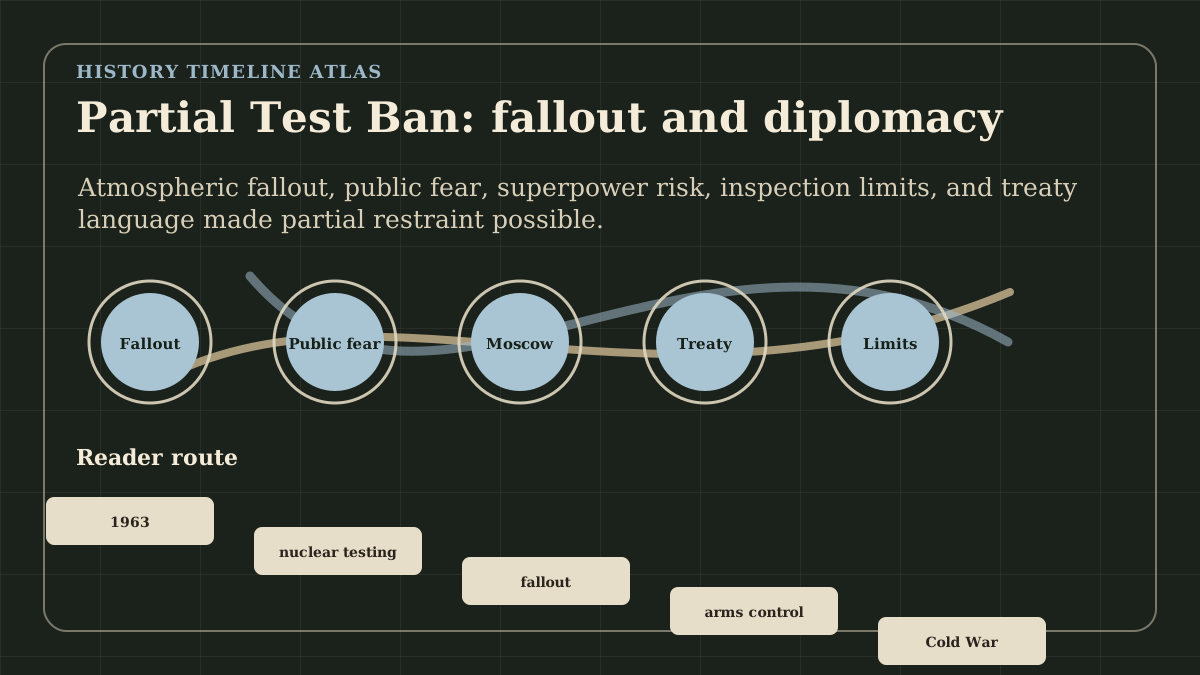
This context prepares the reader to see the event as part of a sequence rather than as an isolated headline. The treaty belongs after the Cuban Missile Crisis because it shows fear becoming diplomacy. Atmospheric testing raised health and environmental concerns, while nuclear brinkmanship made leaders and publics more aware that rivalry needed guardrails. The treaty did not end the arms race, but it changed what kinds of tests were politically acceptable. Fallout makes the page concrete. Radioactive particles did not respect borders, and public concern grew through scientific warnings, public-health debate, mothers worried about milk, and visible unease about open-air tests.
Nuclear danger was no longer only a military abstraction; it entered bodies, food systems, weather, newspapers, laboratories, and family life. The diplomacy also reveals limits. The United States, Soviet Union, and United Kingdom could agree on banning tests in the atmosphere, outer space, and underwater, but they did not accept the inspection regime needed for a comprehensive underground ban. The compromise mattered because it made restraint possible without requiring full trust.
The Turning Point
The treaty did not end the nuclear arms race, and underground testing continued. Its importance lies in showing that rivals could still negotiate limits after a near-catastrophic crisis. Arms control became part of Cold War competition rather than an escape from it. The turning point was not simply that the event occurred, but that it changed the range of options available afterward. People connected to United States negotiators, Soviet negotiators, British negotiators acted inside constraints created by earlier conflicts, institutions, and expectations. Some choices were deliberate; others were responses to pressure, fear, opportunity, or failed compromise. The event's form as arms control treaty also shaped how consequences unfolded.
It made certain outcomes easier to imagine, gave later actors new evidence or symbols to use, and forced communities to adapt to a situation that could no longer be treated as temporary. The turning point was the acceptance that some nuclear competition harmed both sides even when rivalry continued. After 1962, leaders could not treat every agreement as weakness. A limited treaty became a way to reduce shared risk while preserving strategic competition. Moscow mattered as a scene of negotiation because the treaty converted public fear, scientific evidence, and superpower crisis management into written rules. The agreement's partial character is exactly why it is historically useful: readers can see what diplomacy could solve and what it avoided.
Consequences
The treaty entered into force in October 1963 and limited several forms of nuclear testing. It became an early milestone in nuclear arms control, environmental diplomacy, and public debate over technological risk. The immediate result mattered, but the longer effect came from how later people interpreted and reused the event. Some consequences were institutional: laws, borders, offices, alliances, or systems of rule changed. Others were social or cultural: public memory, political language, religious identity, or expectations about power shifted. Read the event on two clocks at once. One clock follows the immediate aftermath; the other follows the slower movement of influence into later crises, reforms, debates, and historical comparisons. Its importance lies in partial restraint.
Underground testing continued, arsenals remained, and distrust did not disappear. Still, the agreement proved that rivals could create limited rules around shared danger. That pattern helps readers understand later arms-control agreements as practical risk management rather than sudden friendship. The treaty also created a memory of arms control as step-by-step work. Later agreements on nonproliferation, strategic arms, and intermediate-range missiles did not emerge from trust alone. They followed a path in which verification problems, public pressure, alliance politics, and environmental concern had to be translated into clauses. For readers, the treaty is a bridge between nuclear fear and institutional behavior.
It asks how societies decide that a weapon is not only powerful but also politically, medically, and environmentally costly to test in public air and water.
Interpretation Notes
Supporters treated the treaty as a first step toward restraint, while critics argued that it left too much of the arms race intact.
Why Keep Reading
The next useful step is to follow the linked events, people, topic routes, and timelines. Partial Nuclear Test Ban Treaty becomes clearer when it is compared with what came before and after it, especially events in Cold War and related pages about Cold War and Nuclear Weapons. The map helps locate the event, the mind map separates causes from effects, and the source list gives readers a way to check the factual spine. Keep reading to see whether this event was a beginning, a turning point, an ending, or a symbol that later generations kept reworking. Read this page after the Cuban Missile Crisis and before the INF Treaty, Chernobyl, and wider Cold War timeline pages.
That path follows nuclear danger from brinkmanship into restraint, technical systems, public trust, and later arms-control fragility.
Reading Path
Follow the story without losing the thread
Before This
- Organization of African Unity FoundedMay 25, 1963
- Cuban Missile CrisisOctober 1962
- Berlin Wall BuiltAugust 1961
After This
- Vietnam War Escalation1965
- ASEAN FoundedAugust 8, 1967
- Prague Spring1968
Same Period
- Cuban Missile CrisisOctober 1962
- Apollo 11 Moon LandingJuly 20, 1969
- Fall of the Berlin WallNovember 9, 1989
Wider Timeline
Mind Map
How to think about Partial Nuclear Test Ban Treaty
Pressure
Nuclear testing had become a public health, environmental, diplomatic, and strategic issue. The Cuban Missile Crisis made the danger of nuclear escalation more vivid, while fallout concerns gave arms control a public audience beyond military planners.
Map Layer
Where this event sits geographically
Gold pins mark the approximate locations of published event pages. This is a schematic locator map, not a historical border map.
Coordinates are approximate and are used to help readers orient themselves before opening a full event page.
References
Where to Check the Facts
- U.S. National Archives: Test Ban TreatyArchive reference for the 1963 treaty, signing, ratification, and test limits.
- U.S. Department of State: Limited Test Ban TreatyOfficial treaty reference for entry into force and treaty terms.
- U.S. National Archives: The Cold WarArchive reference hub for Cold War records, federal documentation, and research guidance.
- Office of the Historian: The Early Cold War, 1945-1952Official diplomatic history reference for early Cold War foreign-policy context.