At a Glance
The shape of the event
- Date
- December 10, 1948
- Place
- Paris
- Type
- Human Rights Declaration
The United Nations General Assembly adopted the Universal Declaration of Human Rights after World War II and the Holocaust.
December 10, 1948; place the event in Paris before comparing causes or consequences.
It became a foundation for human rights law, activism, diplomacy, and debates over universal values and state sovereignty.
Eleanor Roosevelt / United Nations are the first names or groups to compare before widening the story.
The declaration set out a shared language of rights, dignity, and freedoms even without direct treaty enforcement.
The declaration set out a shared language of rights, dignity, and freedoms even without direct treaty enforcement.
It became a foundation for human rights law, activism, diplomacy, and debates over universal values and state sovereignty.
If this moment interests you, follow the threads that the declaration set in motion: the negotiating history of subsequent human‑rights treaties, the Cold War contests over rights language, and the legal cases in nati...
Background
World War II and the Holocaust left a legal and moral vacuum: established institutions had failed to prevent mass violence, and newly evident crimes against civilians demanded a response beyond traditional diplomacy. The United Nations, founded as a forum for newly sovereign and older powers alike, confronted the question of how to rebuild international order so atrocities would not recur. Within that pressure, advocates and officials sought standards that could apply across different legal systems and political ideologies without immediately dissolving state authority. Debates at the time balanced frustration with powerlessness against wariness of imposing foreign norms on sovereign states. People who had been excluded or persecuted wanted recognition and protection; diplomats wanted stability and legitimacy.
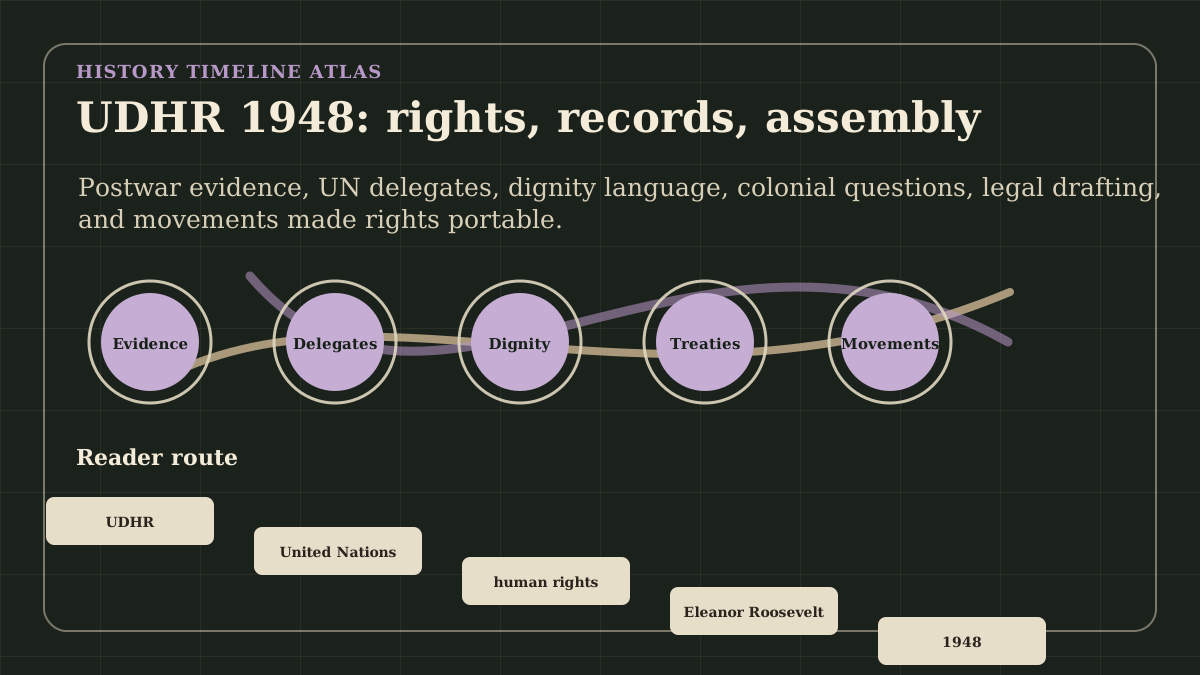
Those competing pressures—moral urgency, political caution, and legal imagination—shaped the work that led to the declaration. The text was formed not in a vacuum but at the intersection of grief, institutional reform, and a desire to make future abuses harder to conceal or justify. The Universal Declaration of Human Rights should not read like a list of noble phrases floating above history. It came after world war, fascist violence, the Holocaust, displacement, empire, and the creation of the United Nations. Delegates were trying to write a public language of dignity that could answer recent catastrophe while still passing through very different legal, religious, socialist, liberal, colonial, and diplomatic traditions.
Eleanor Roosevelt's role matters, but the drafting story was broader than one person. Representatives and thinkers from many places argued over rights, duties, sovereignty, social welfare, religion, speech, equality, labor, education, and the status of colonial peoples. The declaration's power came partly from compromise: it was not a binding treaty, but its language was clear enough to travel. Readers should also see the tension between universality and politics. States could vote for rights language while denying rights at home or in colonies. That hypocrisy did not make the declaration meaningless. It made the text useful to activists, lawyers, dissidents, students, workers, and anti-colonial movements who could cite promises back to power.
The Turning Point
On 10 December 1948 the United Nations General Assembly adopted a non‑binding declaration that placed ideas of dignity, freedom and rights into a single international statement. This was a deliberate choice by the UN and the delegations gathered in Paris: rather than produce an immediately enforceable treaty, they framed a universal articulation that could be widely cited, taught and invoked. Eleanor Roosevelt is named among the people associated with the effort; visible figures and national delegations pressed for language that spoke both to wartime horrors and to everyday claims for protection.
The turning point was not a battlefield conquest but a collective decision about form and audience—accept a declaration with moral force but no direct treaty enforcement, and you create a common vocabulary that can be mobilized by courts, activists and states. That compromise allowed wider agreement in a polarized postwar world, but it also left unresolved questions about how words would be translated into binding obligations and who would enforce them. The Paris adoption thus marks the moment language about human worth was internationalized, while leaving the mechanisms of accountability for future debates. The turning point was the General Assembly's adoption of a shared rights vocabulary in 1948.
The declaration did not create immediate enforcement, but it made dignity, equality, freedom, asylum, education, work, and legal protection part of a global public grammar. Its non-binding character is part of the story. Because it was a declaration rather than a treaty, it could gather broader support and moral authority. Later covenants, courts, constitutions, campaigns, and monitoring groups gave parts of that language more institutional weight.
Consequences
In the near term the declaration offered a recurrent reference point for diplomats drafting later treaties and for activists seeking protection under public opinion and law. States cited its articles when negotiating separate conventions—on genocide, racial discrimination, and later civil and political or economic and social rights—even when those later texts took different legal forms. Over the longer twentieth and twenty‑first centuries the declaration functioned as a foundation: a common lexicon that influenced constitutions, court decisions, international bodies and civil society campaigns. It helped reframe questions of legitimacy, making claims of rights part of diplomatic argument and domestic reform. Yet consequences were—and remain—ambivalent.
The absence of direct enforcement meant that powerful states could ignore or reinterpret principles without immediate sanction; questions about cultural particularity, political sovereignty and geopolitical rivalry produced ongoing disputes over what “universal” means in practice. Historians and practitioners also disagree about the balance between individual agency—campaigners, drafters and witnesses—and deeper structural forces like empire, economic interests and institutional design. The declaration did not settle those debates; it gave them a stage and a vocabulary, changing how future generations argued about justice even as the struggle over enforcement continued. The immediate consequence was a reference point for postwar rights claims.
The longer consequence was much larger: civil-rights movements, women's rights campaigns, decolonization, refugee advocacy, anti-apartheid organizing, dissident networks, truth commissions, and international law all drew on rights language in different ways. A careful page also keeps contestation visible. Governments and critics have debated individual and collective rights, sovereignty, cultural difference, economic rights, selective enforcement, and geopolitical hypocrisy. The UDHR matters not because it ended abuse, but because it gave later struggles a portable language for naming it.
Interpretation Notes
The memory of Universal Declaration of Human Rights often depends on who tells the story. A court, army, religious community, merchant network, or later nation can emphasize different causes and make Paris stand for different lessons.
Why Keep Reading
If this moment interests you, follow the threads that the declaration set in motion: the negotiating history of subsequent human‑rights treaties, the Cold War contests over rights language, and the legal cases in national and international courts that tested the declaration’s reach. Exploring those episodes shows how a statement adopted in Paris moved from moral exhortation to material politics—sometimes protecting people, sometimes serving diplomatic needs, and often sparking renewed argument about universality and sovereignty. Reading on will help you see when words produced change, when they were contested, and how actors used the declaration to press for accountability and reform.
Read the UDHR after the Holocaust, Nuremberg, and the founding of the United Nations, then continue to civil rights, decolonization, apartheid, Helsinki, and truth commissions. That route shows rights language moving from postwar text into social movements and legal institutions.
Reading Path
Follow the story without losing the thread
Before This
- Marshall Plan AnnouncedJune 1947
- United Nations FoundedOctober 24, 1945
- Yalta ConferenceFebruary 1945
After This
- NATO FoundedApril 4, 1949
- Helsinki Final ActAugust 1, 1975
- Rwandan GenocideApril-July 1994
Same Period
- Nuremberg Trials1945-1946
- Coronation of CharlemagneDecember 25, 800
- Norman Conquest of England1066 CE
Wider Timeline
Mind Map
How to think about Universal Declaration of Human Rights
War and atrocity
Mass violence and the Holocaust created moral and political pressure for new international standards
Map Layer
Where this event sits geographically
Gold pins mark the approximate locations of published event pages. This is a schematic locator map, not a historical border map.
Coordinates are approximate and are used to help readers orient themselves before opening a full event page.
References
Where to Check the Facts
- United Nations: History of the United NationsOfficial institutional reference for United Nations founding, charter drafting, and postwar aims.
- United Nations: Universal Declaration of Human RightsOfficial reference for the Universal Declaration of Human Rights and its global human-rights framework.