At a Glance
The shape of the event
- Date
- December 9, 1961
- Place
- Dar es Salaam
- Type
- Independence
Tanganyika became independent from British rule, with Julius Nyerere and TANU turning nationalist organization into a new East African state.
December 9, 1961; place the event in Dar es Salaam before comparing causes or consequences.
The event anchors East African decolonization and leads into debates over socialism, rural development, language, and postcolonial state-building.
Julius Nyerere are the first names or groups to compare before widening the story.
Tanganyika entered independence before uniting with Zanzibar in 1964 to form Tanzania.
Tanganyika entered independence before uniting with Zanzibar in 1964 to form Tanzania.
The event anchors East African decolonization and leads into debates over socialism, rural development, language, and postcolonial state-building.
Read next through Nyerere, Zanzibar, African decolonization, Ghana, Kenya, and the Organization of African Unity.
Background
For decades before 1961, Tanganyika had been governed under British colonial administration, which left a patchwork of institutions, economic patterns, and legal frameworks. Political organization grew unevenly: urban activists, local chiefs, and rural communities each pressed different grievances and demands, while TANU emerged as a mass party capable of linking town and countryside. International pressures — from anti-colonial sentiment across Africa to changing metropolitan calculations about the costs of empire — made sovereignty more likely, but decolonization was not a single force. It was a sequence of negotiations, elections, and local struggles that produced a range of expectations about what independence would deliver.
Julius Nyerere became the most visible leader able to bind diverse constituencies into political majorities, but the society he assumed to lead was not uniform. Ethnic, regional, and economic differences persisted, and practical questions — which colonial institutions to keep or replace, how to organize rural development, and what languages and curricula would shape public life — awaited detailed policy choices. Reading independence therefore requires attention to these layered pressures rather than collapsing them into a single cause. Tanganyika's independence came through mass organization, negotiation, and a political style associated with Julius Nyerere and TANU. The territory had passed from German to British rule, and colonial administration shaped land, labor, education, and authority unevenly across communities.
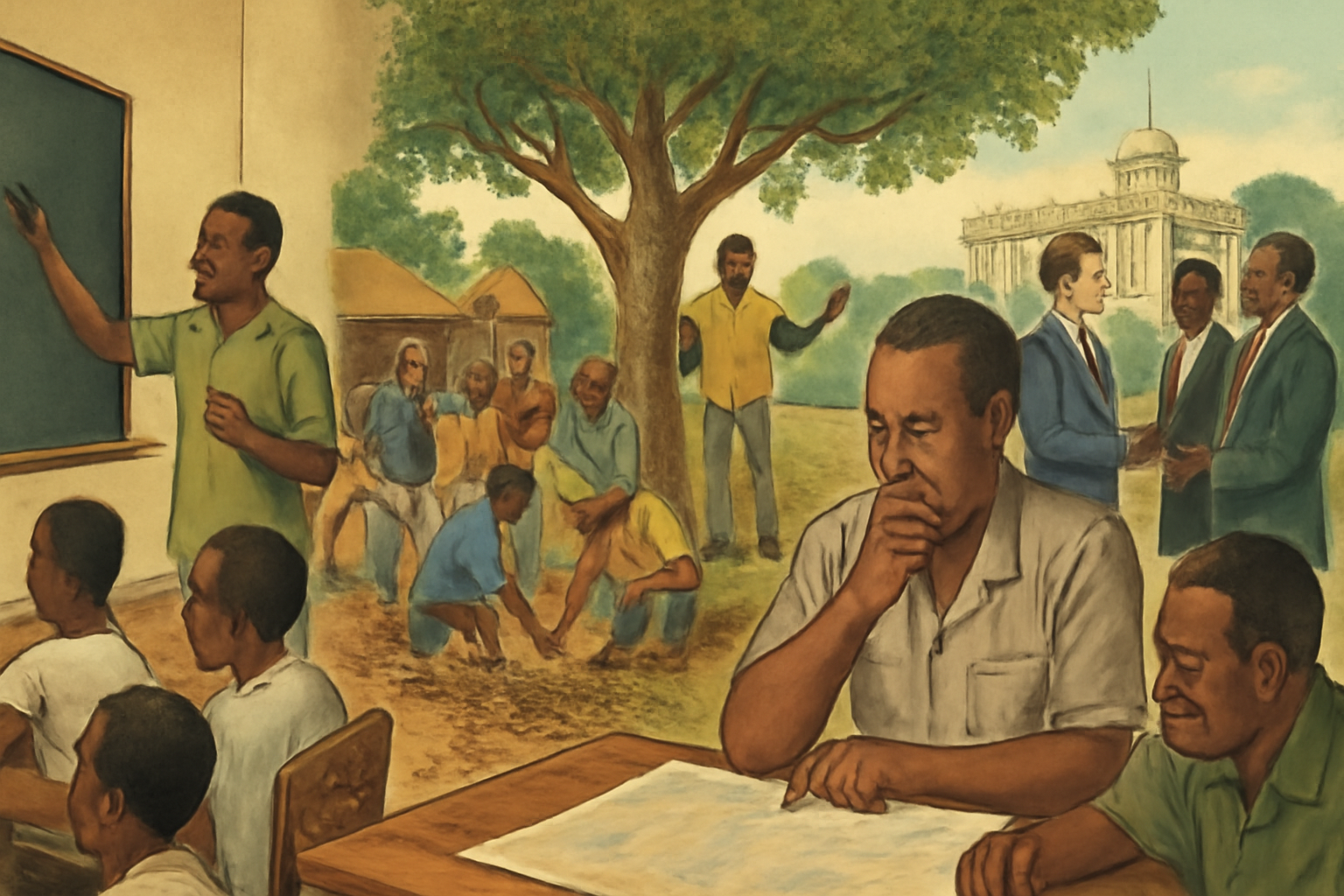
Nationalism did not simply appear at the last moment. Teachers, clerks, farmers, unions, local organizers, and party networks helped turn grievances into a broad claim for self-government. Dar es Salaam became a political center, but independence drew meaning from villages and towns across the territory. Tanganyika's independence was negotiated through organized nationalist politics. TANU built a broad movement under Julius Nyerere, while British officials managed a transfer of power that avoided some forms of settler conflict but still left hard questions about rural poverty, education, language, land, and administrative capacity. Kiswahili helped create a national political vocabulary, yet independence did not automatically settle how a new state would govern villages, schools, borders, or regional identity.
The Turning Point
On 9 December 1961 the legal transfer of sovereignty concentrated authority and symbolic legitimacy in a newly independent Tanganyika. In Dar es Salaam the ceremony crystallized electoral gains and negotiations that had placed TANU, under Julius Nyerere’s leadership, at the head of government. That shift from opposition to administration forced immediate, concrete decisions: which parts of colonial bureaucracy to retain, who would staff ministries and local offices, and how to use limited public revenues to pay teachers, maintain roads, and support agriculture. TANU faced the practical challenge of turning rhetoric into routine governance — collecting taxes, running schools, and administering justice — while trying to maintain popular legitimacy.
Independence also altered external relations: Tanganyika could now negotiate directly with other states and development partners. Yet the change was as much organizational as it was symbolic; sovereignty opened new possibilities while placing burdens on a government that had to build capacity quickly. The essential significance of that day lies in the pivot it produced — from anti-colonial mobilization toward sustained state-building and policy choices that would shape the country’s direction. The turning point was the peaceful transfer of sovereignty on December 9, 1961. That outcome reflected British calculations, international decolonization pressure, TANU's organizational strength, and Nyerere's ability to frame nationalism in inclusive terms.
Independence created a new state, but it also created immediate responsibilities: staffing institutions, managing regional diversity, building schools, negotiating economic dependency, and defining citizenship after colonial rule.
Consequences
In the years immediately after independence Tanganyika set to work converting sovereignty into everyday administration. Party leaders and civil servants began shaping policies on education, agriculture, and local government, aware that success in the countryside would be decisive for legitimacy. Politically, independence anchored TANU’s dominance and sharpened debates about the desirable pace and form of social and economic change. Those debates — over socialism, rural development, and the language of education and administration — became central themes in policy discussions and public life. Over the longer term, Tanganyika’s independence became a regional reference point in East Africa’s decolonization. The polity moved within three years to a formal union with Zanzibar in 1964, creating a new multinational state.
Since then, 9 December has functioned in multiple ways in memory and history: for some it is a founding moment to celebrate, for others a legal change that left colonial structures and social inequalities largely intact. The date therefore anchors both a story of national formation and the start of decades of contested policymaking and remaking of public memory. Tanganyika's independence later fed into the union with Zanzibar and the creation of Tanzania. It also set the stage for debates over ujamaa, rural development, one-party politics, and self-reliance. The event matters because it shows decolonization as both achievement and beginning.
A flag and government changed the legal order, but the deeper work of turning colonial territory into a just and durable state remained open. The later union with Zanzibar and the turn toward ujamaa changed the meaning of 1961. Independence opened sovereignty, but the political project kept moving through debates about party dominance, socialist development, education, rural production, and how Tanganyika would become Tanzania. That longer arc keeps the page from treating independence day as the whole story.
Interpretation Notes
Tanganyika Gains Independence is easy to flatten into one dramatic date. A stronger reading separates immediate action from deeper causes, affected communities, and the memory later states or movements built around the event.
Why Keep Reading
Read next through Nyerere, Zanzibar, African decolonization, Ghana, Kenya, and the Organization of African Unity. The route shows how a negotiated transfer of sovereignty became a wider argument about nation-building, language, rural development, and postcolonial political authority.
Reading Path
Follow the story without losing the thread
Before This
- Congo Independence and Crisis1960 CE
- Guinea Votes No to the French CommunitySeptember 28, 1958
- Ghana IndependenceMarch 6, 1957
After This
- Organization of African Unity FoundedMay 25, 1963
- Vietnam War Escalation1965
- Arusha Declaration1967 CE
Same Period
- Fifth Pan-African CongressOctober 1945
- Ghana IndependenceMarch 6, 1957
- Indonesia Proclaims IndependenceAugust 17, 1945
Wider Timeline
Mind Map
How to think about Tanganyika Gains Independence
Colonial governance
British administrative, legal, and economic structures in Tanganyika that shaped postwar politics and prompted nationalist organization.
Map Layer
Where this event sits geographically
Gold pins mark the approximate locations of published event pages. This is a schematic locator map, not a historical border map.
Coordinates are approximate and are used to help readers orient themselves before opening a full event page.
References
Where to Check the Facts
- Encyclopaedia Britannica: Tanzania, independenceReference for Tanganyika's path to independence and Nyerere's leadership.
- Encyclopaedia Britannica: Julius NyerereBiographical reference for Nyerere and Tanzanian state formation.