Historical Role
Julius Nyerere gives the atlas a postcolonial biography where education, nationalism, socialism, rural life, and Pan-African diplomacy meet. Tanganyika's independence in 1961 was not only a flag moment. It was the beginning of a difficult experiment in making a new state across languages, regions, colonial institutions, poverty, and hopes for political unity.
The Arusha Declaration is the strongest doorway into Nyerere's governing project. Ujamaa promised self-reliance, egalitarian development, rural cooperation, public ethics, and a rejection of elite accumulation. Those claims mattered because they offered an African socialist language that did not simply copy Soviet or Western models. They also created coercive and practical problems when villagization, party authority, and economic constraints collided with local realities.
Nyerere's regional role also matters. Tanzania supported liberation movements in southern Africa, hosted exiles, participated in African diplomacy, and helped make anti-apartheid and anti-colonial struggle part of state policy. The biography works best when schoolteacher, party leader, socialist theorist, president, and regional organizer remain part of the same life rather than separate labels.
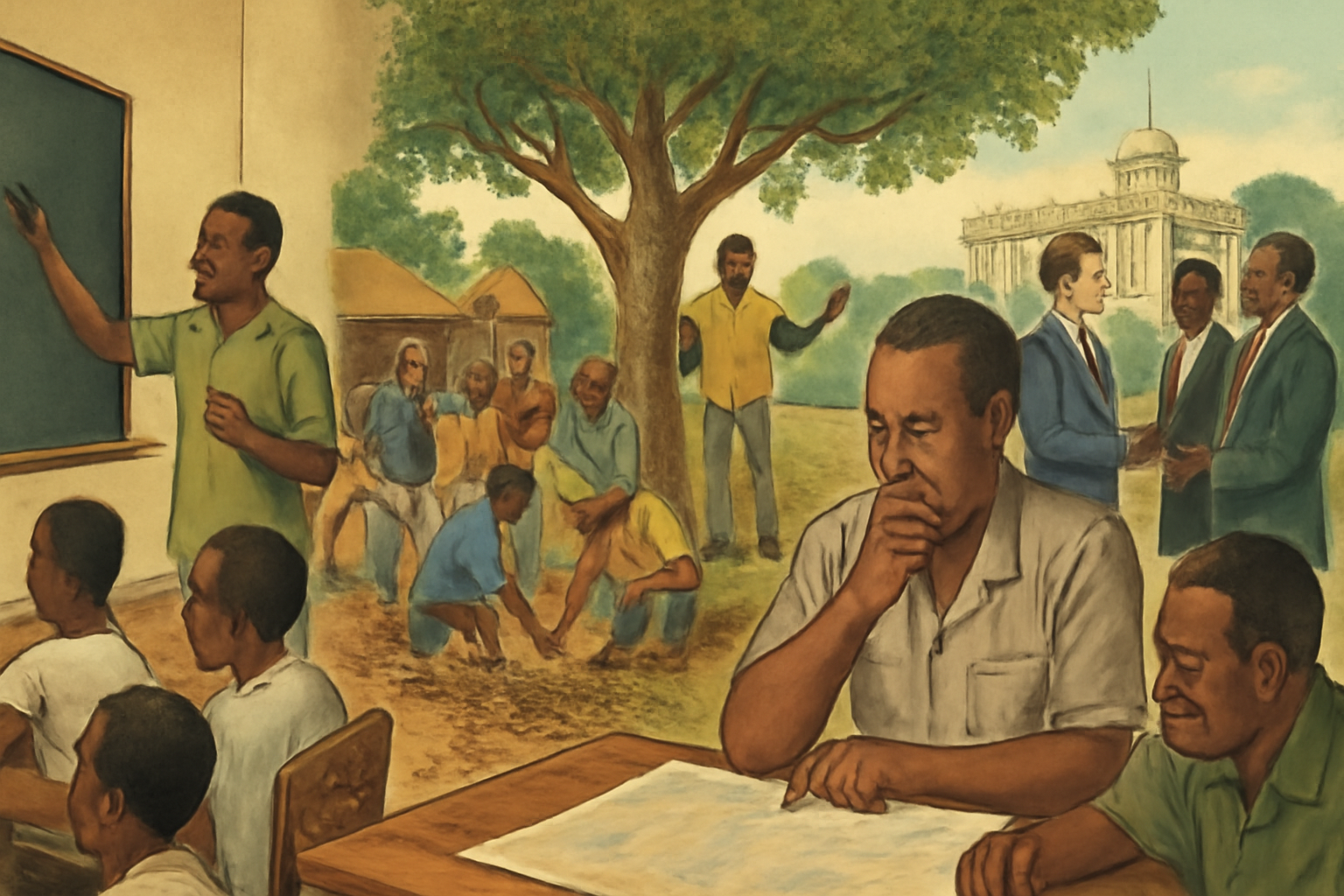
Language and education make his politics concrete. Swahili, adult education, teacher training, civic discipline, and public speeches helped imagine a national community that could cross ethnic and regional lines without relying on colonial categories. Nyerere's teacherly style was not a personality detail; it was part of how he thought a new public could be formed.
The union between Tanganyika and Zanzibar adds another layer. Tanzania was not only Tanganyika renamed. It emerged from a mainland independence story, a violent island revolution, regional security concerns, and a negotiated union whose balance remained politically sensitive. That setting helps readers see Nyerere as a state-builder working with territory, ideology, and legitimacy at once.
Villagization shows the ethical and coercive sides of Ujamaa. Officials and party cadres tried to reorganize rural settlement, services, farming, and citizenship around planned villages. Some communities saw schools, clinics, and a moral language of equality; others experienced disruption, pressure, lost autonomy, or disappointing production results. The policy's mixed record makes the story human rather than slogan-like.
Nyerere's later decision to step down also belongs in the biography. It did not solve Tanzania's economic problems, but it shaped his memory as a leader who accepted limits more visibly than many contemporaries. The afterlife of his career therefore includes admiration for integrity, criticism of economic outcomes, and continuing debate over whether postcolonial justice could be built without stronger markets, looser party control, or a different rural policy.
Julius Nyerere helps connect individual action with wider historical change in Tanzania. The biography works best when it keeps the surrounding world visible: authority, conflict, belief, reform, or discovery moved through decisions made under pressure.
The related events show how roles such as Tanzanian president, Pan-Africanist, Ujamaa theorist can be read through dates, places, institutions, and consequences rather than through reputation alone. The biography explains why this person matters, while the linked events explain what changed around them.
A richer reading starts with the limits around the person. Some figures acted through offices, armies, courts, laboratories, churches, parties, ships, trade networks, or protest movements; others became important because later communities turned their lives into symbols. The page therefore asks what this person could actually change, what was already moving before them, and which consequences later readers attached to the name.
Read the biography against absence as well. Many lives around Julius Nyerere are less visible in the record: opponents, collaborators, family members, workers, soldiers, students, subjects, victims, translators, scribes, or local communities. Keeping those surrounding people in view makes the page less like a name card and more like an entry point into historical systems.
Julius Nyerere also works as a navigation point. Open the linked event pages to see where the biography becomes chronology, then use the topic routes to test whether the same pattern appears beyond one life. That extra step matters because historical importance is rarely contained inside a single decision; it usually spreads through institutions, witnesses, opponents, imitators, and later arguments over memory.
Sources and Method
Source method: read Nyerere through Tanganyika independence, the Arusha Declaration, the OAU, liberation movement routes, and UNESCO/CODESRIA-style African history contexts so the page keeps ideals, institutions, and consequences together.
Evidence Notes
How Sensitive Claims Are Sourced
- 1
Independence, language, and education
The biography treats Nyerere's teacherly image as political evidence: education, Swahili, civic discipline, and party organization helped imagine a postcolonial public.
- 2
Ujamaa and regional liberation
The Arusha Declaration and OAU context anchor the page because they connect domestic socialist experiment with Tanzania's wider role in African liberation politics.
Why This Person Matters
Julius Nyerere matters because the connected events make a larger historical pattern easier to follow. The page links biography to consequences so readers can move from a life story into the wider atlas, compare the person with contemporaries, and understand why later memory kept returning to this figure. Julius Nyerere matters because his career asks what independence can do after colonial rule ends. The page connects education, language, rural development, African socialism, one-party politics, liberation diplomacy, and the uneven record of postcolonial state-building.
How did Nyerere try to turn independence into an ethical development project, and why did that vision become so difficult to govern in practice?
How to Read This Life
Julius Nyerere is easiest to understand when the biography is read beside Tanganyika Gains Independence, Arusha Declaration, Organization of African Unity Founded. Those events show the historical setting in motion: dates, places, institutions, conflict, and consequences give the life a structure that a short biography alone cannot provide.
The surrounding route crosses Decolonization, Postcolonial Africa and locations such as Dar es Salaam, Arusha, Addis Ababa. That matters because influence rarely stays inside one person. It moves through offices, armies, movements, laws, texts, speeches, institutions, and later memory.
A useful reading path starts with the role labels, then opens the event pages to see what changed, and finally compares this person with other actors facing similar pressures.
For readers who arrive on a biography first, this page is meant to become a doorway rather than a stop. Read one paragraph for the answer, then use the turning points, topic routes, and event links to test whether the person's reputation matches the wider evidence.
Read Nyerere beside Tanganyika independence, the Arusha Declaration, the OAU, anti-apartheid routes, African decolonization, and Swahili/East African history. That path makes Tanzania both national and regional.
Then compare him with Nkrumah, Nasser, Mandela, Kenyatta, Lumumba, and Sukarno where available. The comparison asks how postcolonial leaders balanced moral vision, economic limits, party authority, and international pressure.
Read Julius Nyerere through the roles of Tanzanian president, Pan-Africanist, Ujamaa theorist rather than as reputation alone.
Place the biography inside Tanzania and the wider events linked below.
Ask which choices were personal and which were constrained by institutions or crisis.
Follow how later memory simplified, contested, or reused this person's role.
Use schools, Swahili, citizenship, and public ethics to read Nyerere's political imagination.
Ask how self-reliance and rural cooperation changed when they became state policy.
Follow Tanzania's role in liberation movements, OAU diplomacy, and anti-apartheid politics.
Legacy, Limits, and Memory
A useful biography keeps scale in view. Julius Nyerere mattered because individual choices met a wider structure: institutions, enemies, allies, audiences, technologies, beliefs, and inherited conflicts. The related event pages help separate personal agency from conditions that no single person controlled.
Memory is part of the biography too. Later readers often simplify a figure into a hero, villain, founder, reformer, conqueror, prophet, scientist, or symbol. Those labels can be helpful, but they become misleading when they hide conflict, compromise, exclusion, uncertainty, or the experiences of people outside the main biography.
For the next step, compare this life with a topic route rather than stopping at the name. If the same pattern appears across several figures, the reader has found a historical structure; if this person breaks the pattern, the contrast is usually where the most interesting question begins.
The main risk is making Ujamaa sound either purely noble or purely failed. It was a serious development vision with ethical force, but it also produced coercion, disruption, administrative pressure, and economic disappointment.
A second risk is isolating Tanzania from the region. Nyerere's importance grows when readers see liberation movements, refugees, border politics, OAU diplomacy, and Cold War nonalignment around him.
Turning Points to Read Next
Tanganyika Gains Independence
Tanganyika became independent from British rule, with Julius Nyerere and TANU turning nationalist organization into a new East African state.
Arusha Declaration
Tanzania's Arusha Declaration set out a socialist and self-reliance program that linked rural development, public ownership, equality, and postcolonial legitimacy.
Organization of African Unity Founded
Independent African states founded the Organization of African Unity to support sovereignty, anti-colonial struggle, cooperation, and continental diplomacy.
Related Timeline
- December 9, 1961Tanganyika Gains Independence
Tanganyika became independent from British rule, with Julius Nyerere and TANU turning nationalist organization into a new East African state.
- 1967 CEArusha Declaration
Tanzania's Arusha Declaration set out a socialist and self-reliance program that linked rural development, public ownership, equality, and postcolonial legitimacy.
- May 25, 1963Organization of African Unity Founded
Independent African states founded the Organization of African Unity to support sovereignty, anti-colonial struggle, cooperation, and continental diplomacy.
References
Where to Check the Facts
- Encyclopaedia Britannica: Julius NyerereBiographical reference for Nyerere's leadership and Tanzanian politics.
- Encyclopaedia Britannica: Algerian WarReference for the 1954-1962 war for Algerian independence from France.
- Encyclopaedia Britannica: African UnionReference for the Organization of African Unity, its 1963 founding, and the later African Union.
- Official African Union: OAU CharterOfficial reference for the 1963 OAU Charter and the continental institution's founding framework.
- Official United Nations: Rwanda genocide historical backgroundInstitutional reference for the 1994 genocide against the Tutsi in Rwanda and UN memory work.
- UNESCO: General History of AfricaAfrican-history reference project for reading decolonization through African scholarship, regional diversity, culture, and postcolonial memory.
- South African History Online: Liberation HistoryAfrican public-history reference for apartheid, liberation movements, township politics, memory, and South African transition.