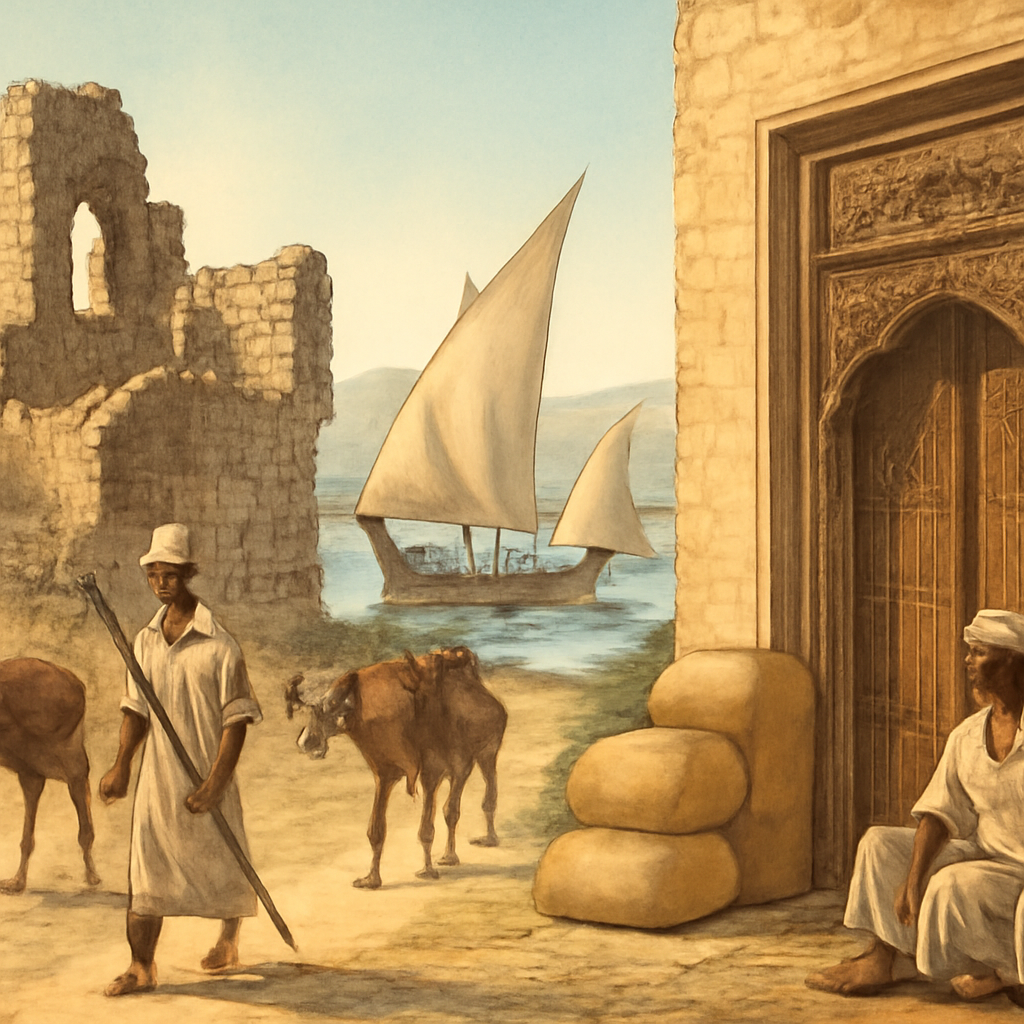
Keep ports and inland producers together; coastal wealth often depended on people and routes far from the sea.
Timeline
Swahili Coast and East Africa Timeline
A route through Swahili city-states, Kilwa, Great Zimbabwe, Indian Ocean travel, Portuguese and Omani rivalry, Zanzibar, colonial rule, rebellion, independence, and Tanzanian socialism.
Timeline Guide
How did East African port cities, inland trade, colonial coercion, resistance, and postcolonial state-building become one connected route?
Read this edited guide as a path through dates, places, affected lives, source limits, and contested memory rather than as an exhaustive database.
This timeline starts by treating East Africa as a historical center, not as a shoreline waiting for outsiders. Aksum, Swahili towns, Kilwa, Great Zimbabwe, and Ibn Battuta's visit show that routes across the Red Sea, inland southern Africa, the Swahili Coast, Arabia, India, and the wider Islamic world were already making political and commercial history before European forts appeared.
The first chapter is about ports and hinterlands. Kilwa could not matter without inland gold and ivory routes; Great Zimbabwe could not be understood without regional power and trade links; Swahili towns could not grow without monsoon sailing, language, religious networks, and merchant trust. The map therefore runs both along the coast and inland. The ocean is a connector, but the inland world supplies much of the wealth and labor.
The second chapter turns connection into coercion. Portuguese attacks, Omani recovery, Zanzibar's clove economy, and German East Africa show power moving through forts, tribute, plantation labor, forced cultivation, colonial treaties, and military violence. The route avoids a romantic Indian Ocean story by keeping enslaved people, rural producers, port workers, and colonized communities visible beside merchants and rulers.
Maji Maji is the timeline's central anti-colonial rupture. It asks readers to connect local spiritual language, cotton policy, forced labor, famine, military repression, and later nationalist memory. The rebellion was not a minor disturbance in a colonial file. It was evidence that imperial administration had entered everyday farming, land, and family life so deeply that resistance became a regional crisis.
Start With These Dates
- c. 330 CEAksum Adopts Christianity, c. 330: Ezana and the Red Sea Context
Aksum adopted Christianity around 330 under King Ezana, making royal Christian language part of Red Sea diplomacy and imperial identity. The key is not instant conversion by every subject, but a public shift in how Aksum represented power.
- c. 900 CESwahili Coast City-States Rise
Swahili-speaking coastal towns grew into Indian Ocean commercial centers, linking African producers, Muslim merchants, monsoon shipping, coral-stone cities, and inland trade routes.
- c. 1200 CEKilwa Sultanate Flourishes
Kilwa became one of the most influential Swahili city-states, mediating gold, ivory, ceramics, cloth, and Islamic prestige between inland routes and Indian Ocean ports.
- c. 1250 CEGreat Zimbabwe Flourishes
Great Zimbabwe reached a high point as a stone-built political and commercial center connected to cattle wealth, gold routes, regional authority, and Indian Ocean trade.
- 1885 CEGerman East Africa Established
German East Africa emerged during the Scramble for Africa, turning coastal claims, chartered-company ambition, treaties, coercion, and inland conquest into colonial rule.
- 1994Fall of Apartheid
South Africa held its first fully democratic elections, ending apartheid rule and bringing Nelson Mandela to the presidency.
- April-July 1994Rwandan Genocide
Extremist forces in Rwanda organized mass killing of Tutsi civilians and moderate Hutu during a rapid genocide that unfolded over roughly one hundred days.
- 1996 CESouth African Truth and Reconciliation Commission Hearings
South Africa's Truth and Reconciliation Commission held public hearings on apartheid-era abuses, linking testimony, amnesty, public memory, and democratic transition.
Sources Used Here
- Encyclopaedia Britannica: Kilwa
Reference for Kilwa as a Swahili city-state, commercial center, Portuguese occupation, and later decline.
- Official UNESCO World Heritage Centre: Ruins of Kilwa Kisiwani and Songo Mnara
Reference for the material remains and Indian Ocean setting of Kilwa and Songo Mnara.
- Encyclopaedia Britannica: Zanzibar
Reference for Zanzibar's Indian Ocean position, port economy, and later clove-export history.
- Official UNESCO World Heritage Centre: Stone Town of Zanzibar
Reference for Stone Town as an Indian Ocean Swahili trading center shaped by maritime commerce and cultural exchange.
- Encyclopaedia Britannica: Maji Maji
Reference for the 1905-1907 uprising against German colonial rule in East Africa.
The independence chapter changes the question from who controlled the coast to what sovereignty could do. Tanganyika's independence, the OAU, Arusha, Soweto, Rwanda, and South Africa's truth commission show that postcolonial history includes institutions, development policy, liberation, violence, and memory. Independence did not close the route; it opened new questions about land, language, rural life, justice, and state legitimacy.
The sequence is deliberately cross-regional. East Africa is connected to West African pilgrimage, southern African stone cities, Indian Ocean exchange, German colonialism, Pan-African institutions, apartheid resistance, and genocide memory. That makes the page useful for readers who arrive through Kilwa, Maji Maji, Nyerere, or Rwanda and need a route that does not collapse Africa into one simplified story.
Source types change along the route. Early nodes use archaeology, architecture, travel writing, material culture, and later synthesis. Colonial nodes use official records, missionary accounts, oral memory, and nationalist interpretation. Modern nodes use speeches, state documents, survivor testimony, international reports, and public memory. The timeline asks readers to notice those source shifts because different records make different people visible.
The payoff is a broader East African history. Ports, plantations, rebellions, institutions, and truth commissions all belong on one map because they ask the same question: how do routes, labor, violence, and memory make authority real across distance?
This route makes the coast-and-hinterland relationship harder to miss. Kilwa, Mombasa, Zanzibar, Great Zimbabwe, Mali, and inland caravan routes sit in the same story because the coast's wealth depended on gold, ivory, food, labor, credit, and trust reaching the sea from inland societies. A map that stops at the shoreline hides too much of the history. The reader needs both directions: ships moving with monsoon winds and inland routes carrying the goods and people that made ports matter.
The early Swahili chapter also needs language and religion in view. Swahili urban life was not simply trade plus architecture. It involved Bantu-speaking communities, Islam, coral-stone building, kinship ties, mosque patronage, legal habits, local elites, and visiting merchants who had to negotiate belonging. Ibn Battuta's Kilwa is useful because it shows the coast through an outside traveler's eyes, but the page stays careful: travel writing reveals contact and reputation while leaving many local voices indirect.
The Portuguese and Omani nodes are not only shifts in who controlled forts. They show how military technology, tribute, diplomacy, and commercial choke points could change the terms of Indian Ocean exchange. Portuguese violence at Kilwa and Mombasa disrupted older patterns, while Omani and Zanzibari power later tied the coast to cloves, plantation labor, slavery, and long-distance demand. The same sea that carried cosmopolitan exchange could also carry coercive power.
Colonial East Africa enters through everyday pressure, not only maps in European conference rooms. The Berlin Conference and German East Africa matter because diplomatic paper became taxes, forced cotton, labor demands, military patrols, and punishments in villages. Maji Maji then becomes more than a rebellion date. It is the moment where water, spirit mediumship, crop policy, famine, rural anger, and colonial gunfire collided in a way later Tanzanian memory could not ignore.
The independence section gives the route a political afterlife. Tanganyika, the OAU, and the Arusha Declaration ask what sovereignty could mean after colonial rule: national language, party organization, rural development, African socialism, continental diplomacy, and debates over self-reliance. These nodes make Julius Nyerere and Tanzanian history visible without turning the timeline into a biography. The route is about institutions and choices as much as leaders.
The late nodes deliberately include southern Africa and Rwanda because East African and Swahili Coast history connects to wider African questions of liberation, state violence, and public memory. Soweto and apartheid's end show the regional and continental pressure around racial rule. Rwanda and the South African Truth and Reconciliation Commission keep testimony and accountability visible. The result is not a single Africa story, but a route where East Africa links to larger African and global debates.
A source-aware reading separates archaeology, architecture, travel accounts, colonial records, nationalist memory, and survivor testimony. Kilwa's ruins, Great Zimbabwe's stone architecture, Ibn Battuta's writing, German colonial files, Pan-African congress records, and truth-commission testimony do not preserve the same kinds of evidence. The page gains depth when readers notice when the archive is material, official, oral, international, or commemorative.
The reading path is built around four recurring problems: who controlled movement, who controlled labor, who claimed moral authority, and who later told the story. A beginner can follow Kilwa, Zanzibar, Maji Maji, Tanganyika, Arusha, and Rwanda. A deeper reader can add Aksum, Great Zimbabwe, Mansa Musa, Zheng He, Suez, Berlin, the OAU, Soweto, and the TRC to see how East Africa belongs to world history without being reduced to outside arrival.
The story is strongest when read in layers. First, follow the dates from c. 330 CE to 1996 CE. Then read across the event types: religious change, urban and commercial expansion, commercial florescence, urban and political florescence. The timeline becomes more than chronology when those dates reveal decisions, institutions, violence, reform, and memory.
German East Africa Established sits near the middle of the sequence. Ask what had already become unavoidable by 1885 CE, what actors still believed they could control, and which consequences were already beginning to move beyond the original setting.
The named events are Aksum Adopts Christianity, c. 330: Ezana and the Red Sea Context, Swahili Coast City-States Rise, Kilwa Sultanate Flourishes, Great Zimbabwe Flourishes, Mansa Musa's Hajj, Ibn Battuta Visits Kilwa. Each one pushes a more precise question: what changed, who benefited, who paid the cost, and what later page explains the aftermath more clearly?
Read the timeline against geography too. Places matter because power moves through corridors, borders, cities, ports, capitals, and frontiers. The map below keeps those distances visible while the event pages explain the human and institutional consequences.
A good timeline has a pulse: pressure, decision, expansion, resistance, and aftermath. When you move through Late Antique Africa, Medieval Indian Ocean, and Medieval Africa, keep asking whether an event is creating a new problem, revealing a hidden weakness, or making an earlier choice harder to reverse.
The human layer matters because timelines can become too abstract. Figures such as King Ezana, Swahili merchant communities, Kilwa sultans, Swahili merchants, Shona rulers, Gold traders, and Mansa Musa help the sequence feel lived rather than mechanical. Their choices do not explain everything, but they show where institutions, ideas, military systems, social movements, and public fear entered real decisions.
The ending is not only the last date. With closing events such as Eritrea Becomes Independent, Fall of Apartheid, Rwandan Genocide, and South African Truth and Reconciliation Commission Hearings, the reader can ask what remained unsettled: which institutions survived, which arguments continued, which victims or opponents were left outside the official story, and which later crisis reused the same vocabulary.
Read this page once quickly for order, then read it again for contrast. Compare early confidence with later uncertainty, local decisions with global consequences, and visible turning points with slower changes in law, economy, belief, technology, borders, or memory. That second pass is where a timeline becomes an explanation.
Causation in this sequence is layered. One event may supply the trigger, another may reveal an older weakness, and a later event may show the consequence that people at the beginning did not expect. The useful habit is to separate background pressure, immediate decision, turning point, and aftermath before deciding which event matters most.
Consequences are uneven. A political settlement might look successful in one capital while creating resentment elsewhere; a military victory might end a campaign while deepening civilian trauma; a scientific or institutional breakthrough might solve one problem while creating new risks. The timeline is strongest when those mixed outcomes remain visible.
The final pass is comparative. After reading this sequence, open a neighboring topic or person page and ask whether the same pattern appears again. Repetition usually points to a structure; contrast usually points to a historical choice that could have gone another way.
Importance is not the same thing as drama. Some events are remembered because they were spectacular, while others matter because they changed rules, expectations, alliances, legal categories, technologies, or public language. Use the timeline to test both kinds of importance before deciding what belongs at the center of the story.
The page rewards moving outward. A timeline gives order, but the event pages give causes, maps, people, sources, and reading paths. When a date feels too compressed, open the full event page and then return here; the sequence becomes clearer with each pass instead of asking the reader to memorize a list.
Read cloves, cotton, plantations, forced work, rural production, and development policy as one long labor question.
Maji Maji, Rwanda, and the TRC show that public memory becomes part of political history after violence.
Follow Tanganyika, Tanzania, the OAU, and truth commissions as attempts to turn sovereignty into public order.
Notice when the evidence changes from archaeology and architecture to travel writing, colonial files, nationalist documents, and testimony after mass violence.
Follow where moral authority is claimed: mosque, palace, plantation, village, conference hall, party state, liberation movement, courtroom, and memory site.
For a fast route, read Kilwa, Zanzibar, Maji Maji, Tanganyika, Arusha, and Rwanda; for a wider route, add Great Zimbabwe, Mansa Musa, Suez, Berlin, OAU, Soweto, and the TRC.
Aksum Adopts Christianity, c. 330: Ezana and the Red Sea Context gives the opening problem a date and place. Ask what was already unstable before it happened.
German East Africa Established is a compression point: earlier causes are now crowded together with decisions that will shape the sequence's ending.
Follow the path through Aksum, East African coast, Kilwa Kisiwani, Great Zimbabwe, and Mali to Mecca and ask how distance changed communication, logistics, fear, and control.
South African Truth and Reconciliation Commission Hearings works as both an ending and a beginning: it closes one sequence while opening later disputes, institutions, memories, or reforms.
Which conditions existed before the first event, and which later decision turned those conditions into visible historical change?
Who had the power to choose, who had fewer choices, and who is missing when the story is told only through leaders or institutions?
Which facts are date anchors, which are interpretations, and which claims need checking through the event sources before being repeated?
Which linked event, person, year, or topic page would change your interpretation if you read it next?
Interactive Timeline
Explore Swahili Coast and East Africa Timeline by sequence
Aksum Adopts Christianity, c. 330: Ezana and the Red Sea Context
Aksum adopted Christianity around 330 under King Ezana, making royal Christian language part of Red Sea diplomacy and imperial identity. The key is not instant conversion by every subject, but a public shift in how Aksum represented power.
Read the full event pageNarrative Stages
Read this timeline in chapters
Port Cities and Inland Wealth
Aksum, Swahili towns, Kilwa, Great Zimbabwe, Mali, and travel writing show East Africa inside African and Indian Ocean systems before European forts appear.
- Aksum Adopts Christianity, c. 330: Ezana and the Red Sea Contextc. 330 CE
- Swahili Coast City-States Risec. 900 CE
- Kilwa Sultanate Flourishesc. 1200 CE
- Great Zimbabwe Flourishesc. 1250 CE
- Mansa Musa's Hajj1324-1325 CE
- Ibn Battuta Visits Kilwa1331 CE
Ocean Routes, Forts, and Sultanates
Ming voyages, Portuguese attacks, Omani recovery, and Zanzibar's plantation economy reveal connection turning into armed and commercial coercion.
Colonial Partition and Rural Resistance
The Suez Canal, Berlin Conference, German East Africa, and Maji Maji show imperial mapping entering land, labor, crops, and village life.
- Opening of the Suez CanalNovember 17, 1869
- Berlin Conference1884-1885
- German East Africa Established1885 CE
- Maji Maji Rebellion1905-1907 CE
Pan-African and Independence Politics
Pan-African organizing, Ghana, Tanganyika, the OAU, and Arusha turn the route from colonial resistance toward state-building and development choices.
- Fifth Pan-African CongressOctober 1945
- Ghana IndependenceMarch 6, 1957
- Tanganyika Gains IndependenceDecember 9, 1961
- Organization of African Unity FoundedMay 25, 1963
- Arusha Declaration1967 CE
Liberation, Violence, and Testimony
Apartheid struggle, genocide, and truth-commission testimony keep memory and accountability visible after formal independence.
- Soweto UprisingJune 16, 1976
- Nelson Mandela ReleasedFebruary 11, 1990
- Fall of Apartheid1994
- Rwandan GenocideApril-July 1994
- South African Truth and Reconciliation Commission Hearings1996 CE
Map Layer
Swahili Coast and East Africa Timeline geography
Gold pins mark the approximate locations of published event pages. This is a schematic locator map, not a historical border map.
Event location Simplified land areaClick a pin to open the event page
Coordinates are approximate and are used to help readers orient themselves before opening a full event page.
References
Where to Check the Facts
- Encyclopaedia Britannica: KilwaReference for Kilwa as a Swahili city-state, commercial center, Portuguese occupation, and later decline.
- Official UNESCO World Heritage Centre: Ruins of Kilwa Kisiwani and Songo MnaraReference for the material remains and Indian Ocean setting of Kilwa and Songo Mnara.
- Encyclopaedia Britannica: ZanzibarReference for Zanzibar's Indian Ocean position, port economy, and later clove-export history.
- Official UNESCO World Heritage Centre: Stone Town of ZanzibarReference for Stone Town as an Indian Ocean Swahili trading center shaped by maritime commerce and cultural exchange.
- Encyclopaedia Britannica: Maji MajiReference for the 1905-1907 uprising against German colonial rule in East Africa.
- Encyclopaedia Britannica: German East AfricaReference for the colonial setting, geography, and German rule behind the Maji Maji rebellion.
- Encyclopaedia Britannica: Algerian WarReference for the 1954-1962 war for Algerian independence from France.
- Encyclopaedia Britannica: African UnionReference for the Organization of African Unity, its 1963 founding, and the later African Union.
- Official African Union: OAU CharterOfficial reference for the 1963 OAU Charter and the continental institution's founding framework.
- Official United Nations: Rwanda genocide historical backgroundInstitutional reference for the 1994 genocide against the Tutsi in Rwanda and UN memory work.
- UNESCO: General History of AfricaAfrican-history reference project for reading decolonization through African scholarship, regional diversity, culture, and postcolonial memory.
- South African History Online: Liberation HistoryAfrican public-history reference for apartheid, liberation movements, township politics, memory, and South African transition.