At a Glance
The shape of the event
- Date
- c. 330 CE
- Place
- Aksum
- Type
- Religious Change
Aksum adopted Christianity around 330 under King Ezana, making royal Christian language part of Red Sea diplomacy and imperial identity. The key is not instant conversion by every subject, but a public shift in how Aksum represented power.
c. 330 CE; place the event in Aksum before comparing causes or consequences.
The conversion shows that late antique Christianity was not only Mediterranean or European; it moved through African courts, trade routes, languages, and inscriptions.
King Ezana are the first names or groups to compare before widening the story.
Christianity became part of Aksumite royal identity and long-term Ethiopian religious memory.
Christianity became part of Aksumite royal identity and long-term Ethiopian religious memory.
The conversion shows that late antique Christianity was not only Mediterranean or European; it moved through African courts, trade routes, languages, and inscriptions.
Follow Aksum into Red Sea trade, Constantine, the Council of Nicaea, Ethiopian Christianity, and Indian Ocean exchange.
Background
By the early fourth century, the kingdom of Aksum occupied a strategic position between inland trade routes and the maritime lanes of the Red Sea. Its wealth and influence rested on commerce that moved goods, ideas, and people between Africa, Arabia, and the Mediterranean. Aksumite rulers already spoke in public through inscriptions, minted objects, and court ceremony: material forms that translated authority into visible signs. Christian communities were expanding across late antiquity, not confined to the Mediterranean basin. Within this dynamic landscape, religious identity was one tool among many for elites to manage loyalties, assert legitimacy, and shape international relations.
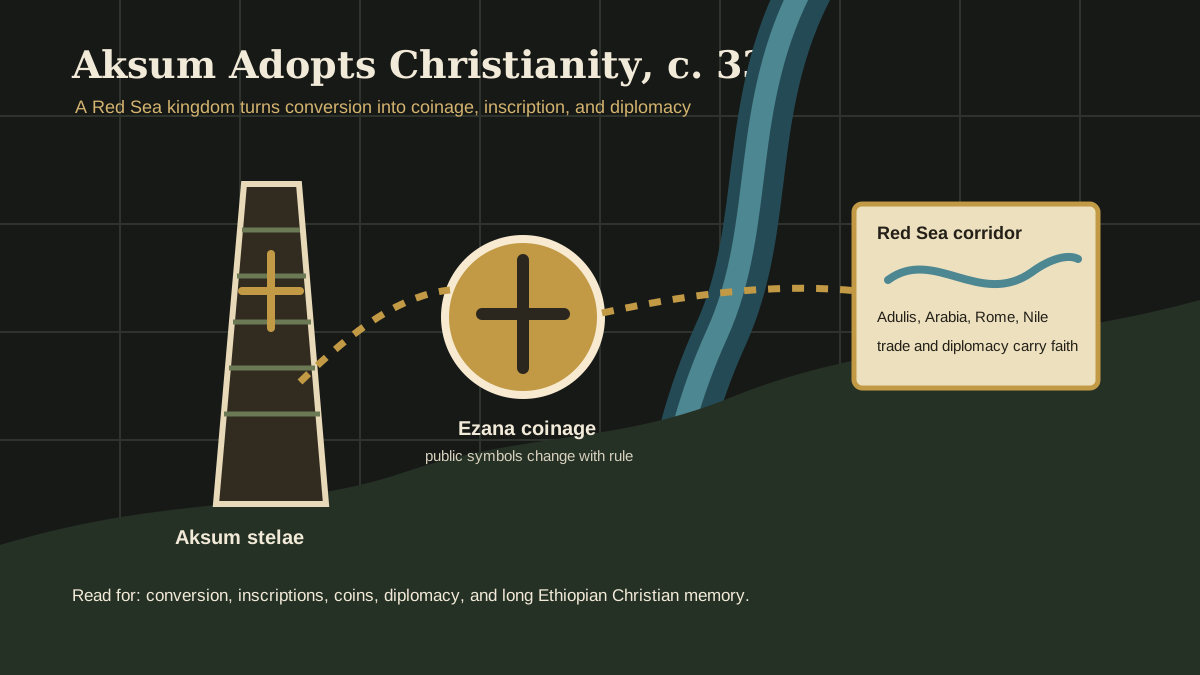
Pressure to align with wider religious networks sat alongside more immediate concerns—controlling trade, calming or commanding military forces, and asserting royal presence in towns, ports, and frontier zones. No single cause explains the kingdom's turn; instead, conversion must be understood as a choice made where commercial ties, inscriptional practices, and political calculation met the persuasive power of a religion that was itself on the move. Aksum's adoption of Christianity under King Ezana belongs to the Red Sea world. The kingdom connected the Horn of Africa to Arabia, the Nile, the Mediterranean, and Indian Ocean routes through trade, coinage, inscriptions, and diplomacy.
Christianity arrived through human networks, including merchants, captives, clergy, and royal contacts, rather than as an abstract idea floating into an isolated kingdom. Ezana's inscriptions show a ruler using religious language to frame victory, legitimacy, and international connection. Aksum's conversion is best read through royal evidence and gradual social change together. Ezana's inscriptions and coins show a changing public language of rule, while traditions about Frumentius connect the kingdom to wider Christian networks around the Red Sea and Mediterranean. Royal adoption did not mean every community changed at once, and later Ethiopian and Eritrean Christian memory gave the moment meanings that continued to evolve.
Aksum sat near Red Sea routes that linked northeast Africa, Arabia, Egypt, the Mediterranean, and the Indian Ocean. That geography made religion a matter of diplomacy as well as belief: merchants, envoys, captives, clergy, inscriptions, and coinage moved through the same world as ivory, gold, and prestige goods. King Ezana's reign matters because royal statements began to use Christian language while Aksum remained an African imperial power with its own inscriptions, monuments, language traditions, and regional ambitions. Reading the event through Frumentius and Ezana keeps the page anchored in evidence rather than treating conversion as a vague cultural drift.
The Turning Point
The decisive moment around c. 330 CE is best understood as a set of interlocking choices by a king and his advisers rather than a solitary act of private faith. King Ezana’s adoption of Christianity made the faith legible in royal registers: it was named alongside titles, displayed in public texts, and linked to the symbols that declared sovereign authority. By placing Christianity within the court’s visible vocabulary, the king signalled to merchants who trafficked across the Red Sea, to soldiers who acted on his orders, and to neighboring courts that Aksum spoke a language shared with other Christian polities. The change reshaped ceremonial life—how rulers addressed subjects, how victories and pacts were commemorated, and how written proclamations carried meaning.
It also rerouted diplomatic and religious contact: conversion created durable connections with Christian communities beyond Aksum’s borders and made the kingdom a node in a broader ecclesiastical map. This was not a quiet, private conversion; it was a public redefinition of kingship that used material culture and trade networks to make a new identity stick. The turning point was the alignment of royal authority with Christianity. Conversion at the top did not instantly make every subject Christian, but it changed the language of kingship and the kingdom's diplomatic position. Aksum could now participate in wider Christian networks while maintaining its own African and Red Sea context. The event also shows that early Christianity was not only Mediterranean or European.
It had deep roots in northeast Africa. The turning point was the adoption of Christianity as a royal identity. Once the king's public language changed, Christianity could become tied to legitimacy, diplomacy, coinage, and memory, even though local practice and social conversion developed unevenly.
Consequences
In the near term, Christianity became woven into the symbols and practices of Aksumite rule. It altered the optics of power: inscriptions, coinage, and royal proclamations could now communicate a Christian identity to diverse audiences, from merchants and sailors to regional rivals. Over the longer arc of history, that incorporation shaped how the kingdom—and later polities in the region—remembered themselves. Christianity entered the archive of royal identity and was carried forward into communal memory, influencing liturgy, language, and claims about the past. The adoption also underlines a broader lesson about late antique Christianity: it was not confined to imperial Constantinople or Rome but travelled through African courts, trade routes, and inscriptional practices.
Finally, the event’s afterlife shows how historical memory is contested. A military chronicler might emphasize divine favor in battle; a merchant could see the conversion as a commercial convenience; a later national narrative might claim it as foundational. Those divergent memories shape modern readings of the same moment, reminding us that history is as much about how events are told as what actually happened. Aksum's Christian identity shaped Ethiopian and Eritrean religious history for centuries. It influenced inscriptions, coinage, church traditions, diplomacy, and later memory of sacred kingship. The event also challenges narrow maps of late antique Christianity.
Aksum was not a peripheral copy of Rome or Byzantium; it was a powerful kingdom that adopted and adapted Christianity through its own political and commercial world. The consequences reached far beyond 330. Aksumite Christianity helped shape later Ethiopian and Eritrean Christian memory, linked the Horn of Africa to older Christian worlds, and reminds readers that late antique Christianity was African, Red Sea, and Indian Ocean history as well as Mediterranean history.
Interpretation Notes
Aksum's conversion is visible through royal inscriptions, coins, Red Sea diplomacy, and traditions about Frumentius, but royal adoption did not mean instant social conversion. Later Ethiopian and Eritrean Christian memory also shaped how the event was remembered.
Why Keep Reading
Follow Aksum into Red Sea trade, Constantine, the Council of Nicaea, Ethiopian Christianity, and Indian Ocean exchange. The route shows conversion as royal policy, diplomatic language, material evidence, and long memory rather than as a single instant when an entire society changed at once. Read this page beside Constantine's Constantinople and the Council of Nicaea to compare imperial Christianity in different regions. Then move forward to later Islamic and Red Sea routes to see how Aksum's world stayed connected to wider Afro-Eurasian change.
Reading Path
Follow the story without losing the thread
Before This
- Constantinople FoundedMay 11, 330 CE
- Council of Nicaea325 CE
- Edict of Milan313 CE
After This
- Teotihuacan Reaches Its Urban Peakc. 450 CE
- Plague of Justinian541 CE
- Beginning of Muhammad's Revelationsc. 610 CE
Same Period
- Constantinople FoundedMay 11, 330 CE
- Council of Nicaea325 CE
- Beginning of Muhammad's Revelationsc. 610 CE
Wider Timeline
Mind Map
How to think about Aksum Adopts Christianity, c. 330: Ezana and the Red Sea Context
Trade connections
Red Sea commerce linked Aksum to Christian communities and ideas beyond its borders, creating openings for religious exchange.
Map Layer
Where this event sits geographically
Gold pins mark the approximate locations of published event pages. This is a schematic locator map, not a historical border map.
Coordinates are approximate and are used to help readers orient themselves before opening a full event page.
References
Where to Check the Facts
- Encyclopaedia Britannica: AksumReference for Aksumite chronology, geography, trade, and the adoption of Christianity.
- Official UNESCO World Heritage Centre: AksumInstitutional reference for Aksum's archaeological and cultural significance.
- Encyclopaedia Britannica: Saint FrumentiusReference for Frumentius, Aksum, and the traditional account of Christianity reaching King Ezana's court.
- Encyclopaedia Britannica: EzanaReference for King Ezana, royal inscriptions, Aksumite expansion, and the ruler's Christian association.