At a Glance
The shape of the event
- Date
- c. 650 CE
- Place
- Palembang
- Type
- Maritime Empire
Srivijaya rose around Sumatran waterways and sea lanes, using control of maritime routes, diplomacy, and Buddhist networks to shape regional power.
c. 650 CE; place the event in Palembang before comparing causes or consequences.
Srivijaya makes maritime Southeast Asia central to medieval world history, where ports, ships, monks, merchants, and straits mattered as much as land armies.
Srivijayan rulers / maritime merchants are the first names or groups to compare before widening the story.
The polity became a major force in trade through the Strait of Malacca and in connections between Southeast Asia, India, and China.
The polity became a major force in trade through the Strait of Malacca and in connections between Southeast Asia, India, and China.
Srivijaya makes maritime Southeast Asia central to medieval world history, where ports, ships, monks, merchants, and straits mattered as much as land armies.
Read next through the Chola raid, the rise of Malacca, and Indian Ocean trade pages to see what happens when maritime power is challenged.
Background
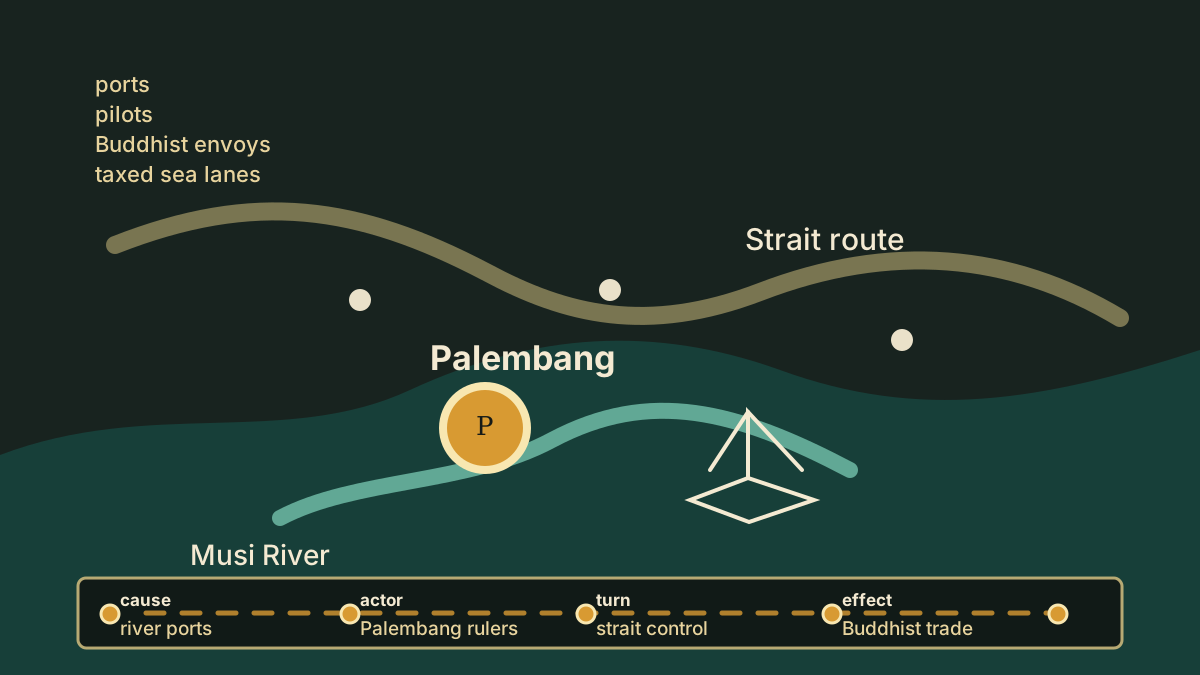
Seventh-century Sumatra sat near the hinge between the Indian Ocean and the South China Sea. Ships moving between South Asia, the Malay world, and China often needed local knowledge, seasonal waiting places, supplies, interpreters, and political protection. Palembang's position near the Musi River gave local rulers access to inland products and to maritime routes, while inscriptions and later Chinese accounts suggest that authority was built through oath-taking, tribute, diplomacy, and control over movement. Buddhism was not a decorative layer on top of trade. Monks, pilgrims, and scholarly centers helped turn ports into trusted meeting places, and religious patronage helped rulers speak a language of legitimacy understood across long-distance networks.
The rise of Srivijaya was therefore not simply a story of a port becoming rich. It was a story of logistics becoming government. A deeper reading also has to treat the archive with care. Srivijaya is known through inscriptions, archaeology, Chinese diplomatic records, later literary memory, and comparison with other port polities. None of those sources gives a clean modern map. The Kedukan Bukit and Talang Tuwo inscriptions, for example, point toward royal ambition, ritual language, and organized movement, but they do not provide a simple list of provinces. Chinese accounts can show diplomatic presence without proving direct control over every port named by later historians.
Archaeology reveals trade and settlement patterns, but it must be connected cautiously to political claims. That makes Srivijaya a useful case for readers learning how historians reconstruct maritime power from partial evidence rather than from a single royal chronicle.
The Turning Point
The turning point was the consolidation of Palembang-centered authority into a wider maritime system. Srivijayan rulers appear to have converted strategic geography into repeated practice: regulating river mouths, rewarding loyal chiefs, attracting merchants, and presenting themselves to Chinese courts as legitimate rulers in a world of diplomatic exchange. That mattered because maritime power is fragile when every ship can choose another harbor. Srivijaya's achievement was to make its route feel useful, predictable, and politically protected. Its influence also depended on balancing coercion and service. Fleets and local allies could threaten rivals, but merchants also needed storage, water, repair, credit, and a degree of trust. The state grew where those practical needs met ritual authority and diplomatic recognition.
The practical mechanics of Srivijayan power are worth slowing down over. A ruler who could coordinate pilots, river chiefs, warehouse managers, and religious patrons could make a route safer and more predictable than a rival harbor. That predictability was a political asset. Merchants did not need an empire that occupied every shoreline; they needed reliable storage, reduced piracy, recognized tolls, and diplomatic channels if disputes arose. Srivijaya's rise can be read as a solution to those problems. It created enough order across strategic points to make long-distance trade choose its waters repeatedly, while also using ritual and diplomatic language to make that order appear legitimate beyond the immediate harbor.
Consequences
In the near term, Srivijaya helped make the Strait of Malacca one of the decisive corridors of the medieval world. Palembang and linked ports benefited from tolls, gifts, market activity, and the movement of high-value goods such as aromatics, forest products, textiles, ceramics, and metals. In the longer term, the empire placed maritime Southeast Asia at the center of world history rather than at its edge. It shaped Buddhist travel between India and China, influenced later port-polity models, and created patterns that later powers, including Chola raiders and Malay successors, had to confront. The limits are just as important: Srivijaya was not a modern territorial state with crisp borders.
It was a layered network of ports, loyalties, river basins, and sea routes, which makes the evidence harder to read but also more interesting. Srivijaya's afterlife also helps explain why later conflict focused on the same maritime choke points. The Chola raid of 1025 did not matter because it randomly struck a distant port. It mattered because a South Indian power understood that Srivijaya sat across routes linking South Asia, Southeast Asia, and China. Later Malay and Javanese polities inherited a world in which the straits were not background geography but a political prize.
The page should therefore be read not as an isolated origin story but as the first layer in a long sequence: river ports become route managers, route managers become diplomatic actors, and diplomatic actors become targets for rivals who want the same flow of goods and prestige.
Interpretation Notes
Srivijaya Maritime Empire Rises can look simple when reduced to one date, but the evidence usually points to a wider setting. The useful debate is which part mattered most: leadership, logistics, belief, social pressure, or the institutions that survived afterward.
Why Keep Reading
Read next through the Chola raid, the rise of Malacca, and Indian Ocean trade pages to see what happens when maritime power is challenged. Srivijaya teaches the site-wide pattern: ports can become states when geography, protection, ritual authority, and commercial trust reinforce one another. It also prepares readers to compare Southeast Asian sea power with overland empires, where roads, fields, and forts often mattered more than monsoon timing and harbor diplomacy. A strong reading path is Srivijaya rise, Chola raid, Malacca, Indian Ocean world, and maritime Southeast Asia timeline. Together those pages show that sea power is made from services as much as from war: pilots, law, markets, faith, diplomacy, and the ability to make strangers trust a harbor.
Reading Path
Follow the story without losing the thread
Before This
After This
Same Period
Wider Timeline
Mind Map
How to think about Srivijaya Maritime Empire Rises
Strait geography
The Malacca and Sunda routes gave Palembang leverage over ships moving between the Indian Ocean and China seas.
Map Layer
Where this event sits geographically
Gold pins mark the approximate locations of published event pages. This is a schematic locator map, not a historical border map.
Coordinates are approximate and are used to help readers orient themselves before opening a full event page.
References
Where to Check the Facts
- Encyclopaedia Britannica: Srivijaya empireReference for Srivijaya's chronology, geography, maritime power, and trade context.
- World History Encyclopedia: Srivijaya EmpireSupporting reference for Srivijaya's Buddhist, commercial, and regional influence.