Central Question
What changes when Indian Ocean history is read through Asian, African, and Islamic port networks instead of starting with European exploration?
Start With These Dates
- c. 100 CEFunan Maritime Network Rises
Funan emerged around lower Mekong trade routes, linking mainland Southeast Asia to wider Indian Ocean commerce, ports, ritual power, and political consolidation.
- c. 650 CESrivijaya Maritime Empire Rises
Srivijaya rose around Sumatran waterways and sea lanes, using control of maritime routes, diplomacy, and Buddhist networks to shape regional power.
- 1025 CEChola Raid on Srivijaya
The Chola dynasty launched naval attacks against Srivijaya, exposing how South Asian and Southeast Asian powers competed over Indian Ocean and Strait of Malacca routes.
- 1324-1325 CEMansa Musa's Hajj
Mansa Musa's pilgrimage to Mecca displayed Mali's wealth, Islamic connections, and diplomatic visibility across North Africa and the wider Muslim world.
- 1325 CEIbn Battuta Begins His Travels
Ibn Battuta left Tangier on a journey that eventually crossed North Africa, the Middle East, East Africa, South Asia, Central Asia, and parts of Southeast Asia and China.
- 1498 CEVasco da Gama Reaches India
Vasco da Gama reached India by sea from Europe, opening a Portuguese route into established Indian Ocean trade networks.
- November 17, 1869Opening of the Suez Canal
The Suez Canal opened a direct water route between the Mediterranean and Red Sea, shortening sea travel between Europe and Asia.
Sources Used Here
- The Metropolitan Museum of Art: Trade and Travel in the Islamic World
Reference for routes, travel, trade goods, and cross-regional exchange across Islamic and Indian Ocean worlds.
- UNESCO: Silk Roads Programme
Reference for cross-regional exchange, routes, cultural contact, and movement between Eurasian and oceanic systems.
- The British Museum: Albukhary Foundation Gallery of the Islamic world
Museum reference for Indian Ocean and Islamic-world material culture.
Indian Ocean World is designed as a route, not a folder. It gathers events that answer related reader questions about power, belief, conflict, exchange, institutions, and memory. The strongest way to read the page is to move from the earliest events toward the later ones, watching how one kind of pressure changes form across different places.
The route currently runs from c. 100 CE to November 17, 1869. That span lets readers compare immediate turning points with slower consequences: the founding of institutions, the spread of ideas, the shock of war or disease, and the way later societies reused earlier events as warnings, models, or symbols.
Start with Funan Maritime Network Rises, Srivijaya Maritime Empire Rises, Chola Raid on Srivijaya, Mansa Musa's Hajj, Ibn Battuta Begins His Travels and then follow the internal links into people, timelines, years, maps, and source lists. The route structure stays visible when each event explains why it belongs with the others and where the next useful page is.
Compare the events by scale. Some are concentrated moments, such as a battle, proclamation, trial, or publication. Others are long processes, such as a reform movement, pandemic, trade route, or diplomatic order. Reading both types together helps prevent the page from becoming a list of dates.
A useful route keeps uncertainty visible. Historical change rarely has one cause or one clean ending, so the reader can separate background pressure, immediate trigger, turning point, result, and later memory. That pattern is what makes the atlas expandable without making the reader start over each time.
This route is also a comparison tool. After reading one event, compare it with a later event on the same page and ask what changed in scale, language, geography, technology, authority, or public memory. The comparison is often more useful than the individual summary because it reveals the pattern the topic page is built to expose. When a claim feels too neat, open the full event page and check whether the evidence supports one cause, several causes, or a contested interpretation before moving on.
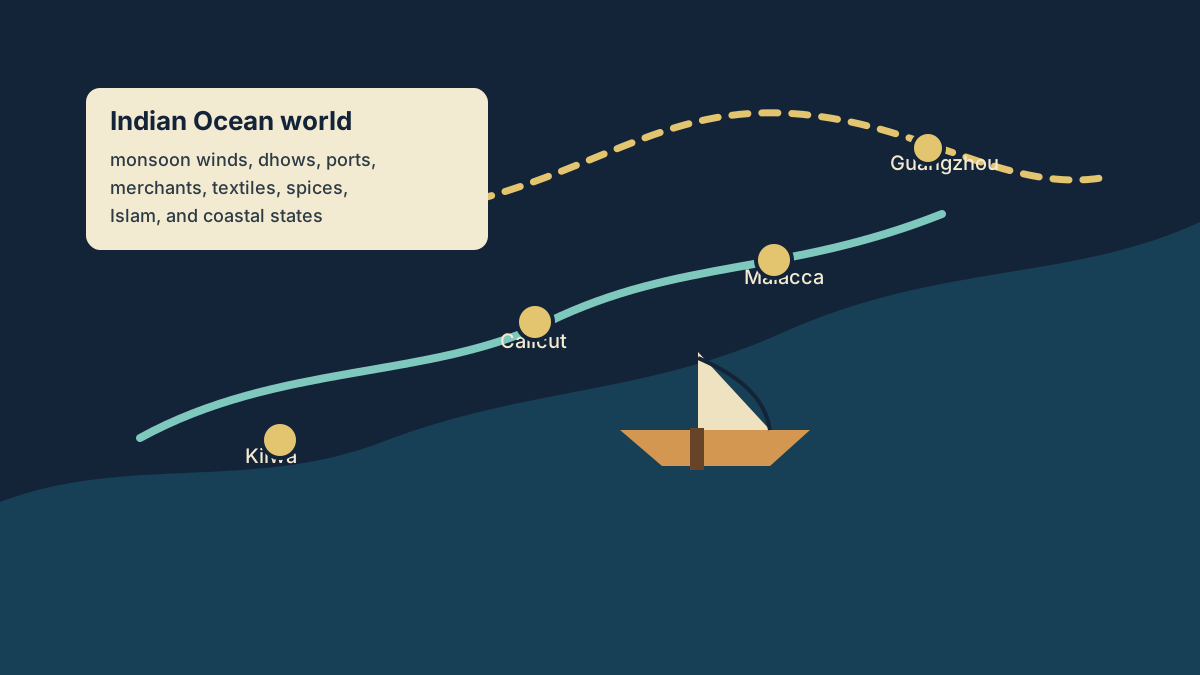
The Indian Ocean World hub exists to correct a common distortion: oceanic history does not begin when Europeans sail into it. By the time Vasco da Gama reached India, monsoon routes, port cities, Muslim merchant networks, Hindu and Buddhist connections, Malay sultanates, Tamil shipping, Swahili towns, Chinese fleets, pilgrims, scholars, textiles, horses, ceramics, spices, and gold had already made the ocean a dense historical system.
The route's earliest anchors show that Southeast Asia and South Asia were not passive crossroads. Funan and Srivijaya used river mouths, ports, Buddhist patronage, tribute, and sea-lane access to organize power. The Chola raid on Srivijaya then makes maritime competition visible from a South Asian angle. It proves that fleets, temples, merchants, and coastal polities mattered before the usual European age-of-exploration frame.
Travel gives the page a human scale. Ibn Battuta's journey connects North Africa, the Middle East, East Africa, South Asia, and beyond through law, pilgrimage, hospitality, courts, ports, and narrative memory. Zheng He's voyages add a state-sponsored Ming layer: fleets and diplomacy entered an existing oceanic world rather than creating it. Mansa Musa's hajj belongs here too because pilgrimage, gold, Cairo, Mecca, and transregional reputation connected West Africa to oceanic and Islamic routes.
The European entry is important, but it is placed late in the route. Vasco da Gama, the Dutch East India Company, and Suez change the balance of power, but they do not erase the older Asian and African system. The point is not to minimize European empire. It is to make empire more intelligible by showing the ports, routes, commodities, and political opportunities that European powers entered and then violently reorganized.
A reader leaves the hub with a map in mind: East African ports, the Red Sea, the Persian Gulf, Gujarat, the Malabar Coast, Sri Lanka, Bengal, the Bay of Bengal, the Strait of Malacca, Java, Sumatra, South China Sea routes, and Ming diplomacy. The page becomes compelling when geography does explanatory work. Monsoons, straits, harbors, currents, and seasonal sailing calendars are not background; they shape historical possibility.
Monsoon timing gives the route its rhythm. Ships did not simply sail whenever rulers wished. Merchants, pilots, pilgrims, envoys, sailors, and port officials organized movement around seasonal winds, waiting periods, repair cycles, and market calendars. That rhythm created long stays in port, mixed households, legal pluralism, language exchange, and communities that were local and oceanic at the same time.
Ports were social institutions as much as economic sites. Aden, Hormuz, Calicut, Cambay, Kilwa, Malacca, Aceh, Colombo, and other ports depended on brokers, translators, tax collectors, shipwrights, religious judges, warehouse keepers, money changers, and migrant families. A port could welcome foreign merchants while still controlling customs, marriage, credit, dispute settlement, and political loyalty. This makes the ocean a world of negotiated trust.
Religious movement gives the Indian Ocean route a deep human layer. Islam, Buddhism, Hindu traditions, Christianity, and local ritual systems traveled through merchants, monks, Sufi teachers, pilgrims, sailors, and families. Conversion and religious patronage often moved through commerce and kinship rather than conquest alone. Mosques, temples, shrines, inscriptions, and travel accounts reveal how belief became part of port life.
Commodities help readers see scale without losing people. Pepper, cloves, nutmeg, textiles, horses, porcelain, dates, rice, gold, ivory, enslaved people, books, and medicines all moved through overlapping routes. Each item had its own labor system and political meaning. Horses connected Central Asian and Arabian suppliers to South Asian warfare; textiles linked Indian producers to African and Southeast Asian consumers; porcelain and spices linked household taste to imperial competition.
East Africa belongs near the center of the route. Swahili ports, inland gold and ivory routes, Islamic learning, stone towns, and family networks tied the coast to Arabia, Persia, India, and beyond. Reading Kilwa or Mombasa only as coastal outposts misses their role as brokers between inland societies and oceanic demand. The Indian Ocean hub therefore links directly to East African and Swahili Coast pages.
The Chola and Zheng He episodes show that Asian states could project maritime power in different ways. Chola raids connected temple wealth, South Indian politics, and Southeast Asian routes. Zheng He's fleets displayed Ming diplomacy, gifts, naval organization, and imperial ceremony. Neither example is identical to European company empire. Comparing them helps readers avoid treating all maritime power as the same kind of colonialism.
Vasco da Gama's arrival is best read as disruption inside an existing world. Portuguese violence, cartaz passes, cannon-armed ships, fortresses, and attempts to control chokepoints changed the politics of movement, but Portuguese power had to deal with older pilots, ports, rulers, and merchants. European empire depended on knowledge and routes that it did not create, even when it tried to dominate them.
The Dutch East India Company adds a corporate layer. Shares, forts, monopolies, contracts, violence, warehouses, and record-keeping turned some oceanic routes into company systems. Yet company power still depended on local rulers, Asian merchants, laborers, sailors, and ecological realities. The Indian Ocean did not become European simply because a company wrote contracts. It became a contested field of force, negotiation, and adaptation.
Suez gives the hub a modern hinge. The canal shortened routes between Europe and Asia, changed imperial logistics, and made Egypt and the Red Sea more strategically central. Steamships, coaling stations, telegraph lines, and insurance markets reorganized time. The canal did not replace older routes immediately, but it made global movement faster, more militarized, and more dependent on infrastructure chokepoints.
The source trail is exceptionally diverse. Ship logs, port records, ceramics, coins, inscriptions, mosque and temple remains, travel narratives, customs registers, company archives, maps, oral memory, and archaeology all matter. Some sources privilege merchants and rulers; others preserve objects without names. The route teaches readers to combine evidence carefully: a shard of porcelain, a traveler's description, and a customs account answer different questions.
Visual material makes the Indian Ocean intelligible. A monsoon map explains timing; a port map explains brokerage; a dhow or junk image explains maritime technology; a ceramic find explains exchange; a fort image explains coercion; a Suez image explains modern infrastructure. Good visuals show that the ocean was not empty water, but a built and remembered network of routes.
The final reading path moves from older Asian and African networks to travelers, state fleets, European entry, company power, and modern infrastructure. That sequence lets readers answer common searches about Indian Ocean trade, Zheng He, Vasco da Gama, Srivijaya, Malacca, Swahili ports, and Suez without splitting them into disconnected pages. The hub's central claim is that the ocean itself was a historical center.
Family and diaspora give the route a lived scale. Merchants did not only arrive, sell, and vanish. Many married locally, learned languages, funded religious institutions, raised children, and created communities that bridged regions. Hadhrami, Gujarati, Malay, Tamil, Swahili, Persian, Armenian, Chinese, and other networks show that oceanic exchange was social reproduction as much as trade.
Labor belongs beside commerce. Sailors, navigators, pearl divers, shipwrights, dockworkers, porters, warehouse workers, enslaved people, clerks, cooks, and caravan laborers made exchange possible. A port's prosperity depended on bodies carrying, repairing, counting, translating, cooking, guarding, and waiting. The route becomes more honest when the glamour of spices and voyages sits beside the labor that moved them.
Law and trust were infrastructure. Merchants needed contracts, witnesses, credit, weights, measures, dispute settlement, religious courts, rulers who protected strangers, and brokers who could cross language boundaries. Port cities often worked because multiple legal and moral systems overlapped in practical ways. This explains why exchange could persist across political borders and why trust was as important as wind.
Violence and coercion also belong inside the oceanic story. Piracy, naval raids, slave trading, company monopolies, forced labor, convoy systems, fortresses, and customs enforcement shaped who could move safely. The Indian Ocean was not a peaceful alternative to Atlantic violence. It had its own systems of protection, exploitation, and armed control.
Environmental knowledge kept the system alive. Reefs, storms, currents, freshwater points, ship timber, disease environments, pearl banks, spice ecologies, and coastal food supplies shaped what ports could support. A monsoon map tells only part of the story. Sailors and coastal communities also needed intimate knowledge of hazards, repair, provisioning, and seasonal risk.
The closing synthesis is that the Indian Ocean was made by repeated acts of timing, trust, labor, and coercion. Monsoons opened possibilities, but people built the institutions that made those possibilities durable. That is why the route can connect medieval ports, Islamic networks, Asian fleets, European companies, and Suez without treating any one moment as the ocean's beginning.
The route also helps readers compare voluntary and forced movement. Merchants, pilgrims, scholars, envoys, and sailors often moved for opportunity, duty, or devotion. Enslaved people, coerced laborers, refugees, and debt-bound workers moved under very different conditions. The same port could mean profit for one person and captivity for another. That contrast keeps oceanic history from becoming a romantic trade story.
A final comparison links the Indian Ocean to other atlas routes. The Swahili Coast explains African urban and inland connections. Maritime Southeast Asia explains straits and sultanates. Abbasid and MENA routes explain Islamic scholarly and commercial networks. Industry and colonialism explain Suez and company power. The Indian Ocean hub acts as the shared waterway between those routes.
The route's final search answer is that Indian Ocean trade was never only commerce. It was seasonal knowledge, legal trust, religious movement, family formation, labor, violence, material culture, and imperial competition. Readers who keep those layers together can understand why the ocean shaped Afro-Eurasian history long before and long after European arrival.
Read the events in order first; the page is built to reveal change over time.
Ask which pressures existed before the visible turning point and which actors had room to choose.
Follow what changed afterward in institutions, borders, law, belief, or everyday life.
Notice which events became symbols and why later generations kept returning to them.
Ask how seasonal winds, port waiting times, and sailing calendars shaped trade, migration, diplomacy, and religious movement.
Follow ports as mixed spaces where merchants, rulers, translators, sailors, scholars, families, and tax officials made exchange durable.
Use Srivijaya, Chola power, Malacca, and Zheng He to keep Asian states and port-polities at the center of the oceanic story.
Read Vasco da Gama and Suez as transformations of an older system, not as the beginning of oceanic history.
Follow pilgrims, Sufi teachers, monks, merchants, shrines, mosques, temples, and families as carriers of religious life.
Use spices, textiles, horses, porcelain, gold, ivory, books, and enslaved people to connect labor, taste, war, and empire.
Choose a Reading Path
Start With the Timeline
Use the related timeline first when you want a chronological route through the topic.
Start with c. 100 CE: Funan Maritime Network RisesOpen a Person Page
Use people pages when the topic is easier to understand through leadership, resistance, reform, or memory.
Start with c. 650 CE: Srivijaya Maritime Empire RisesUse Year Pages
Use year pages when you need a fast answer to what changed in a specific year.
Start with 1025 CE: Chola Raid on SrivijayaReturn to the Map
Use the map to keep geography visible while moving between events and regions.
Start with 1324-1325 CE: Mansa Musa's HajjStart With Ports
Read Funan, Srivijaya, Malacca, and Cairo to see how city and port systems organize long-distance exchange.
Start with 1325 CE: Ibn Battuta Begins His TravelsStart With Travelers
Use Ibn Battuta and Zheng He when the ocean is easier to understand through routes, ships, envoys, and narrative.
Start with 1498 CE: Vasco da Gama Reaches IndiaStart With Empire
Move from Chola and Ming power to Vasco da Gama, company rule, and Suez to compare different forms of maritime power.
Start with November 17, 1869: Opening of the Suez CanalStart With Evidence
Use ceramics, coins, inscriptions, ship logs, port records, and travel writing to see how oceanic history survives in different source types.
How the Story Builds
Begin with Funan Maritime Network Rises. The opening event usually shows the pressure that made the route necessary: a crisis of authority, an expanding exchange system, a new technology, a contested idea, or a conflict that older institutions could no longer contain.
Ibn Battuta Begins His Travels works as a checkpoint because it lets readers ask what had become irreversible, which actors still had choices, and how the route changed scale between the opening event and the later consequences.
The later edge of the route includes Zheng He's First Indian Ocean Voyage, Vasco da Gama Reaches India, and Opening of the Suez Canal. These pages help readers see what survived beyond the first shock: institutions, borders, laws, memories, technologies, movements, or arguments that kept shaping later history.
The route is easier to remember through people and places. Watch figures such as Funan rulers and merchants, Srivijayan rulers, maritime merchants, Rajendra Chola I, and Mansa Musa move through settings such as Mekong Delta, Palembang, Palembang and the Strait of Malacca, Mali to Mecca, and Tangier; that is where large structures become visible as choices, risks, costs, and memories.
Funan and Srivijaya show maritime exchange before European empire and before modern national borders.
Chola, Mansa Musa, and Ibn Battuta show that ships, pilgrimage, law, prestige, and political rivalry traveled through overlapping routes.
Zheng He's voyages make Ming diplomacy visible inside a long-established Indian Ocean world.
Vasco da Gama, company rule, and Suez show later attempts to redirect and control older maritime systems.
Steamships, canals, coaling stations, telegraphs, and insurance made oceanic routes faster, more strategic, and more vulnerable.
- Which event in Indian Ocean World feels like the true point of no return, and why might another reader choose a different event?
- What changes if the route is read from the perspective of ordinary people rather than rulers, armies, inventors, reformers, or institutions?
- Which consequence was immediate, and which consequence only became clear decades later?
- Where does the map change the interpretation by showing distance, borders, routes, ports, capitals, or frontiers?
- What changes when the Indian Ocean is treated as a historical center rather than a route between other centers?
- How did monsoon geography shape political power differently from land empire?
- Which communities made exchange work beyond rulers and merchants?
- Where did European empire depend on older Asian and African networks it did not create?
- How did religion, family, and port law make long-distance trade socially durable?
- Which evidence best shows movement: maps, objects, texts, architecture, or oral memory?
Interactive Timeline
Follow Indian Ocean World by sequence
Funan Maritime Network Rises
Funan emerged around lower Mekong trade paths, linking mainland Southeast Asia to wider Indian Ocean commerce, ports, ritual power, and political consolidation.
Read the full event pageMap Layer
Indian Ocean World geography
Gold pins mark the approximate locations of published event pages. This is a schematic locator map, not a historical border map.
Coordinates are approximate and are used to help readers orient themselves before opening a full event page.
Route Events
Events in This Topic
Funan Maritime Network Rises
Funan emerged around lower Mekong trade paths, linking mainland Southeast Asia to wider Indian Ocean commerce, ports, ritual power, and political consolidation.
Srivijaya Maritime Empire Rises
Srivijaya rose around Sumatran waterways and sea lanes, using control of maritime paths, diplomacy, and Buddhist networks to shape regional power.
Chola Raid on Srivijaya
The Chola dynasty launched naval attacks against Srivijaya, exposing how South Asian and Southeast Asian powers competed over Indian Ocean and Strait of Malacca paths.
Mansa Musa's Hajj
Mansa Musa's pilgrimage to Mecca displayed Mali's wealth, Islamic connections, and diplomatic visibility across North Africa and the wider Muslim world.
Ibn Battuta Begins His Travels
Ibn Battuta left Tangier on a journey that eventually crossed North Africa, the Middle East, East Africa, South Asia, Central Asia, and parts of Southeast Asia and China.
Malacca Sultanate Rises
The Malacca Sultanate rose at a strategic strait, turning commerce, Islam, diplomacy, and Malay political culture into a major port-polity.
Zheng He's First Indian Ocean Voyage
Zheng He began the first of the Ming treasure voyages, sending large Chinese fleets through Southeast Asia and across the Indian Ocean.
Vasco da Gama Reaches India
Vasco da Gama reached India by sea from Europe, opening a Portuguese path into established Indian Ocean trade networks.
Opening of the Suez Canal
The Suez Canal opened a direct water path between the Mediterranean and Red Sea, shortening sea travel between Europe and Asia.
References
Where to Check the Facts
- The Metropolitan Museum of Art: Trade and Travel in the Islamic WorldReference for paths, travel, trade goods, and cross-regional exchange across Islamic and Indian Ocean worlds.
- UNESCO: Silk Roads ProgrammeReference for cross-regional exchange, paths, cultural contact, and movement between Eurasian and oceanic systems.
- The British Museum: Albukhary Foundation Gallery of the Islamic worldMuseum reference for Indian Ocean and Islamic-world material culture.