At a Glance
The shape of the event
- Date
- 1405 CE
- Place
- Nanjing and Indian Ocean ports
- Type
- Maritime expedition
Zheng He began the first of the Ming treasure voyages, sending large Chinese fleets through Southeast Asia and across the Indian Ocean.
1405 CE; place the event in Nanjing and Indian Ocean ports before comparing causes or consequences.
The event helps readers compare Asian state-sponsored maritime power with later Portuguese and Dutch entries into the same oceanic system.
Zheng He / Yongle Emperor are the first names or groups to compare before widening the story.
Zheng He's voyages linked China more visibly to Southeast Asian, South Asian, Arabian, and East African ports in the early fifteenth century.
Zheng He's voyages linked China more visibly to Southeast Asian, South Asian, Arabian, and East African ports in the early fifteenth century.
The event helps readers compare Asian state-sponsored maritime power with later Portuguese and Dutch entries into the same oceanic system.
If the 1405 voyage changed expectations at sea, the next chapters show how those expectations were put to the test.
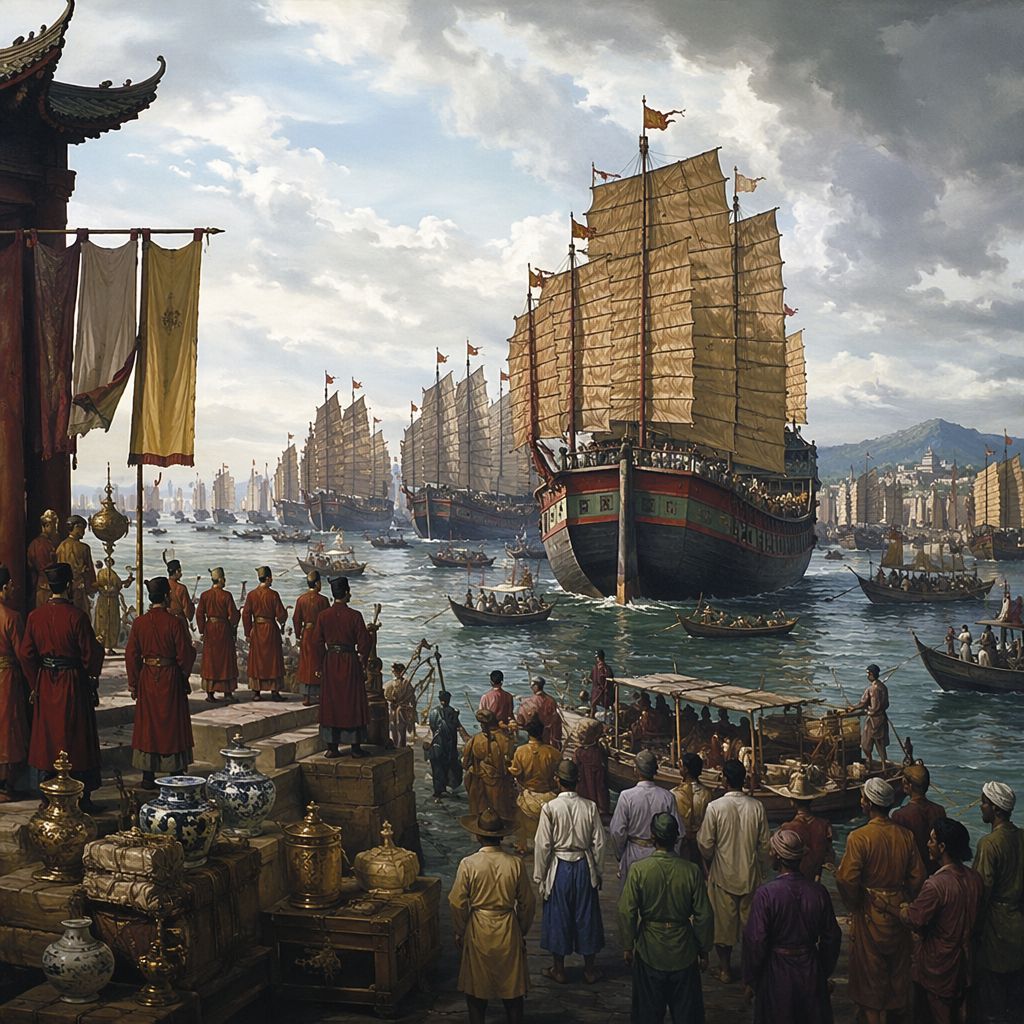
Background
The voyage did not spring from mystery but from choices inside the Ming court. By 1405 the Yongle Emperor had established Nanjing as a political center and turned attention to projecting authority beyond the shoreline. The court had access to shipbuilding capacity and to officials experienced with maritime exchange; there were active debates about how to manage commerce, diplomacy and tribute without ceding control to private interests. Zheng He, a commander elevated and trusted by the emperor, was selected to carry those policies into practice.
Sending large fleets into Southeast Asian and Indian Ocean waters reflected an explicit state strategy: make Chinese presence visible, regularize ports of contact, and assert a diplomatic order governed by court ritual as well as by commerce. That approach depended on organized resources—ships provisioned from the capital, crews supplied and directed—and on careful negotiation with rulers and merchant centers encountered en route. These are the practical pressures that framed the 1405 expedition: a court intent on managed overseas engagement, the maritime capacity to reach far shores, and a leader charged to translate policy into extended voyages. Zheng He's first voyage was a projection of Ming authority across the Indian Ocean, not ordinary trade alone.
The Yongle emperor used treasure fleets, envoys, gifts, military display, and ritual diplomacy to place maritime polities inside a Ming-centered order. The voyage also belongs to older Indian Ocean worlds. Southeast Asian ports, South Asian merchants, Muslim networks, monsoon routes, and local rulers already connected the sea; Zheng He's fleet entered that world with unusual scale and imperial backing.
The Turning Point
The first voyage changed scale and practice. Where earlier contacts had been intermittent, Yongle’s court opted for a sustained, state-managed expedition under Zheng He’s command. Zheng He and his officers navigated island archipelagos, stopped at established ports in Southeast Asia, and crossed the Indian Ocean to South Asian, Arabian and East African harbors. Each stop required concrete choices—whether to press tributary rituals, negotiate commercial terms, or accept local arrangements—and those decisions shaped how the fleet was received. The fleet’s official status, visible size and imperial marks functioned as instruments of diplomacy: commanders balanced displays of power with protocol, using ceremony and logistics to underpin trading ties rather than to seize territory.
Back in Nanjing officials monitored provisioning and recorded returns, which informed later orders. The turning point therefore was not a single battle or treaty but a procedural shift: the Ming state transformed sporadic maritime exchange into an organized pattern of imperial presence at sea, changing expectations in ports that now faced recurring, sanctioned contact with China. The turning point was the launch of a state-sponsored maritime mission that made Chinese imperial diplomacy physically visible from Southeast Asia to the Indian Ocean. Ships became moving embassies.
Consequences
In the short term the 1405 expedition made Chinese maritime presence unmistakable along the Asian littoral and across the Indian Ocean. Ports from Southeast Asia to Arabia and East Africa received imperial ships, and that visibility altered how local rulers and merchants calculated trade and diplomacy with the Ming court. Regularized contacts meant the court could anticipate information, tribute and commercial exchange on a different scale than earlier ad hoc encounters. Over the longer term, Zheng He’s voyages reshaped the map of Eurasian oceanic interaction by demonstrating a large Asian state’s capacity to organize seaborne projection before the arrival of Portuguese and Dutch navies.
That comparison is critical: it encourages readers to weigh alternative models of maritime power—state-directed ceremonial diplomacy and trade versus later European models centered on fortified trading posts and colonial settlements. The voyages have prompted contested interpretations—some have framed them as missed opportunities for colonization, while others see them as deliberate instruments of diplomacy, commerce and prestige. The evidence from 1405 asks a subtler question: what objectives did the Ming court prioritize, and how did those priorities shape the character of overseas engagement? The afterlife includes later voyages, Ming court debate over costs and priorities, memory in China and Southeast Asia, maritime archaeology, and arguments over why such voyages stopped despite their reach.
The first voyage matters because it made a temporary policy look world-spanning.
Interpretation Notes
The voyages are sometimes treated as a missed chance for Chinese colonial expansion; the page instead asks what the Ming court was actually trying to accomplish.
Why Keep Reading
If the 1405 voyage changed expectations at sea, the next chapters show how those expectations were put to the test. Continue to follow subsequent treasure voyages, the pattern of ports visited, and the Ming court’s shifting instructions—details that reveal whether missions deepened trade, reshaped local politics, or primarily performed imperial prestige. Compare these state-led expeditions with later Portuguese and Dutch entries into the Indian Ocean to see how different polities turned naval capacity into commercial or colonial systems. Each port call and diplomatic exchange is a lens for judging what the Ming intended and what the voyages actually achieved in world maritime history.
Read this page with Ming China, Malacca, the Swahili Coast, Ibn Battuta, Portuguese Indian Ocean voyages, and trade routes to compare forms of maritime power.
Reading Path
Follow the story without losing the thread
Before This
After This
- Vasco da Gama Reaches India1498 CE
- Portuguese Capture Kilwa1505 CE
- Malacca Falls to the Portuguese1511 CE
Same Period
- Vasco da Gama Reaches India1498 CE
- Funan Maritime Network Risesc. 100 CE
- Majapahit Empire Founded1293 CE
Wider Timeline
Mind Map
How to think about Zheng He's First Indian Ocean Voyage
State strategy
Yongle court’s decision to dispatch organized, large fleets to make Chinese presence visible and manage trade and tribute.
Map Layer
Where this event sits geographically
Gold pins mark the approximate locations of published event pages. This is a schematic locator map, not a historical border map.
Coordinates are approximate and are used to help readers orient themselves before opening a full event page.
References
Where to Check the Facts
- Encyclopaedia Britannica: Zheng HeBiographical reference for Zheng He, the Yongle emperor, and the Indian Ocean voyages.
- Encyclopaedia Britannica: Zheng He TimelineTimeline reference for major stages in Zheng He's life and expeditions.