Separate deep-time evidence from written records. Fossils, tools, genetics, pottery, oral memory, maps, and naval archives answer different questions.
Timeline
First Peoples, Migrations, and Pacific Worlds Timeline
Follow human origins, migrations, farming, Southeast Asian trade, Pacific voyaging, Indigenous settlement, colonial contact, and the Pacific War as one long oceanic and deep-time route.
Timeline Guide
How did human migration, Southeast Asian trade, and Pacific voyaging make world history before and beyond continental empires?
Read this edited guide as a path through dates, places, affected lives, source limits, and contested memory rather than as an exhaustive database.
Read the opening as evidence work: a fossil fragment, a stone tool, a genetic model, a sea crossing to Sahul, a Lapita pot sherd, an oral tradition, and a canoe route do not prove the same kind of claim. The timeline separates archaeology, genetics, environmental reconstruction, and living Indigenous memory so deep history does not sound more certain than the evidence allows.
Dates and routes are debated, especially for early migrations, Sahul settlement, Lapita movement, and Polynesian voyaging. The point is not to turn uncertainty into vagueness; it is to show readers how careful history can respect scientific revision and community knowledge without blending them into one generic source.
Specific examples replace blanket labels: Sahul settlement connects to Aboriginal and Torres Strait Islander histories; Lapita pottery connects the Bismarck Archipelago to Remote Oceania; Polynesian navigation belongs with canoe traditions, star paths, genealogies, and community teaching; Maori settlement in Aotearoa belongs to named whakapapa and place memory. The National Museum of Australia and Te Ara are named because archaeology and community knowledge need visible source homes.
This timeline gives the atlas a deeper and wider spine. It begins with Homo sapiens in Africa, moves through migration and the settlement of Australia, then follows farming, Lapita expansion, Southeast Asian river and port systems, Polynesian voyaging, Maori settlement, European contact, and the Pacific War. The sequence is intentionally unusual: it refuses to begin world history only when writing, cities, or empires appear.
Start With These Dates
- c. 300,000 BCEHomo sapiens Emerges
Early Homo sapiens fossils in Africa mark a deep human-origin horizon, showing that modern humans emerged through a long African evolutionary story rather than a sudden single event.
- c. 70,000 BCEOut of Africa Migration Expands
Groups of Homo sapiens expanded beyond Africa over many generations, carrying technologies, social practices, and genetic lineages into Southwest Asia and then wider Eurasia.
- c. 65,000 BCEFirst Peoples Settle Australia
The settlement of Australia by First Peoples shows that human migration crossed sea gaps, adapted to varied environments, and created some of the world's longest continuous cultural histories.
- c. 10,000 BCENeolithic Farming Expands
Farming and settled village life expanded in parts of Southwest Asia, changing human relationships with plants, animals, labor, storage, risk, and landscape.
- c. 1400 CEMalacca Sultanate Rises
The Malacca Sultanate rose at a strategic strait, turning commerce, Islam, diplomacy, and Malay political culture into a major port-polity.
- 1987Nuclear Free New Zealand Act
New Zealand passed nuclear-free legislation that restricted nuclear-powered and nuclear-armed vessels and reshaped alliance politics.
- 1988Bougainville Conflict Begins
Conflict began in Bougainville amid disputes over mining, environmental damage, autonomy, and state authority.
- 2015Small Island States Push the Paris Agreement
Small island states, including Pacific voices, pushed climate diplomacy toward recognizing survival, sea-level rise, and the 1.5 degree goal.
Sources Used Here
- National Museum of Australia: Evidence of First Peoples
Institutional reference for archaeological evidence, community knowledge, and First Peoples' deep presence in Australia.
- Te Ara: Pacific migrations
Reference for Pacific migration routes, voyaging, Maori settlement, and Polynesian navigation context.
- Smithsonian Human Origins Program
Reference for human origins, fossil evidence, tools, and deep-time context.
The opening chapter is about evidence and movement. Homo sapiens emergence and Out of Africa migration depend on fossils, archaeology, genetics, tools, and environmental reconstruction. These events are not simple dates in the way a battle is a date. They are evidence anchors for long processes. Reading them first teaches a useful habit: deep history is powerful, but its claims need careful source awareness.
Australia changes the map. First Peoples' settlement of Sahul places Oceania inside the earliest human story and shows that sea crossings, ecological knowledge, and cultural continuity matter before agriculture or written records. This event also asks readers to connect archaeological evidence with living Indigenous histories in a respectful, careful way.
The Neolithic farming event adds a different kind of transition. Farming did not arrive everywhere at once, and it did not automatically create better lives. It changed settlement density, labor, disease exposure, storage, inequality, ritual, land claims, and later urban possibility. Placing it beside migration keeps the page from turning prehistory into either a march of progress or a list of inventions.
Lapita expansion turns the route toward the ocean. Pottery, crops, animals, canoe knowledge, kinship, and exchange moved across island chains. The event links Island Southeast Asia and Oceania, making the Pacific visible as an active field of routes. It also prepares readers for later Polynesian movement, where navigation, memory, stars, winds, islands, and reefs become historical infrastructure.
The Southeast Asian chapter shows that rivers and straits can organize history as powerfully as imperial capitals. Dong Son and Funan give the route early mainland anchors. Srivijaya, Angkor, Majapahit, and Malacca then show different answers to regional scale: bronze culture, river trade, maritime Buddhism, hydraulic kingship, Javanese court power, Malay port Islam, and strait diplomacy.
The Pacific chapter widens the oceanic argument. Eastern Polynesia and Maori settlement show voyaging as expertise, not accident. Cook's arrival at Tahiti then becomes a moment of contact and translation inside an already mapped and inhabited ocean. Tupaia and other Pacific knowledge holders matter because European movement depended on local knowledge even as imperial systems later distorted the relationship.
The Battle of the Coral Sea closes the current route by showing the Pacific as a twentieth-century strategic space. Aircraft carriers, islands, sea lanes, Australia, Japan, the United States, and local communities all enter the story. The ocean that earlier carried migration and exchange also became a battlefield shaped by logistics and air power.
The timeline is also a geography lesson in changing scale. Early human migration asks readers to think across continents and coastlines. Lapita and Polynesian movement ask readers to think across islands, winds, reefs, and memory. Southeast Asian port-polities ask readers to think about narrow straits that concentrate global traffic. Coral Sea asks readers to think about aircraft range, carrier groups, and supply lines. The same word, distance, keeps changing meaning.
A second pass through the timeline can follow evidence. Homo sapiens and Out of Africa pages rely on fossils, tools, genetics, and environmental reconstruction. Australia and Maori settlement bring archaeology into conversation with living Indigenous memory. Dong Son, Angkor, and Majapahit use material culture, inscriptions, architecture, and later texts. Cook and Coral Sea depend more heavily on written logs, maps, institutional archives, and military records. The route teaches that chronology is only as strong as the evidence beneath it.
A third pass follows affected groups. Early migrant communities, First Peoples, farmers, Lapita navigators, bronze workers, river traders, monks, temple laborers, port merchants, Malay rulers, Polynesian voyagers, Tahitian hosts, Pacific interpreters, sailors, pilots, island communities, and wartime civilians all appear. That human range matters because a route about movement can become abstract unless readers keep asking who moved, who hosted, who was displaced, and who paid the cost.
The timeline also resists a progress story. Migration brought adaptation but also risk. Farming brought storage and density but also new labor and disease pressures. Port-polities brought wealth and cosmopolitan exchange but also vulnerability to conquest and dependency. Contact brought knowledge exchange and violence. War brought strategic visibility and destruction. The point is not that movement always improves life; it is that movement changes the field of possibility.
For students, the route offers a clean essay frame: compare three ways of making distance useful. Deep migration made distance survivable through adaptation. Southeast Asian trade made distance profitable through ports, straits, and diplomacy. Pacific navigation made distance knowable through ocean expertise. Modern war made distance strategic through carriers, aircraft, and logistics. The same structure can support essays on geography, technology, evidence, or empire.
The route also creates clear next reads. A reader interested in origins moves into the prehistory hub. A reader interested in ports moves into Southeast Asia and trade routes. A reader interested in voyaging moves into Oceania and Pacific. A reader interested in twentieth-century strategy moves into the World War II timeline. This keeps the long sequence from becoming a corridor with no doors.
The selected nodes act as a navigable spine rather than a claim of total coverage. Ice Age art, early American settlement, Austronesian expansion, Borobudur, Ayutthaya, colonial conquest, Pacific decolonization, nuclear testing, and climate politics all point toward wider reading. Naming those openings matters because broad coverage is not the same as completeness.
Read as a whole, the timeline is a corrective to continental bias. It gives readers a path from African origins to Pacific war without turning the Pacific into a margin. The recurring questions are movement, evidence, adaptation, oceanic skill, trade, contact, and strategic geography. Those questions make the route broad without making it random.
The expanded route now carries the Pacific beyond first contact and war into sovereignty, nuclear testing, decolonization, regional politics, and climate diplomacy. That change matters because a history of Oceania that ends with Cook or Coral Sea turns Indigenous and island communities into scenery for outsiders. Hawaii, Tonga, Maori settlement, Rapa Nui, Kamehameha, Waitangi, the Maori King movement, the overthrow of Hawaii, Papua New Guinea, Bougainville, and small-island climate diplomacy keep Pacific actors in the story as political communities.
Deep time remains the opening, but the richer route makes evidence visible at every stage. Human origins depend on fossils, tools, genetics, and environmental reconstruction. First Peoples' presence in Australia requires archaeology in conversation with living Indigenous memory. Lapita and Polynesian settlement rely on pottery, linguistics, crops, canoe knowledge, oral traditions, and settlement patterns. Later contact and war bring logs, treaties, colonial records, military archives, environmental records, and international agreements. The route teaches readers to ask what kind of evidence each date can actually carry.
Southeast Asia and the Pacific now read as connected water worlds rather than separate appendices. Dong Son, Funan, Srivijaya, Angkor, Majapahit, Ayutthaya, Malacca, and Zheng He show rivers, straits, monsoons, temples, ports, tribute, Islam, Buddhism, and diplomacy shaping regional scale. Lapita, Hawaii, Tonga, eastern Polynesia, Maori settlement, and Rapa Nui show another kind of scale: navigation, kinship, ritual authority, island ecology, and memory. Both worlds make water a historical medium, but they do it through different institutions.
The contact chapter avoids the word discovery as an explanation. Spanish colonization in the Philippines, Cook at Tahiti and eastern Australia, the First Fleet, Kamehameha, Waitangi, the Maori King movement, and Hawaii's overthrow show contact as translation, coercion, alliance, disease risk, land pressure, treaty conflict, and political adaptation. European arrival changed the balance of power, but it did not create history from emptiness. The route asks who already knew the sea, who interpreted strangers, who signed or contested documents, and who later fought over sovereignty.
The modern Pacific chapter gives the route urgency. Coral Sea shows strategic geography in World War II; Moruroa shows the nuclear age entering island lives; Papua New Guinea and Bougainville show independence and conflict; nuclear-free New Zealand shows law and public protest shaping alliance politics; small-island climate diplomacy shows that the Pacific remains central to global debates about survival, responsibility, loss, and international law. The same ocean that carried settlement and exchange now carries strategic risk and environmental politics.
The deep-time opening needs patience because its dates are evidence ranges, not simple calendar announcements. Homo sapiens emergence and dispersal from Africa depend on discoveries that can be revised by new fossils, dating techniques, and genetic analysis. That uncertainty does not make the story weak; it makes the evidence more interesting. Readers learn that prehistory is not guesswork, but it uses different kinds of proof from political history. A fossil, a stone tool, a migration model, and a later oral memory do not answer the same question.
Australia is one of the route's ethical anchors. Early settlement of Sahul is not only an archaeological event; it connects deep history with living First Peoples, long cultural continuity, land relationships, and debates over how museums and classrooms describe evidence. The route therefore treats Australia as a center of world history, not as a late colonial setting waiting for the First Fleet. When the First Fleet later appears, it lands inside a continent that already has deep human history, law, story, language, and place-based knowledge.
Lapita expansion makes the ocean active. Pottery styles, obsidian movement, crops, animals, settlement patterns, and linguistic relationships reveal a world of families, navigators, gardeners, and exchange partners moving through island chains. The point is not a heroic single voyage, but a long process of testing winds, reefs, soils, kinship, and return routes. That prepares the reader for Polynesian settlement, where navigation is better understood as accumulated expertise than as accidental drift across an empty sea.
Southeast Asia gives the route another model of water power. Dong Son, Funan, Srivijaya, Angkor, Majapahit, Ayutthaya, Malacca, and Zheng He do not all belong to one state or culture, but they share recurring problems: how to control deltas, straits, ports, tribute, rice, temples, merchants, envoys, and military routes. Angkor makes water management and sacred kingship visible. Malacca makes Islamic commerce and strait diplomacy visible. Zheng He shows Ming naval projection entering an already complex maritime world.
Polynesian and island political history adds scale without turning islands into footnotes. Hawaii, Tonga, Maori settlement, and Rapa Nui show that settlement created ritual centers, ranked societies, ecological pressure, oral memory, and political authority. Kamehameha's unification later shows how firearms, trade, chiefly competition, and diplomacy altered Hawaiian politics before the kingdom's overthrow. The route gives readers enough sequence to see that Pacific sovereignty did not begin as a reaction to colonizers; it had its own internal histories first.
The contact chapter is best read through translation and power. Cook relied on Pacific knowledge even when British maps and journals later dominated the archive. Tahitian hosts, interpreters, sailors, naturalists, Indigenous leaders, missionaries, settlers, and colonial officials all changed the meaning of contact. Treaty of Waitangi debates show that documents can carry competing understandings of authority. The Maori King movement shows political organization after treaty conflict. Hawaii's overthrow shows how foreign business interests, diplomacy, and force could dismantle a recognized kingdom.
War and nuclear testing change the ocean's role again. Coral Sea, Midway in the wider World War II route, and later alliance politics show that islands, carriers, runways, fuel, intelligence, and sea lanes could decide strategic outcomes. Moruroa then shifts the question from battle to environmental and bodily risk. Nuclear testing made distant islands seem usable to powerful states precisely because metropolitan publics were kept far from the blast zone. The route asks readers to notice who is protected by distance and who is exposed by it.
The last nodes make the timeline contemporary without turning it into presentism. Papua New Guinea's independence, Bougainville conflict, nuclear-free New Zealand, and small-island climate diplomacy all ask what sovereignty means when military alliances, mineral resources, environmental damage, sea-level rise, and international law collide. Climate diplomacy belongs here because it continues the route's oldest question: how do communities make life possible across water? The difference is that the ocean is no longer only a route; it is also a rising threat and a legal argument.
The human cast is intentionally broad. Early chapters include foragers, toolmakers, navigators, gardeners, potters, fishers, ritual leaders, traders, monks, temple laborers, and port officials. Later chapters include Indigenous hosts, interpreters, sailors, missionaries, convicts, settlers, chiefs, monarchs, anti-colonial organizers, wartime pilots, nuclear protesters, island diplomats, and climate negotiators. That range keeps the route from becoming a parade of explorers. It also lets readers ask whose knowledge made movement possible and whose land, labor, or health carried the cost.
The route corrects three common mistakes. It does not treat prehistory as a vague prologue before real history. It does not treat the Pacific as empty water crossed by Europeans. It does not treat island states as small because their land area is small. Scale works differently here: a reef, a canoe route, a strait, a treaty text, a military base, or a climate delegation can carry world-historical weight. The route asks readers to measure power by relationship and consequence, not only by landmass.
Several reading paths are available. A migration path follows Homo sapiens, Out of Africa, Australia, Lapita, Polynesia, Maori settlement, and Hawaii. A Southeast Asian path follows Dong Son, Funan, Srivijaya, Angkor, Majapahit, Ayutthaya, Malacca, Zheng He, and the Philippines. A sovereignty path follows Kamehameha, Waitangi, the Maori King movement, Hawaii's overthrow, Papua New Guinea, Bougainville, nuclear-free New Zealand, and climate diplomacy. A war-and-risk path follows Coral Sea, Moruroa, alliances, nuclear politics, and climate law.
For a compact study route, read human origins, Australia, Lapita, Srivijaya, Angkor, eastern Polynesia, Maori settlement, Cook, Waitangi, Hawaii's overthrow, Coral Sea, Moruroa, and climate diplomacy. For a deeper route, add Dong Son, Funan, Tonga, Rapa Nui, Majapahit, Ayutthaya, Malacca, Zheng He, the Philippines, the First Fleet, Kamehameha, the Maori King movement, Papua New Guinea, nuclear-free New Zealand, and Bougainville. The payoff is a Pacific and migration route that feels expansive without losing its line of argument.
The route also gives readers a vocabulary for comparing land and sea. On land, borders often look like lines. At sea, power works through routes, anchorages, reefs, currents, ports, ship range, legal zones, and remembered passages. That difference changes how readers interpret sovereignty. A small island can command a large oceanic neighborhood, and a distant empire can reach into island life through ships, treaties, missions, bases, or tests.
The final comparison is between continuity and rupture. Migration, settlement, and navigation show long continuities of knowledge. Colonization, disease, land seizure, nuclear testing, and climate change create ruptures that cannot be softened into simple exchange. The timeline keeps both in view because Pacific history is neither an untouched tradition nor a story of total replacement. It is a history of adaptation under pressure, with living communities continuing to argue over land, memory, risk, and future survival.
The story is strongest when read in layers. First, follow the dates from c. 300,000 BCE to 2015. Then read across the event types: human origins, migration, migration and settlement, agricultural transition. The timeline becomes more than chronology when those dates reveal decisions, institutions, violence, reform, and memory.
Malacca Sultanate Rises sits near the middle of the sequence. Ask what had already become unavoidable by c. 1400 CE, what actors still believed they could control, and which consequences were already beginning to move beyond the original setting.
The named events are Homo sapiens Emerges, Out of Africa Migration Expands, First Peoples Settle Australia, Neolithic Farming Expands, Lapita Expansion Begins, Dong Son Culture Flourishes. Each one pushes a more precise question: what changed, who benefited, who paid the cost, and what later page explains the aftermath more clearly?
Read the timeline against geography too. Places matter because power moves through corridors, borders, cities, ports, capitals, and frontiers. The map below keeps those distances visible while the event pages explain the human and institutional consequences.
A good timeline has a pulse: pressure, decision, expansion, resistance, and aftermath. When you move through Prehistory, Neolithic, and Prehistoric Pacific, keep asking whether an event is creating a new problem, revealing a hidden weakness, or making an earlier choice harder to reverse.
The human layer matters because timelines can become too abstract. Figures such as early Homo sapiens communities, early human migrant communities, First Peoples of Australia, early farming communities, Lapita communities, Dong Son communities, and Funan rulers and merchants help the sequence feel lived rather than mechanical. Their choices do not explain everything, but they show where institutions, ideas, military systems, social movements, and public fear entered real decisions.
The ending is not only the last date. With closing events such as Papua New Guinea Gains Independence, Nuclear Free New Zealand Act, Bougainville Conflict Begins, and Small Island States Push the Paris Agreement, the reader can ask what remained unsettled: which institutions survived, which arguments continued, which victims or opponents were left outside the official story, and which later crisis reused the same vocabulary.
Read this page once quickly for order, then read it again for contrast. Compare early confidence with later uncertainty, local decisions with global consequences, and visible turning points with slower changes in law, economy, belief, technology, borders, or memory. That second pass is where a timeline becomes an explanation.
Causation in this sequence is layered. One event may supply the trigger, another may reveal an older weakness, and a later event may show the consequence that people at the beginning did not expect. The useful habit is to separate background pressure, immediate decision, turning point, and aftermath before deciding which event matters most.
Consequences are uneven. A political settlement might look successful in one capital while creating resentment elsewhere; a military victory might end a campaign while deepening civilian trauma; a scientific or institutional breakthrough might solve one problem while creating new risks. The timeline is strongest when those mixed outcomes remain visible.
The final pass is comparative. After reading this sequence, open a neighboring topic or person page and ask whether the same pattern appears again. Repetition usually points to a structure; contrast usually points to a historical choice that could have gone another way.
Importance is not the same thing as drama. Some events are remembered because they were spectacular, while others matter because they changed rules, expectations, alliances, legal categories, technologies, or public language. Use the timeline to test both kinds of importance before deciding what belongs at the center of the story.
The page rewards moving outward. A timeline gives order, but the event pages give causes, maps, people, sources, and reading paths. When a date feels too compressed, open the full event page and then return here; the sequence becomes clearer with each pass instead of asking the reader to memorize a list.
Follow migration as repeated adaptation across generations, environments, sea gaps, islands, and social networks.
Rivers, deltas, monsoons, straits, reefs, and open ocean are not scenery; they shape what trade, settlement, and war can do.
Keep First Peoples, Maori, Polynesian voyagers, and Pacific knowledge holders visible before contact and through later contact.
Srivijaya, Angkor, Majapahit, and Malacca show Buddhism, Islam, court ritual, ports, merchants, and diplomacy reshaping Southeast Asian power.
Coral Sea reveals the Pacific as a military and logistical region, where islands and sea lanes altered the course of World War II.
Follow canoes, monsoons, stars, reefs, ports, straits, charts, carriers, and climate models as different ways of knowing distance.
Compare Kamehameha, Waitangi, Maori political organization, Hawaii's overthrow, Papua New Guinea, Bougainville, and nuclear-free New Zealand.
Keep archaeology, genetics, oral memory, treaty texts, colonial records, and living Indigenous histories distinct instead of forcing them into one archive.
Judge power through routes, reefs, ports, currents, legal zones, bases, climate negotiations, and remembered passages, not only through land area or population size.
Read long knowledge traditions beside colonization, disease, land seizure, nuclear testing, and climate danger, so continuity does not hide injury and rupture does not erase survival. The strongest reading keeps both pressures visible at the same time, across the whole route, from origin stories to climate diplomacy and future law debates.
Homo sapiens Emerges gives the opening problem a date and place. Ask what was already unstable before it happened.
Malacca Sultanate Rises is a compression point: earlier causes are now crowded together with decisions that will shape the sequence's ending.
Follow the path through Jebel Irhoud, Northeast Africa and Southwest Asia, Northern Australia, Fertile Crescent, Bismarck Archipelago, and Red River Delta and ask how distance changed communication, logistics, fear, and control.
Small Island States Push the Paris Agreement works as both an ending and a beginning: it closes one sequence while opening later disputes, institutions, memories, or reforms.
Which conditions existed before the first event, and which later decision turned those conditions into visible historical change?
Who had the power to choose, who had fewer choices, and who is missing when the story is told only through leaders or institutions?
Which facts are date anchors, which are interpretations, and which claims need checking through the event sources before being repeated?
Which linked event, person, year, or topic page would change your interpretation if you read it next?
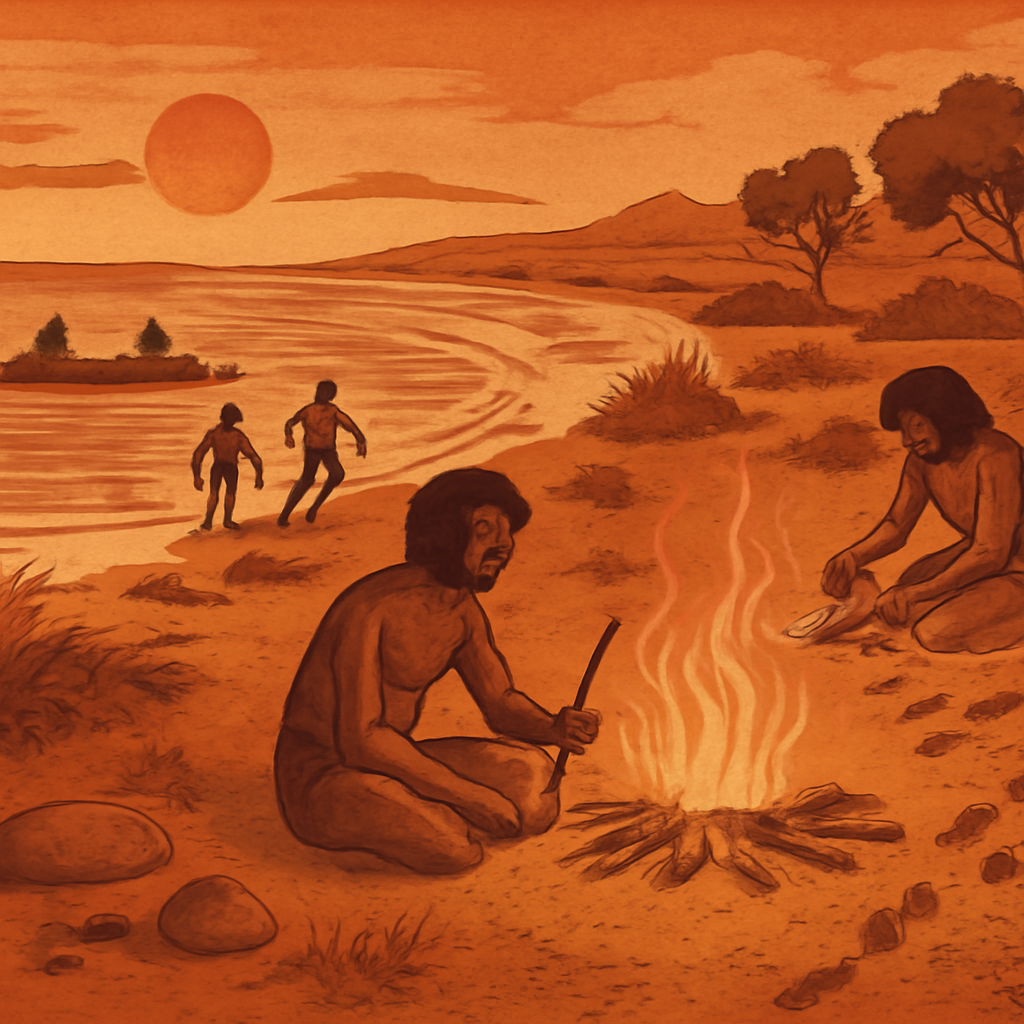
Interactive Timeline
Explore First Peoples, Migrations, and Pacific Worlds Timeline by sequence
Homo sapiens Emerges
Early Homo sapiens fossils in Africa mark a deep human-origin horizon, showing that modern humans emerged through a long African evolutionary story rather than a sudden single event.
Read the full event pageNarrative Stages
Read this timeline in chapters
Deep Time Migration and First Settlement
Human origins, dispersal from Africa, early Australian settlement, and farming show movement before empires, writing, or modern borders.
- Homo sapiens Emergesc. 300,000 BCE
- Out of Africa Migration Expandsc. 70,000 BCE
- First Peoples Settle Australiac. 65,000 BCE
- Neolithic Farming Expandsc. 10,000 BCE
Austronesian and Southeast Asian Worlds
Lapita expansion, bronze cultures, river polities, Srivijaya, and Angkor make water, trade, ritual, and infrastructure visible before European empire.
- Lapita Expansion Beginsc. 1600 BCE
- Dong Son Culture Flourishesc. 600 BCE
- Funan Maritime Network Risesc. 100 CE
- Srivijaya Maritime Empire Risesc. 650 CE
- Angkor Empire Founded in 802: Jayavarman II and the Long Buildout802 CE
Oceanic Settlement and Regional Polities
Hawaii, eastern Polynesia, Tonga, Maori settlement, Rapa Nui, Majapahit, Ayutthaya, Malacca, and Zheng He show ocean knowledge becoming political geography.
- Hawaiian Settlement Expandsc. 900 CE
- Eastern Polynesia Settlement Expandsc. 1000 CE
- Tongan Maritime Chiefdom Expandsc. 1200 CE
- Maori Settlement of Aotearoac. 1250 CE
- Rapa Nui Moai Building Peaksc. 1250 CE
- Majapahit Empire Founded1293 CE
- Ayutthaya Kingdom Founded1351 CE
- Malacca Sultanate Risesc. 1400 CE
- Zheng He's First Indian Ocean Voyage1405 CE
Contact, Colonization, and Indigenous Sovereignty
Spanish colonization, Cook's voyages, the First Fleet, Hawaiian unification, Waitangi, Maori political organization, and Hawaii's overthrow test power after contact.
Pacific War, Nuclear Age, Independence, and Climate
Coral Sea, Moruroa, Papua New Guinea, nuclear-free New Zealand, Bougainville, and small-island climate diplomacy show the modern Pacific as strategic and sovereign.
Map Layer
First Peoples, Migrations, and Pacific Worlds Timeline geography
Gold pins mark the approximate locations of published event pages. This is a schematic locator map, not a historical border map.
Event location Simplified land areaClick a pin to open the event page
Coordinates are approximate and are used to help readers orient themselves before opening a full event page.
References
Where to Check the Facts
- National Museum of Australia: Evidence of First PeoplesInstitutional reference for archaeological evidence, community knowledge, and First Peoples' deep presence in Australia.
- Te Ara: Pacific migrationsReference for Pacific migration paths, voyaging, Maori settlement, and Polynesian navigation context.
- Smithsonian Human Origins ProgramReference for human origins, fossil evidence, tools, and deep-time context.