At a Glance
The shape of the event
- Date
- 1810
- Place
- Hawaiian Islands
- Type
- State Formation
Kamehameha I unified the Hawaiian Islands after warfare, diplomacy, and control of changing military technologies.
1810; place the event in Hawaiian Islands before comparing causes or consequences.
The event gives Hawaii a sovereign state-formation chapter before later foreign pressure and annexation.
Kamehameha I / Hawaiian chiefs are the first names or groups to compare before widening the story.
The Hawaiian Kingdom became a centralized Pacific monarchy.
The Hawaiian Kingdom became a centralized Pacific monarchy.
The event gives Hawaii a sovereign state-formation chapter before later foreign pressure and annexation.
This episode is the hinge between island politics and the wider Pacific world.
Background
Before 1810 the Hawaiian Islands were politically diverse: island and district chiefs exercised authority through kinship ties, ritual standing, and control of land and labor. That diversity produced frequent negotiations—marriage alliances, tribute, localized warfare—and sometimes large coalitions that reached across channels and coasts. Outside pressures were growing too: seafaring traffic, new goods and ideas, and unfamiliar military options altered the balance between rivals without erasing older social systems. For chiefs, the strategic questions were practical: how to secure food, labor, and loyalty across fragmented shorelines; how to sustain ritual legitimacy while making bargains with other leaders; and how to decide when to fight or when to bind rivals through marriage and diplomacy.
Kamehameha I emerged from this world as a leader who combined battlefield command with negotiation and administrative reordering. Yet those options were unevenly available across islands and social groups. Rank-and-file commoners, priests, and lesser chiefs experienced the same processes as disruptions: shifting obligations, relocations, and the remolding of economic and ritual life. Historical evidence for this era exists in different registers—chiefly records, oral memory, archaeology, and later diplomatic and legal documents—and those registers sometimes provide divergent accounts of both agency and consequence. Kamehameha's unification of Hawaii should be read as Pacific state formation, not as an isolated island legend.
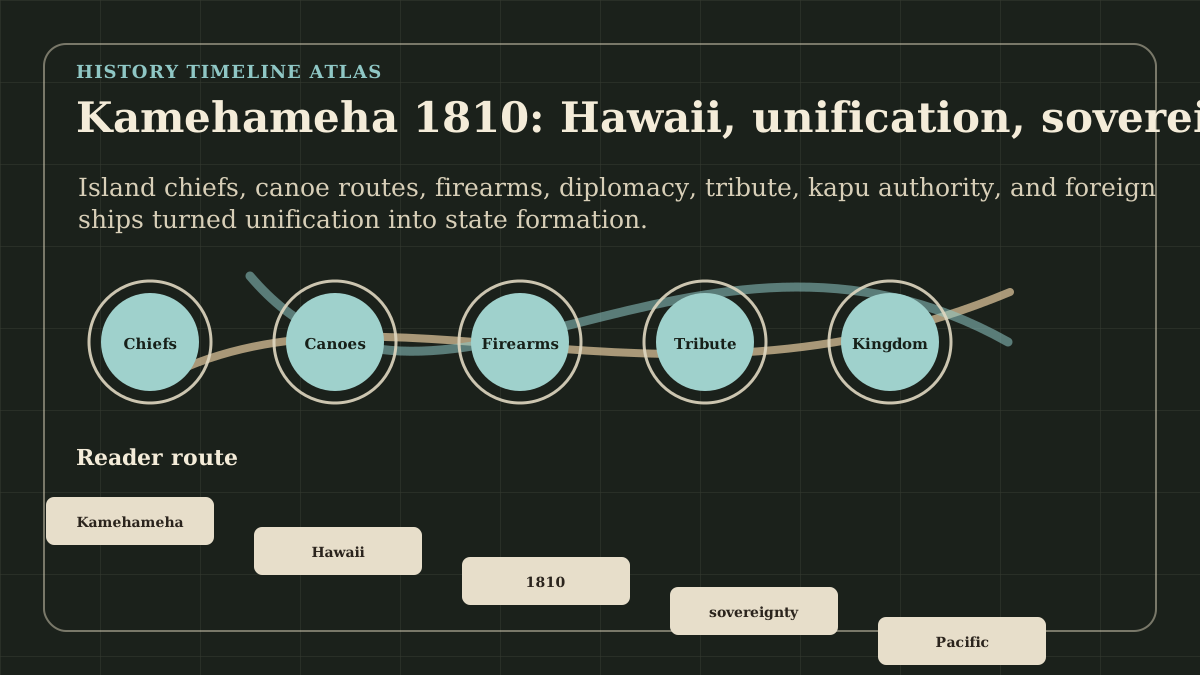
The Hawaiian Islands already had complex political systems built on chiefly rank, land stewardship, ritual authority, tribute, canoe travel, fishing, farming, and inter-island competition. Unification changed how those systems were coordinated at kingdom scale. Military technology mattered, but it did not replace Hawaiian politics. Firearms, cannon, foreign advisers, and trade goods widened the range of possible warfare, while marriage alliances, negotiated submission, kapu authority, genealogical legitimacy, and control of resources shaped whether rivals resisted, bargained, or joined the new order. The event also belongs to a longer sovereignty story. A unified kingdom could negotiate with foreign ships and later foreign governments as a single polity.
That strength was real, even though it also opened new diplomatic, commercial, missionary, legal, and military pressures that later tested Hawaiian independence.
The Turning Point
In the years culminating in 1810 Kamehameha I and other chiefs made a series of consequential choices that transformed island politics. Kamehameha pursued a mixed strategy: he waged campaigns where force could secure strategic advantage, he negotiated alliances to absorb or neutralize rivals, and he integrated new martial capabilities that widened his options. Chiefs who accepted compacts with him retained some status but ceased to operate as fully independent rulers; those who resisted faced sustained pressure. These decisions were not made in isolation. Families, retainers, and religious specialists were drawn into shifting networks of obligation, and local leaders judged the costs of resistance against the prospects of protection or reward under a larger authority.
The practical result was a reorganization of authority: command of resources and manpower began to centralize, diplomatic channels were extended across islands, and governance practices were standardized enough to present a single Hawaiian polity to outsiders. Yet the change entailed accommodation as often as conquest; diplomacy and negotiated submission mattered as much as battlefield outcomes. For many communities the turning point was experienced as a reordering of everyday obligations—who owed labor or food to whom, where chiefs resided, and how decisions affecting land and sea would be made. The turning point was the move from conquest and rivalry toward recognized kingdom-wide authority by 1810.
The submission of Kauai through diplomacy, rather than simply battlefield destruction, shows that unification was made through negotiation as well as war. Centralization changed everyday life. Tribute, labor obligations, chiefly offices, land management, port access, and relations with visiting ships increasingly moved through a kingdom framework rather than only local chiefly networks.
Consequences
The immediate consequence of unification was the emergence of a centralized Hawaiian Kingdom capable of exercising authority across multiple islands. That centralization allowed Kamehameha’s successors to register decisions, negotiate with foreign captains and visitors as a single polity, and attempt to codify rules of succession, land use, and tribute under a monarchic framework. For islanders the changes rippled through everyday life: obligations of labor and food were redirected, alliances were formalized into recognized offices, and some regional practices were reshaped to fit a kingdom-scale administration. In the longer term, the unification created a sovereign chapter in Hawaii’s history—a period in which an indigenous monarchy governed the archipelago and engaged in Pacific diplomacy and trade on its own terms.
That chapter did not make Hawaii immune to external pressures; later foreign interest, legal claims, and diplomatic maneuvering would test the kingdom’s sovereignty. Historians’ readings of these outcomes vary depending on which sources they privilege: official records highlight state-building successes; oral memories and local accounts emphasize continuity, loss, or accommodation; and archaeology and legal documents reveal uneven impacts on land, labor, and ritual life. Taken together, the consequences of 1810 are best seen as both a creation of a centralized monarchy and the opening of new vulnerabilities in a changing international order. The immediate consequence was a Hawaiian Kingdom able to govern across the archipelago and present a unified face to outside powers.
That gave Kamehameha and his successors more leverage in trade, diplomacy, and internal order. The longer consequence was double. Unification gave Hawaii a sovereign monarchy before later foreign pressure, but it also placed the kingdom inside expanding Pacific commerce and imperial attention. A careful page should hold both truths together.
Interpretation Notes
Interpretations of Kamehameha Unifies Hawaii depend on whose evidence is centered: rulers and official records, affected communities, oral memory, archaeology, law, diplomacy, labor, and later public memory do not always tell the same story.
Why Keep Reading
This episode is the hinge between island politics and the wider Pacific world. Read on to trace how a centralized Hawaiian Kingdom governed, how it negotiated with visiting powers, and how internal systems of land, labor, and law adapted—or did not—to new pressures. Follow the timelines that show how diplomatic choices, legal changes, and economic ties set the stage for later confrontation with foreign interests. Pay attention to contrasting sources—chiefly records, oral histories, archaeology, and law—to understand how the same event can mean different things to rulers, communities, and later historians. Each lane of evidence leads to a different map of consequence; together they reveal why 1810 matters in Hawaiian and Pacific history.
Read Kamehameha beside Pacific voyaging, the Hawaiian Kingdom overthrow, Waitangi, Maori sovereignty, and Pacific nuclear-testing pages. That route turns Oceania from a margin into a central history of navigation, state power, law, and sovereignty.
Reading Path
Follow the story without losing the thread
Before This
After This
- Overthrow of the Hawaiian Kingdom1893
- Attack on Pearl HarborDecember 7, 1941
- Papua New Guinea Gains Independence1975
Same Period
- Attack on Pearl HarborDecember 7, 1941
- Lapita Expansion Beginsc. 1600 BCE
- Eastern Polynesia Settlement Expandsc. 1000 CE
Wider Timeline
Mind Map
How to think about Kamehameha Unifies Hawaii
fragmented chiefdoms
Island and district chiefs exercised authority through kinship, ritual standing, and control of labor before 1810.
Map Layer
Where this event sits geographically
Gold pins mark the approximate locations of published event pages. This is a schematic locator map, not a historical border map.
Coordinates are approximate and are used to help readers orient themselves before opening a full event page.
References
Where to Check the Facts
- Te Ara: Pacific migrationsReference for Pacific voyaging, settlement paths, Polynesian migration, and Aotearoa context.
- Te Ara: TupaiaPacific-based biographical reference for Tupaia's navigation, mediation, and role during Cook's voyage.
- University of Hawaii ScholarSpace: Epeli Hau'ofa, Our Sea of IslandsPacific scholar's argument for reading Oceania as a connected sea of islands rather than scattered small places.
- Waitangi Tribunal: Treaty claims and Te TiritiPacific-based institutional reference for Te Tiriti, Maori claims, Crown obligations, and treaty interpretation.
- Encyclopaedia Britannica: Hawaii historyReference for Hawaiian settlement, kingdom history, and later United States annexation.
- Encyclopaedia Britannica: Te Tiriti o WaitangiReference for the Treaty of Waitangi and British annexation of New Zealand.
- Official UNESCO World Heritage Centre: TaputapuateaInstitutional reference for a Polynesian cultural landscape connected to voyaging, ritual, genealogy, and ocean paths.