At a Glance
The shape of the event
- Date
- c. 10,000 BCE
- Place
- Fertile Crescent
- Type
- Agricultural Transition
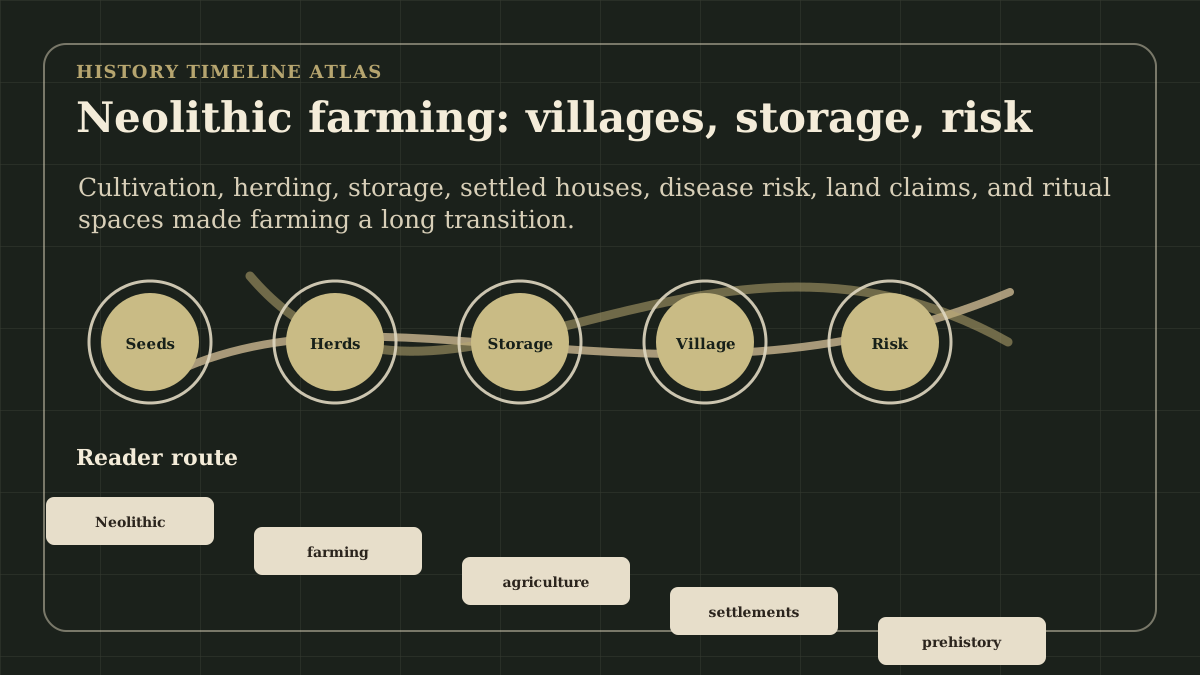
Farming and settled village life expanded in parts of Southwest Asia, changing human relationships with plants, animals, labor, storage, risk, and landscape.
c. 10,000 BCE; place the event in Fertile Crescent before comparing causes or consequences.
The Neolithic transition is a long process rather than a single invention, but it is one of the atlas's key bridges from deep prehistory to cities and states.
early farming communities are the first names or groups to compare before widening the story.
Agriculture supported denser settlements, new forms of work, food surplus, inequality, ritual life, and later urban development.
Agriculture supported denser settlements, new forms of work, food surplus, inequality, ritual life, and later urban development.
The Neolithic transition is a long process rather than a single invention, but it is one of the atlas's key bridges from deep prehistory to cities and states.
Follow this thread to see how settled villages set the stage for the first towns, bureaucracies and monumental architecture.
Background
The closing chapters of the last Ice Age left human groups across Southwest Asia facing new environmental rhythms and opportunities. Mobile hunting and gathering continued alongside experiments with plant tending and animal management. In places of the Fertile Crescent, people lived close to diverse resources—rivers, floodplains and uplands—that made repeated, long-term use of particular places more feasible. Pressure to secure reliable food supplies could come from many directions: population growth, the need to survive seasonal lean months, the advantages of predictable returns for cooperation and exchange. At the same time, social innovations—shared storage, new household arrangements and collective labor—began to emerge. None of these pressures explains the whole story.
Instead, the background is a crowded set of ecological possibilities and social responses in which different communities experimented unevenly and over many generations. Neolithic farming is strongest when it is not treated as a single invention or an automatic march of progress. In Southwest Asia, cultivation, herding, foraging, storage, seasonal movement, and village life overlapped for long periods. People experimented with plants and animals before agriculture became a dominant way of organizing life. Food production changed time. Sowing, harvesting, protecting fields, tending animals, repairing storage, and staying near houses created new rhythms of work.
Some risks decreased because stored food could buffer scarcity, while other risks increased because crops could fail, disease could spread in denser settlements, and land claims could become sharper. The material record gives readers a way into daily life. Seeds, grinding stones, animal bones, house plans, burials, tools, plastered floors, and ritual spaces show changes that written records cannot explain. The evidence is intimate: food, labor, illness, family, and memory before states or writing.
The Turning Point
What changed in this long transition was the balance of daily life: many groups shifted time and energy from wide-ranging foraging to repeated cultivation of plots, greater investment in permanent or semi-permanent houses, and forms of labour that required cooperation across seasons. Concrete actors in this shift were ordinary households and their neighbours—people who chose to plant in preferred patches, to defend stored food, to invest in repairs to dwellings, and to arrange labour for sowing and harvesting. Herders and those experimenting with animal management made complementary choices about mobility and access to grazing.
These were not always coordinated by charismatic 'inventors' but often emerged from distributed decisions: when one household saved seed, another copied a terrace or a pit for storage; when several families pooled labour for a harvest, their pattern of cooperation hardened into customary expectations. The turning point, therefore, is best seen as a widening adoption of practices that reworked relationships to plants, animals, labour and landscape—turning occasional tending into committed settlement and regular food surplus. It was this aggregation of choices that made denser village life a sustainable option rather than a fleeting experiment. The turning point was not a sudden choice to become farmers. It was the gradual point at which cultivation, herding, settlement, and storage became mutually reinforcing.
Once households invested in fields, houses, and stored goods, mobility, inheritance, cooperation, and conflict all changed. Settlement also created new forms of collective action. Villages needed shared rules about water, paths, animals, boundaries, ritual spaces, and stored surplus. Authority could begin in everyday coordination long before kings or formal states appeared.
Consequences
In the near term, the expansion of farming supported larger and more stable settlements. With food kept for lean times and surplus available, communities could invest differently—in larger houses, in craft specialisations, and in ritual spaces where groups reaffirmed shared norms. These material changes encouraged social differentiation: some households accumulated more stored goods or control over labour, and that inequality reshaped obligations and authority. New kinds of work—seasonally concentrated tasks like sowing and harvest, plus year-round storage and maintenance—altered daily rhythms and gendered divisions of labour in complex local ways. Over the long term, the shift from foraging to farming laid the foundations for urban development and new institutions.
Surplus food and settled populations made possible denser settlements that could support specialised craftsmen, administrators and religious specialists, and they created incentives for record-keeping, territorial claims and organised defence. Yet this trajectory was contingent: the Neolithic transition unfolded unevenly across communities and centuries, and the specific social forms that persisted depended on local choices, ecological constraints and the institutions that outlasted early experiments. The consequences were mixed. Agriculture supported denser populations, larger settlements, craft specialization, ritual buildings, and later urban development. It also brought harder labor, inequality, disease exposure, land disputes, vulnerability to harvest failure, and new dependencies. That tension makes the event useful for modern readers. Farming expanded human possibilities, but it did not simply make life better.
It changed the bargain between people, landscape, food, work, and risk. The first cities and states make more sense when this longer transformation is visible.
Interpretation Notes
Neolithic Farming Expands can look simple when reduced to one date, but the evidence usually points to a wider setting. The useful debate is which part mattered most: leadership, logistics, belief, social pressure, or the institutions that survived afterward.
Why Keep Reading
Follow this thread to see how settled villages set the stage for the first towns, bureaucracies and monumental architecture. The steps from household storage and seasonal planning to large-scale public works took many small, repeated decisions. Tracing the next chapters reveals how practices around food, labour and ritual were translated into political power, how networks of exchange spread ideas and crops beyond the Fertile Crescent, and where alternative paths—return to mobility, mixed economies—continued alongside village life. Read Neolithic farming before early cities, Mesopotamia, Egypt, the Indus Valley, and later empire routes. The path connects food systems to settlement, writing, taxation, labor, and political power.
Reading Path
Follow the story without losing the thread
Before This
- First Peoples Settle Australiac. 65,000 BCE
- Out of Africa Migration Expandsc. 70,000 BCE
- Homo sapiens Emergesc. 300,000 BCE
After This
No direct path yet.
Same Period
- Homo sapiens Emergesc. 300,000 BCE
- Out of Africa Migration Expandsc. 70,000 BCE
- First Peoples Settle Australiac. 65,000 BCE
Wider Timeline
Mind Map
How to think about Neolithic Farming Expands
environmental opportunity
local river valleys, floodplains and varied microclimates made repeated cultivation feasible in parts of Southwest Asia
Map Layer
Where this event sits geographically
Gold pins mark the approximate locations of published event pages. This is a schematic locator map, not a historical border map.
Coordinates are approximate and are used to help readers orient themselves before opening a full event page.
References
Where to Check the Facts
- Encyclopaedia Britannica: Neolithic PeriodReference for Neolithic chronology, farming, and settled village development.
- World History Encyclopedia: Neolithic PeriodSupporting reference for the agricultural transition and early settled communities.