At a Glance
The shape of the event
- Date
- 1987
- Place
- Wellington
- Type
- Legislation
New Zealand passed nuclear-free legislation that restricted nuclear-powered and nuclear-armed vessels and reshaped alliance politics.
1987; place the event in Wellington before comparing causes or consequences.
The event links Pacific protest, domestic democracy, and Cold War alliance tensions.
New Zealand lawmakers / Anti-nuclear activists are the first names or groups to compare before widening the story.
New Zealand's policy strained parts of the ANZUS relationship while strengthening anti-nuclear identity.
New Zealand's policy strained parts of the ANZUS relationship while strengthening anti-nuclear identity.
The event links Pacific protest, domestic democracy, and Cold War alliance tensions.
Follow the aftermath and you watch several strands: how small democracies negotiate security with larger powers, how protest can become policy, and how Pacific voices reframe global military questions.
Background
Through the 1970s and 1980s New Zealand sat at the crossroads of global tension and local pressure. Anti-nuclear activism had grown from peace groups, churches, unions and Pacific networks who objected to both weapons testing in the region and the invisible hazards of nuclear power. Those protests met a political system where successive lawmakers had to balance alliance commitments with domestic opinion. In Wellington, parliamentary debate and public campaigns overlapped with diplomatic conversations about military access and strategy across the Pacific. Outside government, oral memory, community archives and the built environment recorded a different cadence: regular demonstrations, petitions and neighbourhood organizing that pushed the question from pulpits to plenum.
At the same time, official records—policy papers, cables and memorandum—tracked the same issue in the language of security and maritime practice. No single cause explains the law. It emerged where street pressure, electoral calculation, and international friction met, producing a legislative response that both reflected and reshaped those tensions. New Zealand's nuclear-free law belongs to Pacific history as much as to Cold War diplomacy. It grew from anti-nuclear activism, memories of nuclear testing in the Pacific, debates over ship visits, environmental fear, Maori and wider civic protest, and arguments about whether alliance loyalty required accepting nuclear ambiguity. The issue reached ordinary voters, ports, churches, unions, local councils, and families, not only foreign ministries.
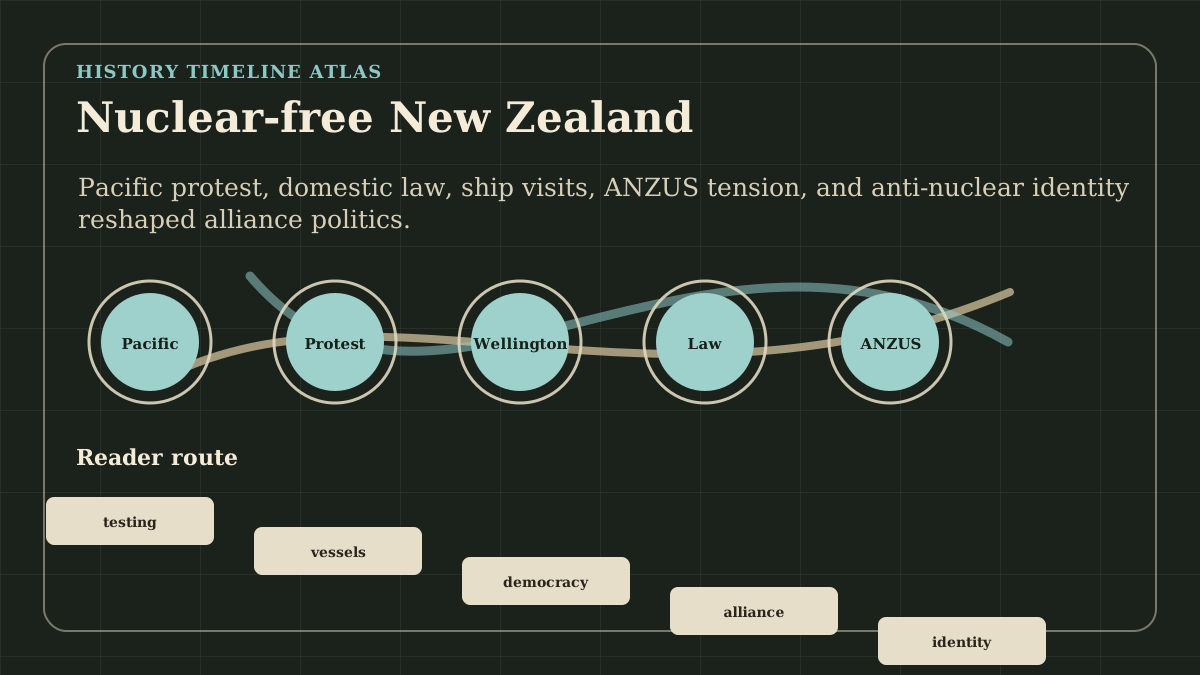
The ANZUS alliance gives the page its geopolitical tension. New Zealand was a small ally in a U. S. -led security system, but domestic politics increasingly rejected nuclear-armed or nuclear-powered vessels. That refusal strained relations with the United States while strengthening a national identity built around Pacific responsibility, democracy, and independent foreign policy. The visual should not be Earthrise. Planetary scale matters to nuclear history, but this page is about law, vessels, harbors, protest, alliance pressure, and Pacific sovereignty. A specific visual helps the reader understand why Wellington legislation and Pacific anti-nuclear sentiment belong in the same frame.
The Turning Point
The turning point came when lawmakers translated sustained civic pressure into statutory prohibition. Anti-nuclear activists had pressured politicians for years; they staged vigils, lobbied MPs, and kept the issue visible in towns and cities across New Zealand and the wider Pacific. Faced with persistent public opposition to nuclear presence, New Zealand lawmakers moved to codify a boundary: the law explicitly restricted entry for nuclear-armed and nuclear-powered vessels into New Zealand waters. That choice was concrete and unilateral. It was a legal assertion of sovereignty about who and what could enter the country’s ports. For activists it was validation—an institutional win after prolonged campaigning.
For some officials in allied capitals, it was a rupture: routine assumptions about mutual naval access and alliance practice were now constrained by domestic statute. The passage of the act was therefore not simply a regulatory change but a political decision in which elected representatives prioritized a collective public stance over prior diplomatic convenience. In doing so they turned decades of protest into enforceable policy and forced a recalibration of how alliances, law and local politics interacted in the Pacific. The turning point was the translation of protest into statute. Activism and public opinion became legal restriction, making policy durable beyond one demonstration or election slogan.
Law changed what foreign ships could assume, and it forced alliance partners to confront a domestic democratic choice. The act also turned nuclear policy into identity. New Zealand was not simply opting out of a weapons system. It was announcing a way to imagine security in the Pacific: less dependent on nuclear deterrence, more tied to environmental protection, public consent, and the experience of island societies living with testing legacies.
Consequences
In the immediate years after the law took effect, New Zealand’s international posture changed in practical and symbolic ways. The statute constrained the movements of nuclear-armed and nuclear-powered vessels, making clear that port visits and naval practice would now answer to domestic law as much as allied expectation. That constraint strained parts of the ANZUS relationship, interrupting established patterns of military cooperation and diplomatic assumption without ending all security ties. Domestically, the law helped consolidate a national anti-nuclear identity: it became both a legal instrument and a touchstone for public memory. Over the longer term the act reshaped conversations in the Pacific about sovereignty and protest.
Historians and commentators now read the legislation through different evidential lenses—official records emphasizing alliance friction, community archives and oral memory stressing protest and local agency, and legal scholars highlighting the statute’s normative force. Those lenses do not always agree. What is consistent is that the law linked grassroots activism to international politics, forcing allies and regional partners to reckon with a democratically enacted limit on Cold War practice. The act did not settle every debate about security or the environment, but it did make visible the costs and moral clarity of choosing restriction over accommodation. The immediate consequence was alliance strain, especially within ANZUS. The longer consequence was a durable political identity.
Nuclear-free policy became part of how New Zealand presented itself domestically and internationally, and it connected the country to wider Pacific criticism of nuclear testing and militarized ocean space. The page should also keep limits visible. Nuclear-free law did not remove all strategic vulnerability, and it did not end nuclear politics globally. Its importance lies in showing how a small democracy used law to reshape the terms of alliance participation and regional moral authority.
Interpretation Notes
Interpretations of Nuclear Free New Zealand Act depend on whose evidence is centered: rulers and official records, affected communities, oral memory, archaeology, law, diplomacy, labor, and later public memory do not always tell the same story.
Why Keep Reading
Follow the aftermath and you watch several strands: how small democracies negotiate security with larger powers, how protest can become policy, and how Pacific voices reframe global military questions. Tracking subsequent diplomatic exchanges, local memory projects, and legal debates reveals how the 1987 law rippled through alliance politics and cultural identity. If you want to understand the human choices behind Cold War realignments, or how communities convert protest into binding law, the next pages trace those threads—through ships denied entry, parliamentary records, and the stories activists carried home. Read this page beside Moruroa nuclear testing, Waitangi, Pacific sovereignty, climate diplomacy, and Cold War alliance routes.
That sequence keeps New Zealand's law inside a wider Pacific story about who gets to define security, risk, and survival.
Reading Path
Follow the story without losing the thread
Before This
- French Nuclear Testing Begins at Moruroa1966
- Attack on Pearl HarborDecember 7, 1941
- Treaty of Waitangi1840
After This
No direct path yet.
Same Period
- French Nuclear Testing Begins at Moruroa1966
- Attack on Pearl HarborDecember 7, 1941
- Eastern Polynesia Settlement Expandsc. 1000 CE
Wider Timeline
Mind Map
How to think about Nuclear Free New Zealand Act
Grassroots pressure
Sustained marches, petitions and community organizing that made nuclear presence a persistent public issue.
Map Layer
Where this event sits geographically
Gold pins mark the approximate locations of published event pages. This is a schematic locator map, not a historical border map.
Coordinates are approximate and are used to help readers orient themselves before opening a full event page.
References
Where to Check the Facts
- Official NZ History: Nuclear testing in the PacificReference for French nuclear testing in the Pacific and regional protest.
- Moruroa Files: Investigation into French nuclear tests in the PacificInvestigative reference for declassified-record analysis and contested health-impact claims around French Polynesian nuclear testing.
- Bougainville Referendum Commission: PublicationsOfficial reference for Bougainville referendum materials, voter information, observers, and public communication.
- PaCSIA: Bougainville Referendum DialoguesCivil-society reference for Bougainville dialogue work, referendum education, and local peace-process participation.
- Pacific Islands Forum: 2050 Strategy for the Blue Pacific ContinentPacific regional institutional reference for climate diplomacy, ocean governance, security, and shared Blue Pacific strategy.
- Encyclopaedia Britannica: Papua New GuineaReference for Papua New Guinea's independence and modern state formation.