At a Glance
The shape of the event
- Date
- 1966
- Place
- Moruroa Atoll
- Type
- Nuclear Testing
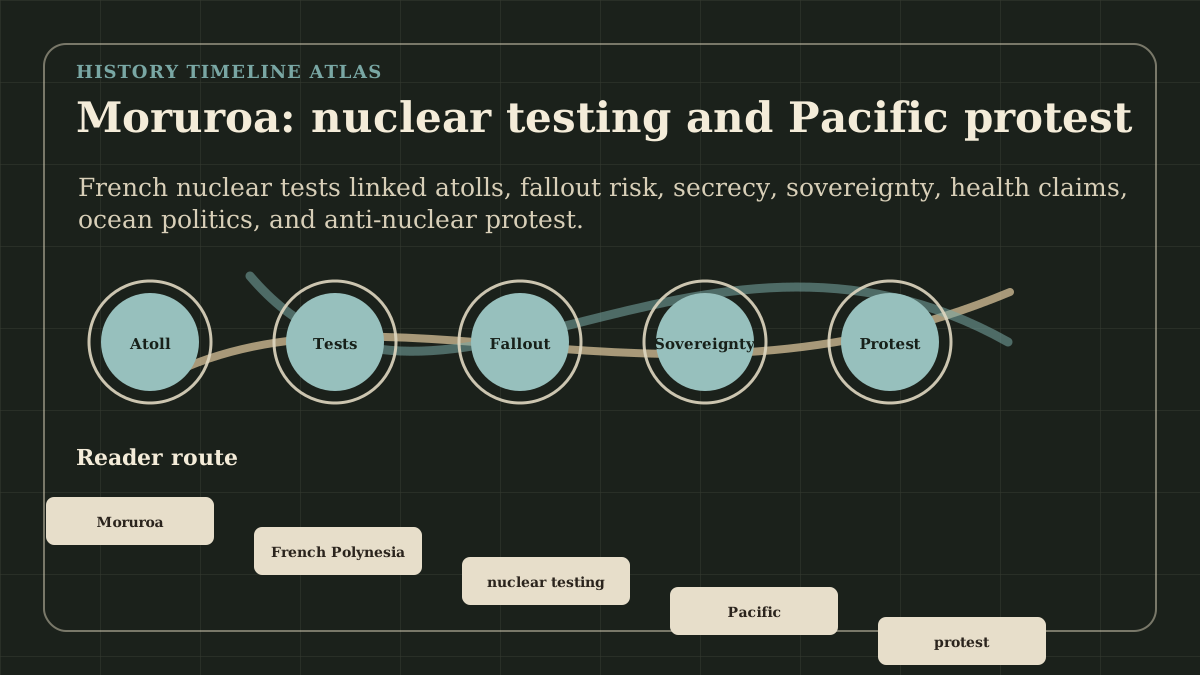
France began nuclear testing at Moruroa, turning Pacific islands into sites of nuclear geopolitics and anti-nuclear protest.
1966; place the event in Moruroa Atoll before comparing causes or consequences.
The event makes nuclear colonialism and environmental risk visible in Pacific history.
French officials / Pacific anti-nuclear activists are the first names or groups to compare before widening the story.
Testing continued for decades and generated regional health, environmental, and sovereignty debates.
Testing continued for decades and generated regional health, environmental, and sovereignty debates.
The event makes nuclear colonialism and environmental risk visible in Pacific history.
Follow the subsequent chronology to see how a single decision in 1966 unfolded into decades of tests, protests, and diplomatic wrestlings.
Background
By the mid-twentieth century, nuclear weapons testing had become a defining feature of Cold War power and technical prestige. Remote island spaces were often chosen because of perceived isolation from metropolitan centres, and colonial and territorial relationships shaped who could make those decisions. In this broad frame, France’s programme moved into French Polynesia in 1966, selecting the atoll of Moruroa in the central Pacific as a testing site. Those moves did not happen in a political vacuum: island communities, regional neighbours, and emerging Pacific activist networks would soon read tests through concerns about land, health, and sovereignty. At the same time, metropolitan officials framed testing in terms of national policy and strategic calculation.
The tensions this produced — between technical plans drawn in distant capitals and lived experience on island shores — set the stage for protests, diplomatic questions, and long debates over responsibility and knowledge that mixed scientific, legal, and moral claims. Moruroa makes nuclear history concrete because the test site was not an empty ocean point. French Polynesian atolls, workers, military planners, local communities, protest networks, fishers, church voices, scientists, and regional governments all became part of the story once France moved testing into the Pacific. The Cold War frame is necessary but not sufficient.
France wanted an independent nuclear force and great-power status, yet Pacific communities had to live with restricted zones, secrecy, health fears, environmental uncertainty, and the political message that distant islands could be treated as strategic space for a metropolitan state. The source problem is part of the event. Governments, scientists, investigative journalists, activists, veterans, and affected communities have not always described risk in the same way. A useful page does not pretend every claim is equally proven, but it does make clear why secrecy and colonial distance damaged trust.
The Turning Point
The opening of Moruroa as a testing site marked a change in the geography of nuclear power: an atoll that had been a local place of life and work became an instrument and symbol of state policy. French officials carried out the decision to test there and to sustain a testing programme, asserting metropolitan authority over a distant territory. Pacific anti-nuclear activists — including local residents, regional campaigners, and sympathetic voices beyond the islands — responded by contesting both the tests themselves and the processes by which they had been authorised. That contest was not only rhetorical: it involved protests, public statements, and regional mobilisation that forced the issue into diplomatic and media arenas.
Choices made in 1966 — to proceed with tests in Moruroa, to prioritise national programmes over local consent, and to treat the atoll as a controlled technical space — reconfigured relations between metropolitan France and Pacific communities. Those decisions also altered the daily lives of people connected to the atoll, introduced contested environmental and safety questions into regional political life, and opened a new chapter of visible Pacific protest against nuclear testing. The turning point was the relocation of French nuclear testing into a Pacific geography that made sovereignty and exposure inseparable.
A weapons program became a regional political issue because the atoll, the ocean, and the people around them were asked to absorb danger for a national project centered elsewhere. Protest turned the event outward. Anti-nuclear campaigns in French Polynesia, New Zealand, Australia, and wider Pacific networks connected health, environment, Indigenous rights, decolonization, and ocean diplomacy. Nuclear testing became a way to ask who had the right to decide what counted as acceptable risk.
Consequences
In the near term, testing at Moruroa provoked regional alarm, public protest, and diplomatic exchanges that centred questions of health, environment, and political authority. The presence of a sustained testing programme made the Pacific a stage for anti-nuclear activism and for challenges to metropolitan governance. Over the longer term, testing continued for decades and generated enduring debates about responsibility, risk, and compensation; it also left material and social traces that communities, scientists, and courts would later examine and contest. The event made visible a form of nuclear colonialism: metropolitan decisions projecting force and technological practice onto island spaces where residents were often marginalised in decision-making.
That visibility sharpened demands for accountability and deepened interest in alternative kinds of evidence — oral memory, local observation, archaeology, and independent scientific study — which sometimes conflicted with official records. The contested legacy of Moruroa remains a touchstone in Pacific history for questions about environmental vulnerability, legal remedy, and how differing forms of evidence shape public memory. Testing continued for decades, leaving arguments over radiation exposure, compensation, environmental harm, military secrecy, and French responsibility. The event still shapes Pacific anti-nuclear memory because it joins body, land, ocean, archive, and state power. The wider consequence was a Pacific political language that linked security to sovereignty. For many island communities, being small did not mean being passive.
Moruroa sits inside a longer route of Pacific diplomacy, nuclear-free politics, climate justice, and demands to be heard in global decisions.
Interpretation Notes
Interpretations of French Nuclear Testing Begins at Moruroa depend on whose evidence is centered: rulers and official records, affected communities, oral memory, archaeology, law, diplomacy, labor, and later public memory do not always tell the same story.
Why Keep Reading
Follow the subsequent chronology to see how a single decision in 1966 unfolded into decades of tests, protests, and diplomatic wrestlings. Reading the later timeline clarifies how activists organised across islands, how legal and scientific claims were marshalled by different parties, and how communities documented and remembered their experiences. Tracing this history next helps readers understand contemporary debates over environmental remediation, sovereignty, and historical responsibility — and it shows why questions about whose evidence counts remain central when states, survivors, scientists, and historians tell conflicting stories about the same place. Read Moruroa beside ANZUS, Nuclear Free New Zealand, Pacific sovereignty routes, Chernobyl, the Partial Test Ban Treaty, and Cold War arms control.
The path connects nuclear technology to place, protest, secrecy, and regional agency.
Reading Path
Follow the story without losing the thread
Before This
- Attack on Pearl HarborDecember 7, 1941
- James Cook Arrives at Tahiti1769 CE
- Maori Settlement of Aotearoac. 1250 CE
After This
Same Period
- Nuclear Free New Zealand Act1987
- Attack on Pearl HarborDecember 7, 1941
- Eastern Polynesia Settlement Expandsc. 1000 CE
Wider Timeline
Mind Map
How to think about French Nuclear Testing Begins at Moruroa
strategic choice
France selected a remote atoll as a testing site, prioritising technical and strategic goals over local consultation.
Map Layer
Where this event sits geographically
Gold pins mark the approximate locations of published event pages. This is a schematic locator map, not a historical border map.
Coordinates are approximate and are used to help readers orient themselves before opening a full event page.
References
Where to Check the Facts
- Official NZ History: Nuclear testing in the PacificReference for French nuclear testing in the Pacific, Moruroa, regional opposition, and anti-nuclear politics.
- Moruroa Files: Investigation into French nuclear tests in the PacificInvestigative reference for declassified-record analysis and contested health-impact claims around French Polynesian nuclear testing.