Historical Role
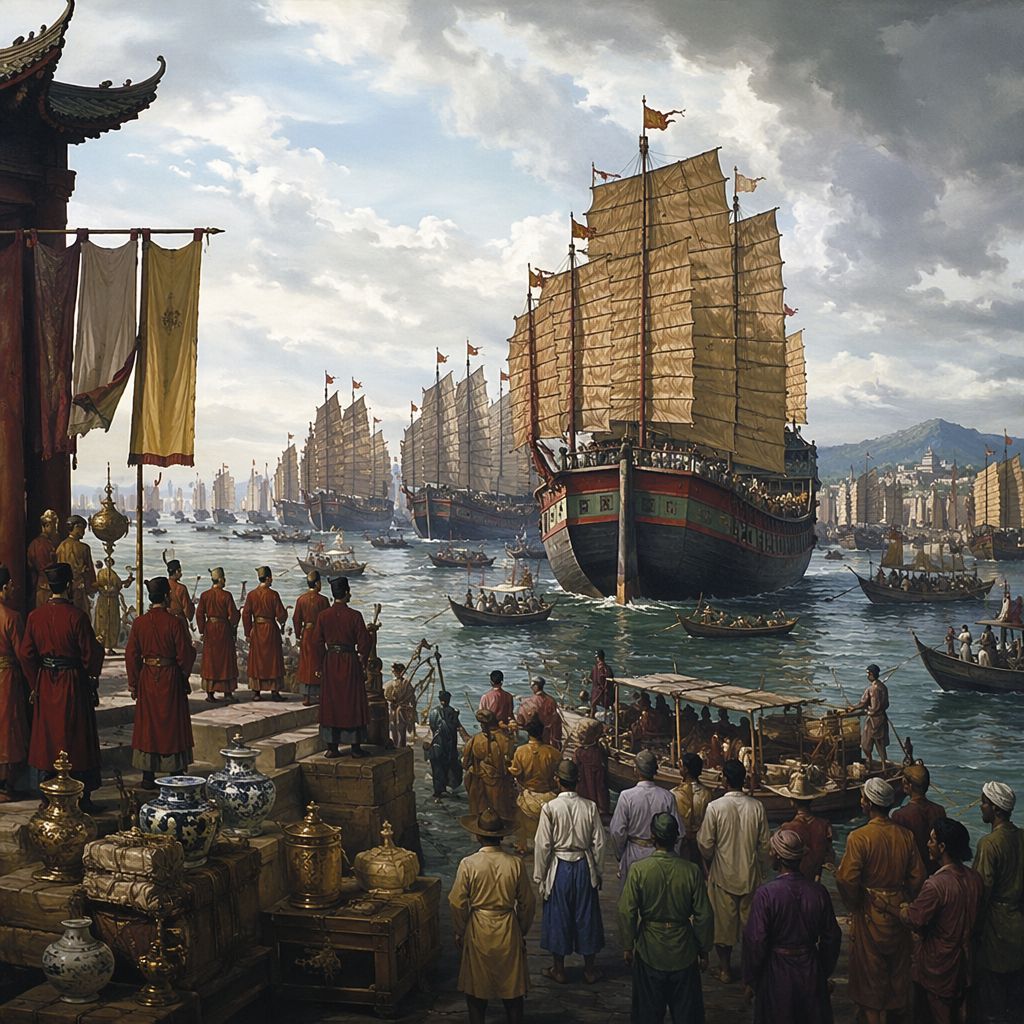
Zheng He's biography works best when it is placed inside Ming statecraft rather than a simple adventure story. The treasure voyages were organized by a court with ships, workshops, records, envoys, soldiers, translators, gifts, ports, and ceremonial expectations. Zheng He mattered because he made imperial presence travel by sea.
The voyages entered an Indian Ocean world that was already dense with movement. Malay, Javanese, Tamil, Gujarati, Persian, Arab, Swahili, Muslim, Hindu, Buddhist, and Chinese communities had long used monsoon routes, port customs, merchant trust, diaspora ties, and diplomatic bargaining. Zheng He's fleets made Ming power spectacular, but they did not invent the ocean's connectivity.
A good page avoids the missed-colonization myth. Zheng He's voyages were not simply a Chinese version of later Portuguese or Dutch empire that stopped too soon. They served Ming court politics, tribute diplomacy, prestige, security, and legitimacy in ways that differed from joint-stock company conquest or Atlantic colonization.
The human scale also matters. Sailors, pilots, interpreters, Muslim officials, court eunuchs, merchants, port rulers, shipbuilders, and envoys all made the voyages possible. Zheng He's own background as a Muslim eunuch serving the Yongle court helps readers see how status, trust, and court service shaped high-level maritime power.
The biography becomes a bridge across regions. It sends readers from Nanjing and the Ming court to Malacca, South Asia, Arabia, and East Africa, then back to the question of why a state could sponsor extraordinary voyages and later reduce that maritime program.
Zheng He helps connect individual action with wider historical change in Ming dynasty. The biography works best when it keeps the surrounding world visible: authority, conflict, belief, reform, or discovery moved through decisions made under pressure.
The related events show how roles such as Admiral, Diplomat, Maritime commander can be read through dates, places, institutions, and consequences rather than through reputation alone. The biography explains why this person matters, while the linked events explain what changed around them.
A richer reading starts with the limits around the person. Some figures acted through offices, armies, courts, laboratories, churches, parties, ships, trade networks, or protest movements; others became important because later communities turned their lives into symbols. The page therefore asks what this person could actually change, what was already moving before them, and which consequences later readers attached to the name.
Read the biography against absence as well. Many lives around Zheng He are less visible in the record: opponents, collaborators, family members, workers, soldiers, students, subjects, victims, translators, scribes, or local communities. Keeping those surrounding people in view makes the page less like a name card and more like an entry point into historical systems.
Zheng He also works as a navigation point. Open the linked event pages to see where the biography becomes chronology, then use the topic routes to test whether the same pattern appears beyond one life. That extra step matters because historical importance is rarely contained inside a single decision; it usually spreads through institutions, witnesses, opponents, imitators, and later arguments over memory.
Sources and Method
Source trail: read Zheng He through the 1405 voyage page, Malacca, Indian Ocean trade, Ming China, and Britannica's biography and timeline references. The page treats voyage scale, diplomacy, and discontinuation as Ming political questions rather than as a simple comparison with Europe.
Why This Person Matters
Zheng He matters because the connected events make a larger historical pattern easier to follow. The page links biography to consequences so readers can move from a life story into the wider atlas, compare the person with contemporaries, and understand why later memory kept returning to this figure. Zheng He matters because his voyages make early fifteenth-century Chinese maritime power visible inside a connected Indian Ocean world. His life helps readers compare diplomacy, trade, state projection, court politics, and ocean geography without forcing every sea route into a European colonial template.
What does Zheng He's career reveal about the difference between displaying imperial power across the ocean and building an overseas empire?
How to Read This Life
Zheng He is easiest to understand when the biography is read beside Zheng He's First Indian Ocean Voyage, Malacca Sultanate Rises. Those events show the historical setting in motion: dates, places, institutions, conflict, and consequences give the life a structure that a short biography alone cannot provide.
The surrounding route crosses Ming Dynasty, Late Medieval Southeast Asia and locations such as Nanjing and Indian Ocean ports, Malacca. That matters because influence rarely stays inside one person. It moves through offices, armies, movements, laws, texts, speeches, institutions, and later memory.
A useful reading path starts with the role labels, then opens the event pages to see what changed, and finally compares this person with other actors facing similar pressures.
For readers who arrive on a biography first, this page is meant to become a doorway rather than a stop. Read one paragraph for the answer, then use the turning points, topic routes, and event links to test whether the person's reputation matches the wider evidence.
Read Zheng He beside Malacca, Ibn Battuta, Vasco da Gama, Chola-Srivijaya, the Indian Ocean route, and East Asia routes. The sequence shows an ocean with many centers before European company power.
Then compare him with Ibn Battuta, Mansa Musa, James Cook, and Vasco da Gama where available. The comparison asks how travel changes when it is pilgrimage, commerce, court diplomacy, mapping, or armed intrusion.
Read Zheng He through the roles of Admiral, Diplomat, Maritime commander rather than as reputation alone.
Place the biography inside Ming dynasty and the wider events linked below.
Ask which choices were personal and which were constrained by institutions or crisis.
Follow how later memory simplified, contested, or reused this person's role.
Read the voyages as Ming state projects shaped by the Yongle court, envoys, gifts, records, and legitimacy.
Place the fleets inside existing port systems, monsoon knowledge, merchant communities, and diplomatic customs.
Compare Zheng He with later Portuguese and Dutch expansion without assuming the same goals.
Legacy, Limits, and Memory
A useful biography keeps scale in view. Zheng He mattered because individual choices met a wider structure: institutions, enemies, allies, audiences, technologies, beliefs, and inherited conflicts. The related event pages help separate personal agency from conditions that no single person controlled.
Memory is part of the biography too. Later readers often simplify a figure into a hero, villain, founder, reformer, conqueror, prophet, scientist, or symbol. Those labels can be helpful, but they become misleading when they hide conflict, compromise, exclusion, uncertainty, or the experiences of people outside the main biography.
For the next step, compare this life with a topic route rather than stopping at the name. If the same pattern appears across several figures, the reader has found a historical structure; if this person breaks the pattern, the contrast is usually where the most interesting question begins.
The scale of the fleets can seduce readers into speculation. The stronger historical question is what the voyages were for, which institutions supported them, and why later Ming priorities changed.
Zheng He cannot make the Indian Ocean seem passive. Ports and rulers across maritime Asia negotiated, welcomed, resisted, profited, and interpreted Ming presence through their own interests.
Turning Points to Read Next
Zheng He's First Indian Ocean Voyage
Zheng He began the first of the Ming treasure voyages, sending large Chinese fleets through Southeast Asia and across the Indian Ocean.
Malacca Sultanate Rises
The Malacca Sultanate rose at a strategic strait, turning commerce, Islam, diplomacy, and Malay political culture into a major port-polity.
Related Timeline
- 1405 CEZheng He's First Indian Ocean Voyage
Zheng He began the first of the Ming treasure voyages, sending large Chinese fleets through Southeast Asia and across the Indian Ocean.
- c. 1400 CEMalacca Sultanate Rises
The Malacca Sultanate rose at a strategic strait, turning commerce, Islam, diplomacy, and Malay political culture into a major port-polity.
References
Where to Check the Facts
- Encyclopaedia Britannica: Zheng HeBiographical reference for Zheng He's voyages, diplomatic role, and Indian Ocean significance.
- Encyclopaedia Britannica: Zheng He TimelineChronology reference for Zheng He's major life and voyage events.