Central Question
What changes when Southeast Asia is read through straits, deltas, port-polities, colonial companies, nationalist movements, and regional institutions?
Start With These Dates
- c. 100 CEFunan Maritime Network Rises
Funan emerged around lower Mekong trade routes, linking mainland Southeast Asia to wider Indian Ocean commerce, ports, ritual power, and political consolidation.
- c. 650 CESrivijaya Maritime Empire Rises
Srivijaya rose around Sumatran waterways and sea lanes, using control of maritime routes, diplomacy, and Buddhist networks to shape regional power.
- 802 CEAngkor Empire Founded in 802: Jayavarman II and the Long Buildout
The traditional 802 foundation date points to Jayavarman II and a remembered claim to Khmer sovereignty, but Angkor's power developed through temples, reservoirs, labor, sacred geography, and repeated political consolidation.
- 849 CEPagan Kingdom Founded
The Pagan kingdom emerged around Bagan, linking kingship, irrigation, Buddhism, temple patronage, and Upper Myanmar into a durable political and religious center.
- 1602 CEDutch East India Company Founded
The Dutch East India Company was founded as a chartered corporation with commercial and political powers in Asian trade.
- April 1955Bandung Conference
Asian and African leaders met at Bandung to discuss anti-colonial solidarity, racial equality, economic cooperation, sovereignty, and alternatives to Cold War bloc politics.
- August 8, 1967ASEAN Founded
ASEAN was founded by Indonesia, Malaysia, the Philippines, Singapore, and Thailand to promote cooperation, development, and regional stability during the Cold War.
Sources Used Here
- Encyclopaedia Britannica: Southeast Asian history
Reference for regional chronology, maritime exchange, colonial rule, nationalism, and modern state formation.
- Encyclopaedia Britannica: Sultanate of Malacca
Reference for Malacca as a major Malay port-polity and commercial center before Portuguese conquest.
- Official UNESCO World Heritage Centre: Angkor
Institutional reference for the Angkor landscape, Khmer capitals, reservoirs, temples, and regional setting.
- Official ASEAN: About ASEAN
Official institutional reference for ASEAN's 1967 founding and regional-cooperation frame.
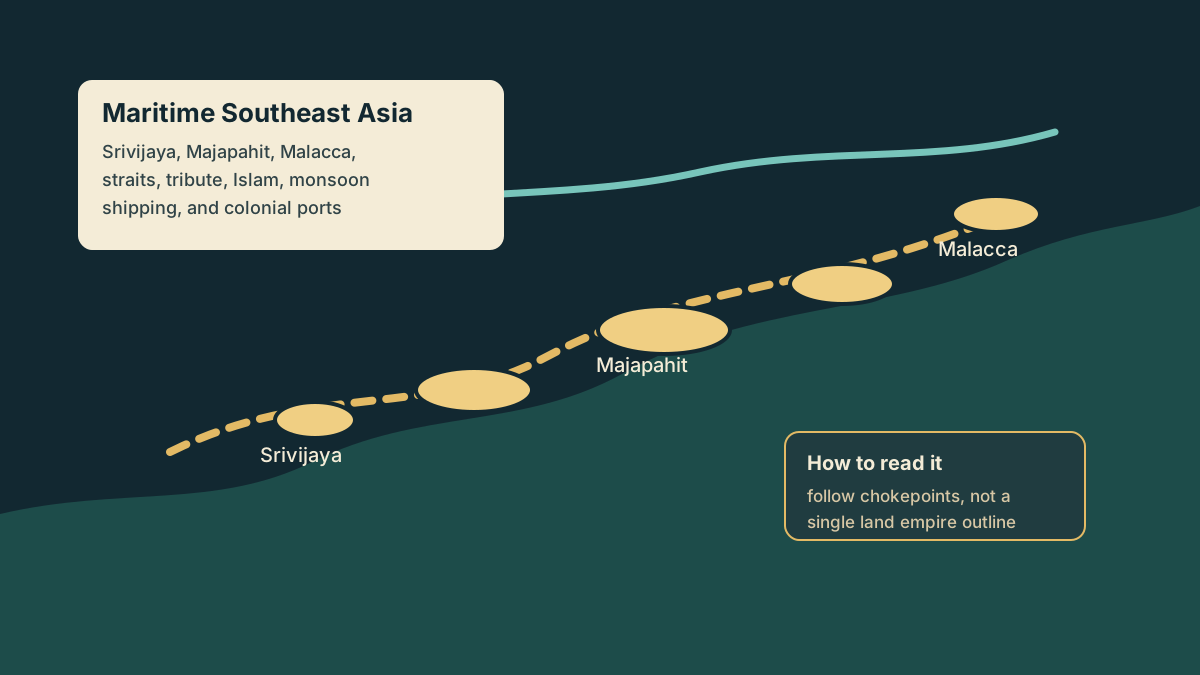
Maritime Southeast Asia is designed as a route, not a folder. It gathers events that answer related reader questions about power, belief, conflict, exchange, institutions, and memory. The strongest way to read the page is to move from the earliest events toward the later ones, watching how one kind of pressure changes form across different places.
The route currently runs from c. 100 CE to August 8, 1967. That span lets readers compare immediate turning points with slower consequences: the founding of institutions, the spread of ideas, the shock of war or disease, and the way later societies reused earlier events as warnings, models, or symbols.
Start with Funan Maritime Network Rises, Srivijaya Maritime Empire Rises, Pagan Kingdom Founded, Angkor Empire Founded in 802: Jayavarman II and the Long Buildout, Ayutthaya Kingdom Founded and then follow the internal links into people, timelines, years, maps, and source lists. The route structure stays visible when each event explains why it belongs with the others and where the next useful page is.
Compare the events by scale. Some are concentrated moments, such as a battle, proclamation, trial, or publication. Others are long processes, such as a reform movement, pandemic, trade route, or diplomatic order. Reading both types together helps prevent the page from becoming a list of dates.
A useful route keeps uncertainty visible. Historical change rarely has one cause or one clean ending, so the reader can separate background pressure, immediate trigger, turning point, result, and later memory. That pattern is what makes the atlas expandable without making the reader start over each time.
This route is also a comparison tool. After reading one event, compare it with a later event on the same page and ask what changed in scale, language, geography, technology, authority, or public memory. The comparison is often more useful than the individual summary because it reveals the pattern the topic page is built to expose. When a claim feels too neat, open the full event page and check whether the evidence supports one cause, several causes, or a contested interpretation before moving on.
Maritime Southeast Asia becomes readable when straits, deltas, islands, river basins, and port cities come first. The route moves from Funan and Srivijaya to Malacca, Bagan, Ayutthaya, Majapahit, Manila, Batavia, Java, Vietnam, Indonesia, and ASEAN. That order prevents a thin colonial story. Southeast Asian societies already had trade, writing, Buddhism, Islam, court ritual, diplomacy, and regional power before European companies arrived.
The port-polity problem is the hub's center. Malacca, Srivijaya, Batavia, and later Singapore-style regionalism show that a city can be powerful because it controls passage, trust, merchants, shipping calendars, tribute, warehouses, and language. A port is not just a place goods pass through. It is a political institution where rulers, brokers, migrants, soldiers, missionaries, and company agents negotiate who gets to move and who pays.
The modern route turns older maritime geography into colonial and anti-colonial history. The VOC, Java War, Philippine Revolution, Indonesian independence, Dien Bien Phu, Vietnam, and ASEAN all show Southeast Asia moving through different forms of pressure: chartered companies, treaty systems, colonial armies, nationalist writing, revolutionary warfare, Cold War intervention, and regional diplomacy. The hub lets a reader arrive through Angkor, Malacca, Vietnam, or ASEAN and still see the same larger regional structure.
The route begins before familiar colonial names because the region already contained sophisticated political forms. Funan used river and sea connections in the lower Mekong world; Srivijaya made Buddhist learning and control of movement part of its authority; Majapahit turned Java into a center of court culture and maritime ambition; Malacca organized trade, Islam, law, and diplomacy around a strategic strait. These were not waiting rooms for European arrival. They were historical systems with their own institutions and rivalries.
Geography explains why the region cannot be reduced to one mainland story. Monsoon winds, volcanic islands, river deltas, uplands, rice plains, spice islands, reefs, and narrow straits created many kinds of power. A ruler in a rice basin faced different problems from a ruler at a customs port. A sultanate guarding a strait needed brokers, ships, language skills, and trust. A highland community could resist lowland states through terrain, mobility, and local alliances.
Religion gives the route another layer of movement. Buddhism, Hindu traditions, Islam, Christianity, local ritual systems, and court cosmologies all moved through ports, monks, merchants, royal patronage, teachers, translations, and marriage networks. Imported religious languages did not simply replace local worlds. They were adapted to legitimize rulers, organize law, shape art, build temples and mosques, and create links with wider Asian and oceanic communities.
The VOC and Batavia show a new form of maritime coercion. Chartered company power mixed shareholders, ships, fortresses, monopoly claims, contracts, local alliances, violence, and bookkeeping. Company rule did not erase Southeast Asian agency, but it changed bargaining conditions. Spices, sugar, coffee, tin, rice, timber, and labor became tied to European demand, while local rulers, merchants, and communities navigated opportunities and threats inside a tightening commercial empire.
The Java War is a useful hinge because it brings rural society, court politics, religion, taxation, and colonial military power together. It prevents the route from becoming only port history. Inland Java mattered. Peasants, religious teachers, aristocrats, soldiers, and colonial officials all entered a conflict over authority and burden. The war reveals how maritime empire reached villages through roads, revenue, land claims, and military campaigns.
The Philippines gives the route a different colonial arc. Spanish rule, Manila's links to the Pacific and Americas, missionary institutions, local elites, print culture, reform movements, revolution, and later American occupation all make the archipelago a bridge across oceans. The Philippine Revolution belongs in this hub because it shows nationalism forming through education, language, martyrdom, armed struggle, and debates over what kind of state independence would create.
Vietnam and Dien Bien Phu bring the route into anti-colonial war and Cold War transformation. French colonial rule, Japanese wartime disruption, communist organization, peasant mobilization, international diplomacy, and U.S. intervention all shaped the longer Vietnamese struggle. Dien Bien Phu was not only a battle. It was a global signal that a European empire could be defeated militarily, and it reshaped debates over decolonization across Asia and Africa.
Indonesia's independence adds another layer: a vast island world turning anti-colonial revolution into state formation. Nationalism had to connect Java, Sumatra, Sulawesi, Kalimantan, eastern islands, Islamic organizations, socialist currents, local leaders, youth groups, Japanese occupation memories, Dutch return, diplomacy, and military struggle. The route becomes richer when Indonesia is read as a problem of making a nation across water, languages, and unequal regional power.
ASEAN gives the route a diplomatic ending without making conflict disappear. The organization emerged from a region marked by decolonization, confrontation, communism, military regimes, economic development, and Cold War pressure. Its importance lies in institution-building: habits of consultation, sovereignty language, economic coordination, and regional identity. ASEAN shows that maritime Southeast Asia is not only a story of colonial pressure and war; it is also a story of states trying to manage proximity after conflict.
The source trail is varied. Inscriptions, temple remains, Chinese records, Arabic and Malay texts, Portuguese and Dutch archives, Spanish missionary records, maps, port ledgers, nationalist newspapers, oral memory, and diplomatic documents each reveal different parts of the route. A trade ledger can show commodities while hiding coercion. A colonial map can show control while hiding local knowledge. A nationalist speech can show aspiration while simplifying regional diversity.
Visual material has a clear job here. A good map shows straits, deltas, ports, monsoon corridors, and island chains. A temple image shows court and religious authority. A ship or warehouse image shows trade infrastructure. A colonial city plan shows how company power organized space. A revolution image shows how anti-colonial politics moved from print and meetings into streets, prisons, and battlefields. The route becomes readable when visuals explain movement and control.
The route also invites comparison with the Indian Ocean, East Asia, and Pacific hubs. Maritime Southeast Asia connects all three without becoming identical to any of them. It shares monsoon trade with the Indian Ocean, diplomatic and cultural exchange with China and Japan, and island navigation with the Pacific, while keeping its own histories of sultanates, spice trade, company rule, nationalism, and regional diplomacy.
For search readers, the broad answer is simple but layered: Southeast Asian history is not a late colonial appendix. It is a history of ports, courts, religions, island networks, rice basins, companies, revolutions, wars, and regional institutions. A visitor asking for Malacca, Srivijaya, VOC, Philippine Revolution, Indonesia, Vietnam, or ASEAN can enter at any point and still find the larger pattern: control over movement repeatedly became political power.
The final reading path moves from older port-polities to colonial companies, then to nationalist revolutions and regional diplomacy. That sequence gives the page momentum. Each event answers a different question: who controlled the strait, who collected revenue, whose law organized trade, who resisted colonial extraction, which movement claimed sovereignty, and how neighboring states later tried to prevent conflict from becoming permanent.
Labor gives this maritime route its human scale. Sailors, pilots, dockworkers, rice farmers, plantation workers, scribes, translators, craft specialists, soldiers, religious teachers, and migrant merchants made the region's connections work. A strait mattered because people loaded ships, repaired hulls, calculated monsoon timing, collected customs, interpreted contracts, and carried news. Without that labor, port-polity power becomes an empty map of arrows.
The route also keeps women visible where the records allow it. Market women, royal women, textile producers, religious patrons, household managers, migrants, and revolutionary organizers shaped economic and political life even when formal chronicles foreground male rulers and soldiers. Southeast Asian history becomes fuller when household, market, and court connections sit beside naval power and diplomatic treaties.
A final source habit is comparison across empires. Portuguese, Dutch, Spanish, British, French, Japanese, and American power entered different parts of the region through different institutions. Comparing them helps readers see why colonial experiences varied so widely. It also explains why postcolonial states inherited different legal systems, languages, military structures, land regimes, and memories of occupation.
The route's strongest classroom question is about scale. Southeast Asia can be read from a single port, a river delta, an island chain, a colonial archive, a nationalist newspaper, or an ASEAN summit. Each scale reveals something and hides something. The hub works when readers can move between scales without losing the people whose lives made those systems real.
Read the events in order first; the page is built to reveal change over time.
Ask which pressures existed before the visible turning point and which actors had room to choose.
Follow what changed afterward in institutions, borders, law, belief, or everyday life.
Notice which events became symbols and why later generations kept returning to them.
Watch Malacca and other chokepoints as political spaces where distance, shipping, customs, and diplomacy became power.
Use the VOC and Batavia to see how finance, ships, forts, monopoly claims, and local alliances became colonial rule.
Read the Philippines, Indonesia, and Vietnam as different answers to colonial power, war, and international recognition.
Compare Buddhism, Islam, Hindu court languages, Christianity, and local ritual systems as sources of authority, art, law, and diplomacy.
Ask how Indonesia, the Philippines, and ASEAN turned island geography, language diversity, and colonial borders into political projects.
Choose a Reading Path
Start With the Timeline
Use the related timeline first when you want a chronological route through the topic.
Start with c. 100 CE: Funan Maritime Network RisesOpen a Person Page
Use people pages when the topic is easier to understand through leadership, resistance, reform, or memory.
Start with c. 650 CE: Srivijaya Maritime Empire RisesUse Year Pages
Use year pages when you need a fast answer to what changed in a specific year.
Start with 802 CE: Angkor Empire Founded in 802: Jayavarman II and the Long BuildoutReturn to the Map
Use the map to keep geography visible while moving between events and regions.
Start with 849 CE: Pagan Kingdom FoundedStart With Port-Polities
Use Funan, Srivijaya, Majapahit, and Malacca to see how ports, courts, religion, and control of movement created power before European companies.
Start with 1602 CE: Dutch East India Company FoundedFollow Company Power
Move to the VOC, Batavia, and Java War when the question becomes monopoly, revenue, land, labor, and colonial military reach.
Start with April 1955: Bandung ConferenceRead National Revolutions
Use the Philippines, Indonesia, and Vietnam to compare print culture, armed struggle, occupation, diplomacy, and postcolonial state-making.
Start with August 8, 1967: ASEAN FoundedEnd With Regionalism
Read ASEAN as an attempt to manage sovereignty, economic development, and diplomatic trust after decolonization and Cold War conflict.
How the Story Builds
Begin with Funan Maritime Network Rises. The opening event usually shows the pressure that made the route necessary: a crisis of authority, an expanding exchange system, a new technology, a contested idea, or a conflict that older institutions could no longer contain.
Dutch East India Company Founded works as a checkpoint because it lets readers ask what had become irreversible, which actors still had choices, and how the route changed scale between the opening event and the later consequences.
The later edge of the route includes Battle of Dien Bien Phu, Bandung Conference, and ASEAN Founded. These pages help readers see what survived beyond the first shock: institutions, borders, laws, memories, technologies, movements, or arguments that kept shaping later history.
The route is easier to remember through people and places. Watch figures such as Funan rulers and merchants, Srivijayan rulers, maritime merchants, Burmese rulers, Buddhist monastic communities, and Jayavarman II move through settings such as Mekong Delta, Palembang, Bagan, Angkor region, and Ayutthaya; that is where large structures become visible as choices, risks, costs, and memories.
Funan and Srivijaya show river mouths, ports, Buddhist learning, tribute, and shipping calendars becoming political infrastructure.
Majapahit and Malacca reveal how courts, law, merchants, Islam, and chokepoints made port-polities durable and contested.
The VOC, Batavia, and Java War connect shares, ships, forts, revenue, land, and rural resistance.
The Philippines, Indonesia, and Vietnam turn colonial crisis into revolution, occupation, diplomacy, and Cold War struggle.
ASEAN turns a region of conflict and decolonization toward consultation, economic coordination, and managed sovereignty.
- Which event in Maritime Southeast Asia feels like the true point of no return, and why might another reader choose a different event?
- What changes if the route is read from the perspective of ordinary people rather than rulers, armies, inventors, reformers, or institutions?
- Which consequence was immediate, and which consequence only became clear decades later?
- Where does the map change the interpretation by showing distance, borders, routes, ports, capitals, or frontiers?
- What made a port-polity powerful without a large land empire?
- How did local rulers adapt imported religious and political languages?
- Why did some Southeast Asian states face direct colonization while Siam preserved formal independence?
- How did ASEAN turn a region of conflict and decolonization toward institutional cooperation?
- How does an island map change the way readers understand nationalism and state formation?
- Which sources make merchants, rulers, villagers, company agents, revolutionaries, and diplomats visible in the same route?
Interactive Timeline
Follow Maritime Southeast Asia by sequence
Funan Maritime Network Rises
Funan emerged around lower Mekong trade paths, linking mainland Southeast Asia to wider Indian Ocean commerce, ports, ritual power, and political consolidation.
Read the full event pageMap Layer
Maritime Southeast Asia geography
Gold pins mark the approximate locations of published event pages. This is a schematic locator map, not a historical border map.
Coordinates are approximate and are used to help readers orient themselves before opening a full event page.
Route Events
Events in This Topic
Funan Maritime Network Rises
Funan emerged around lower Mekong trade paths, linking mainland Southeast Asia to wider Indian Ocean commerce, ports, ritual power, and political consolidation.
Srivijaya Maritime Empire Rises
Srivijaya rose around Sumatran waterways and sea lanes, using control of maritime paths, diplomacy, and Buddhist networks to shape regional power.
Angkor Empire Founded in 802: Jayavarman II and the Long Buildout
The traditional 802 foundation date points to Jayavarman II and a remembered claim to Khmer sovereignty, but Angkor's power developed through temples, reservoirs, labor, sacred geography, and repeated political consolidation.
Pagan Kingdom Founded
The Pagan kingdom emerged around Bagan, linking kingship, irrigation, Buddhism, temple patronage, and Upper Myanmar into a durable political and religious center.
Majapahit Empire Peaks
Majapahit power reached a high point in Java and the wider island world, combining court culture, tribute, trade paths, and later Indonesian political memory.
Ayutthaya Kingdom Founded
Ayutthaya rose in the Chao Phraya basin as a powerful Tai kingdom that combined rice agriculture, royal law, Buddhism, trade, and regional diplomacy.
Malacca Sultanate Rises
The Malacca Sultanate rose at a strategic strait, turning commerce, Islam, diplomacy, and Malay political culture into a major port-polity.
Malacca Falls to the Portuguese
Portuguese forces captured Malacca, a major Malay entrepot, placing European military power inside one of the key choke points of Asian maritime trade.
Spanish Colonization of the Philippines Begins
Spanish colonization began to create a durable imperial presence in the Philippines, linking local societies to Manila, Mexico, Christianity, and Pacific trade.
Dutch East India Company Founded
The Dutch East India Company was founded as a chartered corporation with commercial and political powers in Asian trade.
Batavia Founded
The Dutch East India Company founded Batavia on Java as a fortified colonial port, administrative center, and hub for Asian trade circuits.
Java War Begins
The Java War began as Prince Diponegoro and supporters challenged Dutch colonial power, court politics, land pressure, taxation, and religious grievances.
Bowring Treaty with Siam
The Bowring Treaty opened Siam to expanded British trade and extraterritorial privileges, showing how Southeast Asian states negotiated imperial pressure without direct colonization.
Philippine Revolution
The Philippine Revolution challenged Spanish colonial rule through nationalist organization, armed revolt, reformist memory, and competing visions of independence.
Indonesia Proclaims Independence
Sukarno and Mohammad Hatta proclaimed Indonesian independence after Japan's surrender, opening a revolutionary struggle against the return of Dutch colonial rule.
Battle of Dien Bien Phu
Viet Minh forces defeated the French at Dien Bien Phu, collapsing France's military position in Indochina and reshaping Cold War Southeast Asia.
Bandung Conference
Asian and African leaders met at Bandung to discuss anti-colonial solidarity, racial equality, economic cooperation, sovereignty, and alternatives to Cold War bloc politics.
ASEAN Founded
ASEAN was founded by Indonesia, Malaysia, the Philippines, Singapore, and Thailand to promote cooperation, development, and regional stability during the Cold War.
References
Where to Check the Facts
- Encyclopaedia Britannica: Southeast Asian historyReference for regional chronology, maritime exchange, colonial rule, nationalism, and modern state formation.
- Encyclopaedia Britannica: Sultanate of MalaccaReference for Malacca as a major Malay port-polity and commercial center before Portuguese conquest.
- Official UNESCO World Heritage Centre: AngkorInstitutional reference for the Angkor landscape, Khmer capitals, reservoirs, temples, and regional setting.
- Official ASEAN: About ASEANOfficial institutional reference for ASEAN's 1967 founding and regional-cooperation frame.