At a Glance
The shape of the event
- Date
- 1954 CE
- Place
- Dien Bien Phu
- Type
- Battle
Viet Minh forces defeated the French at Dien Bien Phu, collapsing France's military position in Indochina and reshaping Cold War Southeast Asia.
1954 CE; place the event in Dien Bien Phu before comparing causes or consequences.
The battle became a symbol of anti-colonial victory and a bridge from French imperial defeat to the Vietnam War.
Vo Nguyen Giap / Ho Chi Minh / French commanders are the first names or groups to compare before widening the story.
The Geneva settlement followed, temporarily dividing Vietnam and setting conditions for later conflict.
The Geneva settlement followed, temporarily dividing Vietnam and setting conditions for later conflict.
The battle became a symbol of anti-colonial victory and a bridge from French imperial defeat to the Vietnam War.
If Dien Bien Phu matters to you, follow the thread to the Geneva talks that immediately followed and to the year-by-year choices that turned a temporary division into a longer conflict.
Background
The roots of Dien Bien Phu lay in decades of French colonial rule in Indochina and in the rise of Vietnamese nationalism under leaders like Ho Chi Minh. After World War II the Viet Minh, a nationalist and communist-led coalition, waged an increasingly effective campaign to displace French authority. International pressures shaped the conflict: the Cold War cast local struggles as part of a global confrontation, affecting the flow of arms, advice, and political support. French commanders sought a decisive engagement to blunt the Viet Minh’s momentum and to reassure metropolitan audiences that France could maintain its empire. Viet Minh leaders, including General Vo Nguyen Giap, combined guerrilla tactics with growing conventional capabilities.
These military choices unfolded amid social strains—displacement, conscription, and the disruptions of long war—that affected Vietnamese civilians and French colonial communities alike. The stage at Dien Bien Phu therefore reflected both immediate operational calculations and deeper currents of anti-colonial politics, international rivalry, and the lived experience of communities caught between armies. Dien Bien Phu should not read like a remote battlefield detached from politics. France was trying to hold Indochina after World War II while Vietnamese revolutionaries framed the war as national liberation, social revolution, and anti-colonial legitimacy. The Cold War gave the struggle international meaning, but the battle was rooted in Vietnamese and French choices about empire, sovereignty, supply, and morale. The geography is the key to the story.
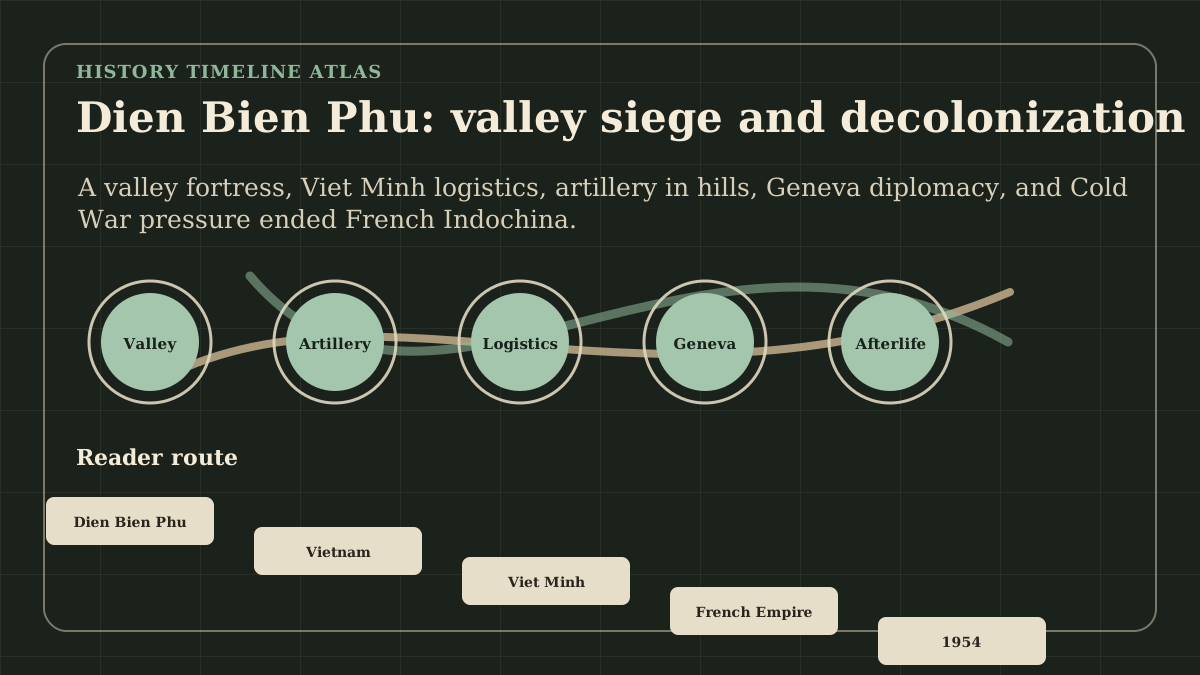
French planners built an air-supplied fortress in a valley, hoping to draw Viet Minh forces into a battle they could destroy. Vo Nguyen Giap's forces turned that assumption against them by moving artillery into surrounding hills, building supply routes, digging trenches, and making the valley less like a trap for the Viet Minh than a trap around the French position. Readers also need the labor layer. Porters, bicycle convoys, engineers, anti-aircraft crews, nurses, local communities, and soldiers made the siege possible. The battle was not only generals on a map; it was a contest over who could keep people, shells, food, roads, and morale moving under pressure.
The Turning Point
Dien Bien Phu crystallized a set of concrete choices taken by commanders on both sides. French commanders established a fortified garrison in a valley, betting that firepower and air supply would compensate for isolation and force the Viet Minh to fight on terms favorable to France. Viet Minh leadership under General Vo Nguyen Giap made the deliberate decision to move heavy artillery into nearby hills and to lay siege rather than engage only in hit-and-run actions. That choice turned the battleground into a war of attrition and engineering: trenches, artillery positions, and supply routes became decisive. Ho Chi Minh’s political role shaped the broader commitment to press the assault as a national liberation struggle.
As the siege tightened, decisions about resupply, reinforcement, and local civilian protection became urgent. French hopes for an organized relief or a negotiated pause collided with Viet Minh persistence and battlefield adaptation. Those concrete tactical and logistical decisions—not a single dramatic moment—produced the collapse of the garrison and the collapse of France’s military posture in Indochina. The turning point was the French loss of control over the conditions of battle. Air supply became dangerous, artillery positions were harder to silence than expected, and Viet Minh trenches tightened the siege. Once the surrounding hills and supply rhythm favored the attackers, the fortress logic began to fail. The fall of Dien Bien Phu mattered because it connected battlefield defeat to negotiation.
The Geneva Conference did not simply record a military fact; it turned French exhaustion, Viet Minh leverage, Chinese and Soviet interests, U. S. caution, and Vietnamese division into a settlement with a long afterlife.
Consequences
In the immediate aftermath, the defeat at Dien Bien Phu removed France’s principal leverage in negotiations over Indochina. The Geneva settlement that followed temporarily divided Vietnam and set conditions that would be contested and reworked in the years to come. Politically, the battle became shorthand for the limits of traditional European colonial power and a proof point for anti-colonial movements elsewhere. For Vietnamese communities the consequences were mixed and complex: some saw the battle as liberation manifested, while others faced new dislocations as borders and administrations changed. Internationally, the outcome reshaped Cold War calculations in Southeast Asia, influencing how external powers assessed intervention, alliance commitments, and the balance between political and military tools.
Over time Dien Bien Phu accumulated symbolic weight beyond its tactical origins; memory and political uses of the battle contributed to narratives that linked French imperial defeat to later conflicts, including the prolonged struggle that followed the Geneva agreements. The result was not a tidy end but a turning of one page that made subsequent chapters of conflict and diplomacy more likely. The immediate consequence was the collapse of France's military position in Indochina and a settlement that temporarily divided Vietnam. The longer consequence was a new stage of conflict in which the United States became more deeply involved, South Vietnam and North Vietnam developed under rival political systems, and the Vietnam War grew out of unresolved decolonization.
Dien Bien Phu also became a global symbol. Anti-colonial movements read it as proof that a European empire could be defeated by organized revolutionary war. That symbolism should not erase Vietnamese suffering or later conflict, but it explains why a valley battle became a world-historical event.
Interpretation Notes
Battle of Dien Bien Phu is easy to flatten into one dramatic date. A stronger reading separates immediate action from deeper causes, affected communities, and the memory later states or movements built around the event.
Why Keep Reading
If Dien Bien Phu matters to you, follow the thread to the Geneva talks that immediately followed and to the year-by-year choices that turned a temporary division into a longer conflict. Explore how different communities interpreted the battle—soldiers, civilians, colonial settlers, and revolutionaries—and how those memories informed later politics. Studying the logistical and diplomatic follow-ups reveals why one battlefield outcome rippled into Cold War strategy, decolonization debates, and the choices of external powers. Each step after Dien Bien Phu helps explain how a military event became a political hinge for Southeast Asia’s mid-century transformations. Read Dien Bien Phu between Indonesia's independence proclamation, Bandung, the Cold War timeline, Vietnam War escalation, and the fall of Saigon.
That path shows decolonization turning into a Cold War system without becoming only a superpower story.
Reading Path
Follow the story without losing the thread
Before This
- Algerian War BeginsNovember 1954
- Guatemalan Coup1954
- Korean ArmisticeJuly 27, 1953
After This
- Warsaw Pact FoundedMay 1955
- Bandung ConferenceApril 1955
- Suez Crisis1956 CE
Same Period
- Bandung ConferenceApril 1955
- Congo Independence and Crisis1960 CE
- Angola Gains IndependenceNovember 11, 1975
Wider Timeline
Mind Map
How to think about Battle of Dien Bien Phu
Colonial pressure
Decades of French rule and rising Vietnamese nationalism created the political context for armed struggle
Map Layer
Where this event sits geographically
Gold pins mark the approximate locations of published event pages. This is a schematic locator map, not a historical border map.
Coordinates are approximate and are used to help readers orient themselves before opening a full event page.
References
Where to Check the Facts
- Encyclopaedia Britannica: Dien Bien PhuReference for the battle and French defeat in Indochina.
- Encyclopaedia Britannica: Ho Chi MinhBiographical reference for Ho Chi Minh and Vietnamese nationalism.
- U.S. National Archives: The Cold WarArchive reference hub for Cold War records, federal documentation, and research guidance.
- Office of the Historian: The Early Cold War, 1945-1952Official diplomatic history reference for early Cold War foreign-policy context.