At a Glance
The shape of the event
- Date
- July 27, 1953
- Place
- Panmunjom
- Type
- Armistice Agreement
The Korean Armistice stopped major fighting in the Korean War and created a military ceasefire framework while leaving Korea divided without a final peace treaty.
July 27, 1953; place the event in Panmunjom before comparing causes or consequences.
The armistice made Korea one of the Cold War's most durable front lines and shaped U.S., Chinese, Korean, and regional security policy for decades.
United Nations Command / North Korean commanders / Chinese commanders are the first names or groups to compare before widening the story.
Large-scale combat halted, but North and South Korea remained divided under a tense military order.
Large-scale combat halted, but North and South Korea remained divided under a tense military order.
The armistice made Korea one of the Cold War's most durable front lines and shaped U.S., Chinese, Korean, and regional security policy for decades.
The next useful step is to follow the linked events, people, topic routes, and timelines.
Background
The war had escalated from a peninsula conflict into a major Cold War war involving the United Nations, the United States, China, and the Soviet-backed North Korean state. By 1953, massive losses and battlefield stalemate made negotiation more attractive than decisive victory. Before Korean Armistice, the surrounding world already contained unresolved tensions over authority, resources, belief, strategy, or legitimacy. Those pressures mattered because they shaped what different actors thought was possible. Single-cause explanations flatten the background, which was usually a mix of long-running structures and immediate decisions. The location in East Asia also matters, because events there connected local choices to wider routes of diplomacy, war, trade, reform, or memory.
This context prepares the reader to see the event as part of a sequence rather than as an isolated headline. The armistice is best read as a frozen ending. By 1953, the Korean War had connected civil conflict, partition, UN action, Chinese intervention, U. S. containment, Soviet support, bombing, refugees, prisoners, and massive destruction. The agreement stopped large-scale fighting, but the political question of Korean sovereignty remained unresolved. The human stakes were enormous. Prisoner-of-war negotiations, displaced families, destroyed cities, military casualties, civilian trauma, ideological division, and the hardening of the Demilitarized Zone all belonged to the same event. A line on a map meant homes, fields, roads, and kin networks were cut by armed rules.
The page matters because readers often ask when the Korean War ended. The careful answer is that the major fighting stopped in 1953, but the political conflict did not end with a peace treaty. That distinction explains why the armistice is still part of living geopolitics.
The Turning Point
The armistice established a ceasefire, prisoner arrangements, and the demilitarized zone. It did not settle sovereignty or reunification. That distinction makes the event crucial: the Cold War could freeze a conflict into an armed border rather than resolve the political question that had started the war. The turning point was not simply that the event occurred, but that it changed the range of options available afterward. People connected to United Nations Command, North Korean commanders, Chinese commanders acted inside constraints created by earlier conflicts, institutions, and expectations. Some choices were deliberate; others were responses to pressure, fear, opportunity, or failed compromise. The event's form as armistice agreement also shaped how consequences unfolded.
It made certain outcomes easier to imagine, gave later actors new evidence or symbols to use, and forced communities to adapt to a situation that could no longer be treated as temporary. The turning point was the decision to freeze the battlefield instead of fight for total victory. Stalemate, casualties, leadership changes, prisoner disputes, and the risk of wider escalation made an armistice more plausible than reunification by force. Panmunjom gave the settlement a place and procedure. Signatures, commissions, demarcation lines, inspections, and prisoner arrangements turned battlefield exhaustion into a managed military order. The event is therefore institutional as well as military.
Consequences
Large-scale combat halted, but North and South Korea remained divided under a tense military order. The armistice made Korea one of the Cold War's most durable front lines and shaped U. S. , Chinese, Korean, and regional security policy for decades. The immediate result mattered, but the longer effect came from how later people interpreted and reused the event. Some consequences were institutional: laws, borders, offices, alliances, or systems of rule changed. Others were social or cultural: public memory, political language, religious identity, or expectations about power shifted. Read the event on two clocks at once. One clock follows the immediate aftermath; the other follows the slower movement of influence into later crises, reforms, debates, and historical comparisons.
The demilitarized zone became a border, a symbol, and a daily security structure. It shaped military planning, family memory, propaganda, refugee lives, and regional diplomacy long after the war disappeared from many global headlines. The event therefore links Cold War military history to the continuing history of divided Korea. The armistice also shaped regional security. U. S. commitments, Chinese memory, United Nations precedent, Japanese security debates, nuclear questions, and later diplomacy all connect back to the fact that the war ended without a final peace. That unfinished quality is exactly why the page should not read like a simple end date. It is a history of rules for not fighting, backed by armies that remained ready to fight.
The armistice created procedures, but it also normalized alertness, propaganda, border incidents, alliance planning, and repeated diplomatic returns to a war that had never been politically closed.
Interpretation Notes
Calling the event an ending can mislead. It ended the main war phase, but it left family separation, militarization, ideological rivalry, and unresolved sovereignty at the center of Korean history.
Why Keep Reading
The next useful step is to follow the linked events, people, topic routes, and timelines. Korean Armistice becomes clearer when it is compared with what came before and after it, especially events in Cold War and related pages about Cold War and Korean War. The map helps locate the event, the mind map separates causes from effects, and the source list gives readers a way to check the factual spine. Keep reading to see whether this event was a beginning, a turning point, an ending, or a symbol that later generations kept reworking. Read the armistice after the Korean War begins, then continue to Cold War containment, China in 1949, Vietnam, nuclear diplomacy, and modern Korean crisis pages.
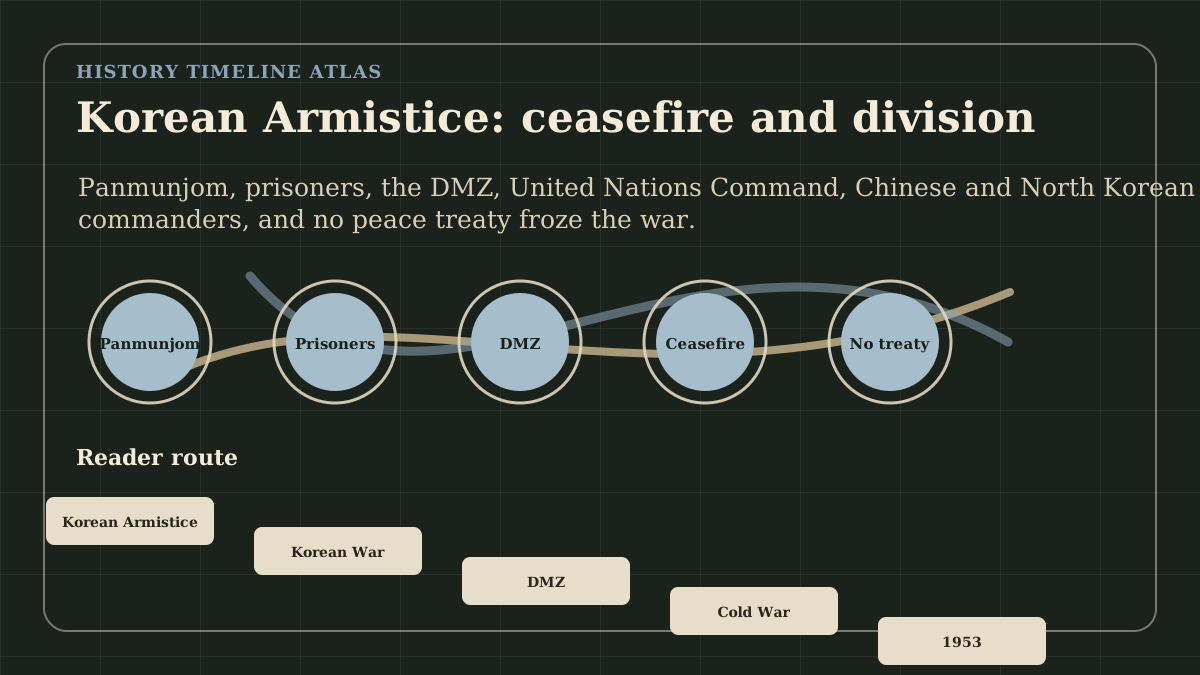
The route shows how a ceasefire can become a long historical structure.
Reading Path
Follow the story without losing the thread
Before This
- ANZUS Treaty Signed1951
- Korean War BeginsJune 25, 1950
- NATO FoundedApril 4, 1949
After This
- Battle of Dien Bien Phu1954 CE
- Guatemalan Coup1954
- Warsaw Pact FoundedMay 1955
Same Period
- Cuban Missile CrisisOctober 1962
- Apollo 11 Moon LandingJuly 20, 1969
- Fall of the Berlin WallNovember 9, 1989
Wider Timeline
Mind Map
How to think about Korean Armistice
Pressure
The war had escalated from a peninsula conflict into a major Cold War war involving the United Nations, the United States, China, and the Soviet-backed North Korean state. By 1953, massive losses and battlefield stalemate made negotiation more attractive than decisive victory.
Map Layer
Where this event sits geographically
Gold pins mark the approximate locations of published event pages. This is a schematic locator map, not a historical border map.
Coordinates are approximate and are used to help readers orient themselves before opening a full event page.
References
Where to Check the Facts
- U.S. National Archives: Korean War Armistice AgreementArchive reference for the July 1953 armistice agreement and its legal setting.
- U.S. Department of State: Text of the Korean War Armistice AgreementGovernment text reference for the armistice terms and ceasefire framework.
- Encyclopaedia Britannica: Korean WarReference for the war's chronology, armistice, and lasting division.
- U.S. National Archives: The Cold WarArchive reference hub for Cold War records, federal documentation, and research guidance.
- Office of the Historian: The Early Cold War, 1945-1952Official diplomatic history reference for early Cold War foreign-policy context.
- United Nations: History of the United NationsOfficial institutional reference for United Nations founding, charter drafting, and postwar aims.