At a Glance
The shape of the event
- Date
- 1025 CE
- Place
- Palembang and the Strait of Malacca
- Type
- Naval campaign
The Chola dynasty launched naval attacks against Srivijaya, exposing how South Asian and Southeast Asian powers competed over Indian Ocean and Strait of Malacca routes.
1025 CE; place the event in Palembang and the Strait of Malacca before comparing causes or consequences.
The raid helps readers see Indian Ocean history as an Asian and Afro-Eurasian network before Portuguese, Dutch, or British imperial entry.
Rajendra Chola I / Srivijayan rulers are the first names or groups to compare before widening the story.
Srivijaya suffered a major blow, while Chola power projected itself across the Bay of Bengal and into Southeast Asian waters.
Srivijaya suffered a major blow, while Chola power projected itself across the Bay of Bengal and into Southeast Asian waters.
The raid helps readers see Indian Ocean history as an Asian and Afro-Eurasian network before Portuguese, Dutch, or British imperial entry.
Move next to Srivijaya, the Indian Ocean trade route, Angkor, Song China, and later Malacca.
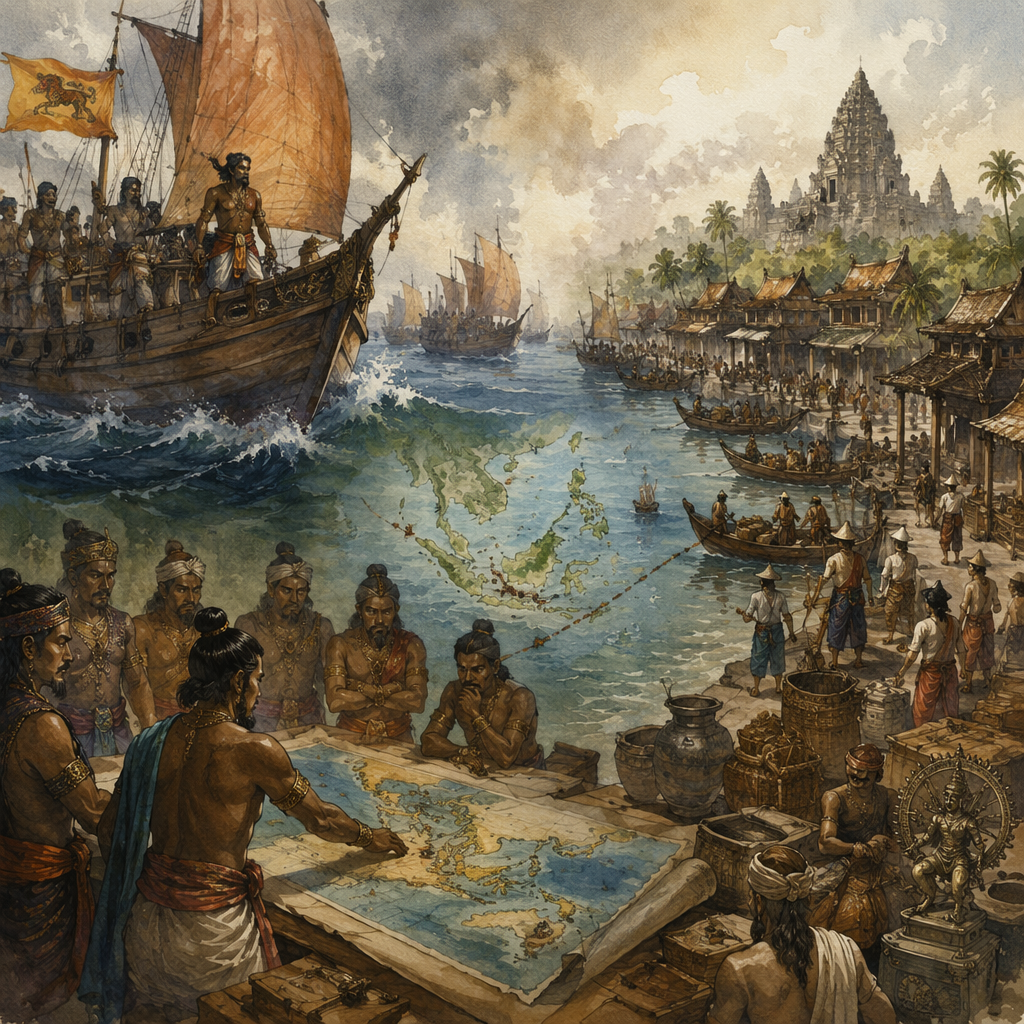
Background
By the early eleventh century the Indian Ocean was a dense web of exchange linking South Asia, Southeast Asia, China and the Arabian world. Srivijaya, based in Palembang and dominant around the Strait of Malacca, had long profited from controlling chokepoints and the flow of luxury goods, pilgrims and regional shipping. The Chola dynasty, based in southern India, had consolidated power on land and developed the maritime reach to protect and expand economic interests across the Bay of Bengal. These were not simple religious or cultural missions; they were commercial and strategic calculations made by rulers whose fortunes depended on seaborne traffic.
Pressure points included control of straits and ports, rights to collect duties or escorts, and the security of merchant networks. Multiple forces—competition for trade revenues, diplomatic rivalry, and opportunities presented by shifting alliances—combined to make armed maritime action a plausible instrument of policy. No single cause explains the raid: it must be read as a response to intertwined economic incentives and political ambitions in a crowded, interlinked ocean. The Chola raid on Srivijaya belongs to a maritime world where power moved by temple patronage, merchant guilds, naval reach, and control of straits. Rajendra Chola I ruled from a South Indian empire with strong links to Bay of Bengal commerce. Srivijaya controlled or influenced key points around the Strait of Malacca.
The raid makes sense when readers see the sea not as empty distance but as a political corridor crowded with ships, envoys, ports, monasteries, and merchant communities.
The Turning Point
The decisive change was the Chola decision to take naval action in 1025 CE under Rajendra Chola I, directing seaborne forces against Srivijayan positions in Palembang and the Strait of Malacca. The operation demonstrated practical command of long-distance maritime logistics: Chola vessels crossed open water, struck port infrastructure, and challenged Srivijaya’s control of a key maritime chokepoint. For contemporaries, the raid announced that coastal power could be contested not only by diplomacy and tribute but by seaborne force projected from across the Bay of Bengal. That choice—targeted naval pressure rather than full-scale continental conquest—shaped the episode’s immediate character.
Srivijaya suffered a major blow to its prestige and capacity to police traffic, while Rajendra Chola I’s realm showed it could operate far beyond its shores. Historians differ on how permanent the Chola occupation, if any, proved; the safer interpretation emphasizes that the raid imposed commercial and political pressure rather than straightforward territorial annexation across the sea. The turning point was the projection of Chola naval power across the Bay of Bengal into Srivijayan space. This was not a border skirmish. It was a long-distance strike against nodes of maritime authority, designed to signal capacity and disrupt a rival's prestige. The campaign shows that Indian Ocean and Southeast Asian politics were deeply connected before European oceanic empires.
South Asian rulers could intervene in Southeast Asian waters, and port polities could become targets because they sat astride routes that mattered far beyond their harbors.
Consequences
In the months and years after 1025, the strike against Srivijaya disrupted established patterns of control in the Strait of Malacca and signaled a new willingness among South Asian powers to use maritime force for commercial ends. Near-term, Srivijaya’s authority over shipping and tributary relationships was damaged; its capacity to act as an uncontested regional broker was diminished. Chola power was visibly projected into Southeast Asian waters, altering diplomatic calculations and encouraging coastal polities to reassess alliances and protections for merchants. In longer perspective, the raid underscored the Indian Ocean as an arena of Asian and Afro-Eurasian agency long before European entries that appear in later centuries.
It contributed to shifting networks of control around key routes and ports, influenced how states thought about naval capability and trade security, and left a historiographical puzzle: the evidence supports a major punitive and commercial intervention but offers contested claims about durable territorial rule. The event thus invites readers to see maritime history as contested, mobile, and driven by commercial stakes as much as by dynastic ambition. The raid damaged Srivijaya's aura of invulnerability, but it did not erase maritime Southeast Asia's importance. Trade continued, ports adapted, and later powers still competed for the same choke points.
The event matters because it reveals how commerce and war were intertwined: protecting merchants, rewarding allies, claiming prestige, and pressuring rivals could all belong to a single naval campaign. It also helps readers avoid a land-centered view of empire. In this case, ships, monsoon routes, and port diplomacy were the battlefield. The safest interpretation is pressure rather than durable conquest. Chola inscriptions celebrate victory, but they do not prove long-term occupation of Srivijaya's ports. A stronger reading treats the campaign as a demonstration of naval reach that disrupted prestige, tribute, and commercial confidence across the Bay of Bengal.
That source boundary matters because royal inscriptions are political texts: they tell readers what the Chola court wanted remembered as much as what happened at each harbor.
Interpretation Notes
The event is sometimes described as conquest, but the safer reading emphasizes targeted maritime pressure, commercial stakes, and contested evidence over durable territorial rule.
Why Keep Reading
Move next to Srivijaya, the Indian Ocean trade route, Angkor, Song China, and later Malacca. The raid becomes more interesting when it is read as one episode in a maritime system where temples, ports, merchants, monsoon timing, and royal inscriptions all shaped power without turning the sea into simple territory.
Reading Path
Follow the story without losing the thread
Before This
- Swahili Coast City-States Risec. 900 CE
- Srivijaya Maritime Empire Risesc. 650 CE
- Funan Maritime Network Risesc. 100 CE
After This
- Kilwa Sultanate Flourishesc. 1200 CE
- Great Zimbabwe Flourishesc. 1250 CE
- Majapahit Empire Founded1293 CE
Same Period
- Swahili Coast City-States Risec. 900 CE
- Kilwa Sultanate Flourishesc. 1200 CE
- Ibn Battuta Visits Kilwa1331 CE
Wider Timeline
Mind Map
How to think about Chola Raid on Srivijaya
trade chokepoint
Strait of Malacca’s control concentrated maritime tolls and influence over regional shipping
Map Layer
Where this event sits geographically
Gold pins mark the approximate locations of published event pages. This is a schematic locator map, not a historical border map.
Coordinates are approximate and are used to help readers orient themselves before opening a full event page.
References
Where to Check the Facts
- Encyclopaedia Britannica: Chola dynastyReference for Chola rulers, South Indian setting, and overseas activity.
- Encyclopaedia Britannica: Srivijaya empireReference for Srivijaya's maritime role and the Chola attack of 1025.