At a Glance
The shape of the event
- Date
- 710
- Place
- Nara
- Type
- Capital Foundation
Japan established a permanent capital at Nara, strengthening court government, Buddhist institutions, and written administration.
710; place the event in Nara before comparing causes or consequences.
The event gives Japanese history a city and institution route inside the wider East Asian map.
Japanese court officials / Buddhist clergy are the first names or groups to compare before widening the story.
Nara became a visible center of state formation and cultural borrowing.
Nara became a visible center of state formation and cultural borrowing.
The event gives Japanese history a city and institution route inside the wider East Asian map.
If Nara made Japan legible on a map of East Asian polities, the next steps tell how that legibility was used and who resisted it.
Background
By the early eighth century, rulers on the islands we call Japan were managing more than palace ritual: they negotiated claims to land and labor, handled diplomatic intercourse with neighboring states, and increasingly relied on text — records, ordinances, and sutras — to make authority stick. Buddhist institutions had grown in size and prestige, drawing elite sponsorship while also shaping literacy and artistic production. Court officials sought tools to coordinate taxation, conscription, and the circulation of legal norms; clergy sought stable bases for teaching and copying texts. External models mattered: Chinese capitals and continental bureaucratic practice provided templates, but local geography, aristocratic networks, and craft skills filtered those models into specifically Japanese forms.
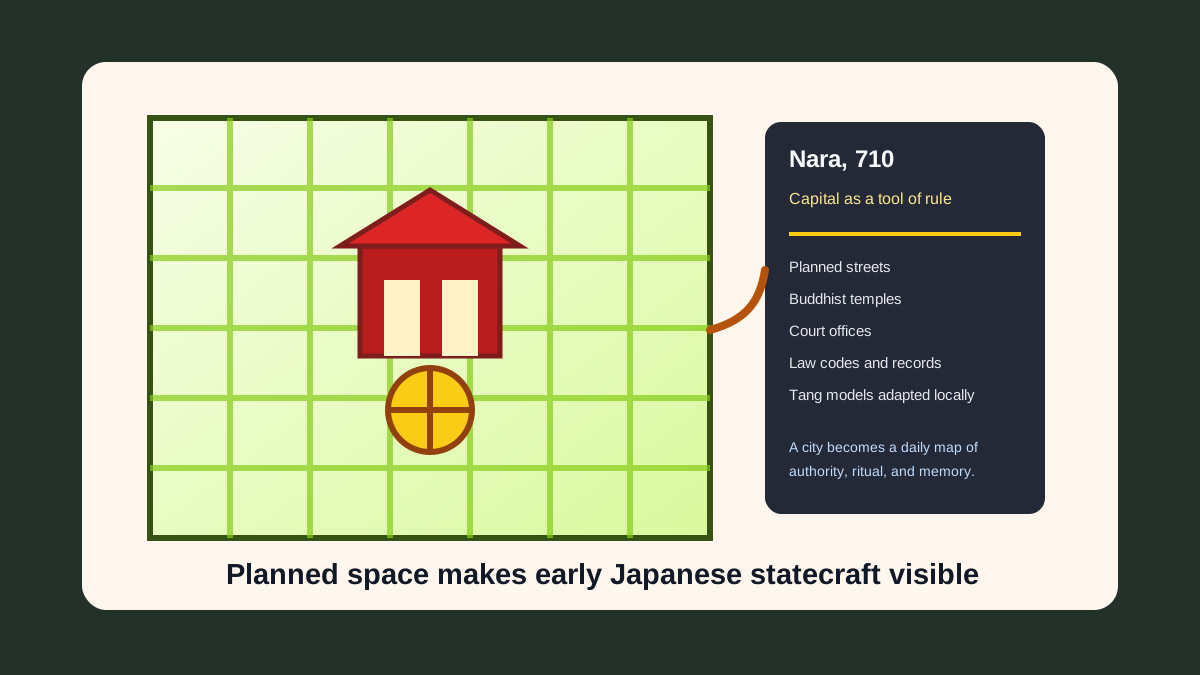
Equally important were the people who physically built and inhabited any capital: laborers quarrying stone, artisans making tiles, monks composing sutras, and administrators filling registers. No single pressure explains the move to Nara; that decision answered administrative needs, religious aspirations, diplomatic postures, and practical possibilities all at once. Nara should be read as a state-building project, not only an early Japanese capital. The new city drew on continental models, court ritual, Buddhism, law codes, written administration, and a planned urban layout. The move helped Yamato rulers make authority visible in streets, temples, offices, and ceremonies. The capital also shows how borrowing works.
Nara's planners learned from Tang China and the wider East Asian Buddhist world, but they did not simply copy. Imported forms were adapted to local aristocratic networks, shrine traditions, landholding, and court politics.
The Turning Point
The founding of Nara in 710 was an act of concentrated decision-making by court officials in close collaboration with Buddhist clergy. Choosing a fixed site marked a break from the earlier pattern of moving the court with each new reign: the court invested resources in permanent palaces, major monasteries, and a planned street grid, and it deliberately embedded religious institutions into the urban fabric. Officials used written instruments — land records, tax lists, and administrative orders — with renewed emphasis, while clergy consolidated large temple complexes that housed scriptoria for copying sutras and training monks. These were not merely symbolic moves.
Laying out a capital required mobilizing labor, organizing supply chains for building materials, and creating visible monuments of state presence. The court’s choices made governance more spatially anchored and made Buddhist institutions more central to public life. Yet what counts as the decisive change depends on which evidence you privilege: the edicts and court diaries that show policy, the scaffolding cuts and tile kilns archaeologists unearth, or local memories of who built and who benefited. The turning point is thus both administrative — a shift toward settled, written governance — and social: an intensified interplay of political will and religious power enacted in brick and timber.
The turning point was the decision to concentrate rule in a more permanent capital with temples, bureaucratic offices, and ritual spaces. Political authority became easier to stage, record, tax, and remember.
Consequences
In the immediate decades after 710, Nara operated as a focal point for state-building: it centralized ritual performance, concentrated bureaucratic staff, and hosted major temples that became repositories of wealth and knowledge. The visible clustering of courts and monasteries made diplomacy and law-making more legible to contemporaries and to later chroniclers. For the people who worked there, the city created new patterns of employment and drew craft production into more regular circuits. Over the longer term, the establishment of a permanent capital left a durable imprint on Japan’s institutional vocabulary. Town planning, written record-keeping, and monastic networks all acquired a model that later rulers could adopt, adapt, or reject.
Nara’s presence on the map also reoriented cultural exchange: it turned Japan into a clearer interlocutor within East Asian diplomatic and religious networks. But consequences were uneven and contested. Temples accumulated wealth and influence, sometimes amplifying court authority and at other times complicating it; archaeological layers reveal both monumental investment and quotidian continuity; oral traditions and later historiography sometimes remake the past to serve later claims. In short, Nara’s establishment opened institutional avenues and left physical traces that shaped trajectories — even while multiple voices continued to argue about what that transformation meant. The Nara period shaped Japanese Buddhism, court culture, law, land policy, and later movement to Heian-kyo.
The page should prepare readers to see capitals as tools of government and memory, not just addresses for rulers. It also helps explain why temples, archives, and urban plans can become evidence for how authority was organized and performed across generations.
Interpretation Notes
Interpretations of Nara Capital Established depend on whose evidence is centered: rulers and official records, affected communities, oral memory, archaeology, law, diplomacy, labor, and later public memory do not always tell the same story.
Why Keep Reading
If Nara made Japan legible on a map of East Asian polities, the next steps tell how that legibility was used and who resisted it. Follow the threads of administrative change and religious patronage to see how law, diplomacy, and artistic production flowed from this new center. Look into the lives of the workers and monks whose labor built the city, and into the archaeological evidence that complicates official narratives. Tracing what Nara made possible leads directly to later capital projects, shifts in court culture, and the slow negotiation between written authority and lived experience — all of which illuminate how statehood is built, remembered, and revised.
Read Nara before Heian, Tang China, Taika reforms, and Buddhist routes to see how East Asian statecraft traveled and changed in local use.
Reading Path
Follow the story without losing the thread
Before This
- Srivijaya Maritime Empire Risesc. 650 CE
- Taika Reforms645
- Kushan Empire Risesc. 30 CE
After This
Same Period
- Qin Unification of China221 BCE
- First Opium War Begins1839 CE
- Meiji Restoration1868 CE
Wider Timeline
Mind Map
How to think about Nara Capital Established
Bureaucratic demand
Need for consistent record-keeping and tax administration pushed officials toward a permanent seat of government.
Map Layer
Where this event sits geographically
Gold pins mark the approximate locations of published event pages. This is a schematic locator map, not a historical border map.
Coordinates are approximate and are used to help readers orient themselves before opening a full event page.
References
Where to Check the Facts
- Encyclopaedia Britannica: Tang dynastyReference for Tang state formation, government, culture, and regional influence.
- Encyclopaedia Britannica: Song dynastyReference for Song political chronology, economy, technology, and culture.
- Official UNESCO World Heritage Centre: Historic Monuments of Ancient NaraInstitutional reference for Nara's capital landscape, Buddhist monuments, and East Asian cultural exchange.