At a Glance
The shape of the event
- Date
- 645
- Place
- Yamato court
- Type
- Reform
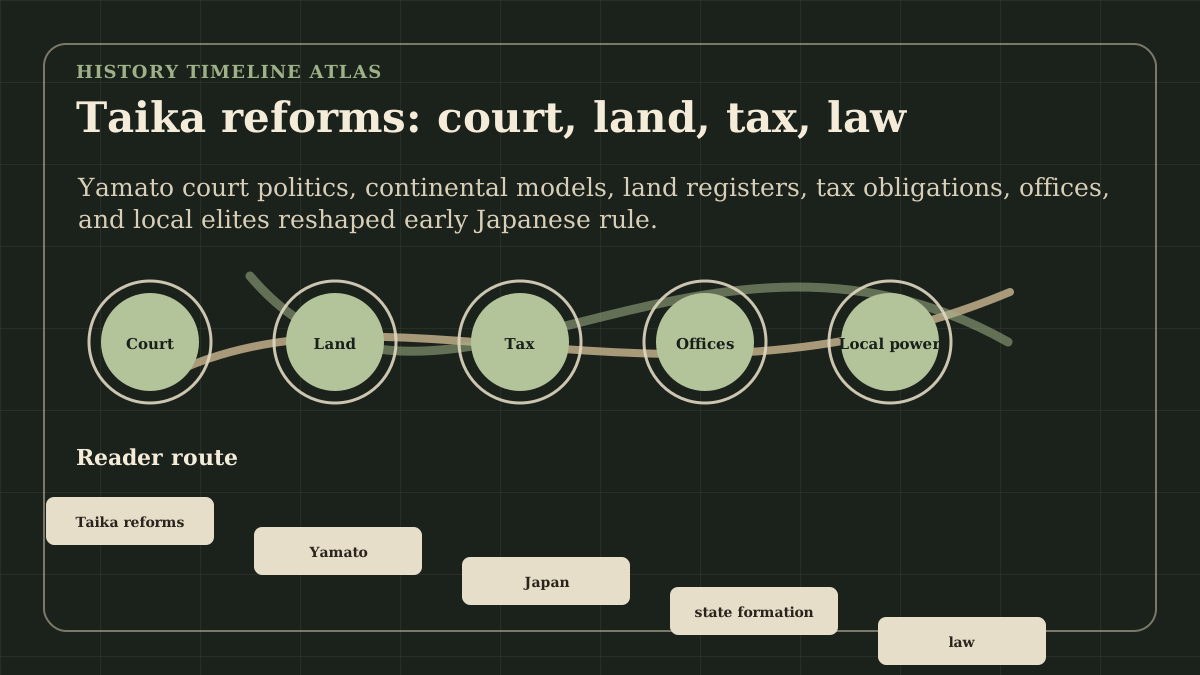
The Taika reforms reorganized court authority, land, taxation, and administration under a more centralized model influenced by continental systems.
645; place the event in Yamato court before comparing causes or consequences.
The event connects East Asian state formation through adaptation rather than simple imitation.
Emperor Kotoku / Nakatomi no Kamatari are the first names or groups to compare before widening the story.
Japan's court moved toward stronger imperial institutions and bureaucratic government.
Japan's court moved toward stronger imperial institutions and bureaucratic government.
The event connects East Asian state formation through adaptation rather than simple imitation.
Follow the next entries to trace how these institutional choices were tested, contested, and made durable.
Background
By the mid seventh century the Yamato court faced overlapping pressures: rival elite factions jockeyed for influence, control of land and manpower mattered for military and ritual claims, and diplomatic and legal practices in nearby polities offered templates for stronger, written administration. Emperors and court aristocrats had long relied on personal networks, kinship, and local magnates to govern a patchwork of provinces. At the same time, longer-distance contacts — envoys, scribes, craftsmen, and objects moving across East Asia — meant that ideas about cadasters, tax registers, and bureaucratic ranks were known within elite circles. Those ideas did not arrive as a single blueprint. They circulated as possibilities that the Yamato court could adapt, reject, or combine with local practice.
The moment before 645 was therefore one of contingency: enough pressure and enough knowledge to make centralizing reform plausible, but not inevitable. Who pushed for change, and which models were chosen, would shape the next phase of Japanese state formation. The Taika reforms become clearer when they are read as a court project to make rule more legible. Yamato leaders were not only copying Tang China. They were selecting continental tools that could help them organize land, rank, offices, taxation, and labor inside a Japanese political world with its own kinship groups and local powers. Court politics gave the reforms urgency.
The killing of Soga no Iruka, the rise of Nakatomi no Kamatari, the role of Prince Naka no Oe, and Emperor Kotoku's reign all show that administrative change came through struggle at the center. Institutional reform followed a contest over who could define legitimate authority. For local communities, centralization was not an abstract model. Registers, land claims, corvee obligations, tax assessments, and provincial offices changed how households became visible to the court. The reform program mattered because it turned political ambition into administrative routines.
The Turning Point
The core decisions of 645 concentrated authority in ways that changed the mechanics of rule. Under the leadership of Emperor Kotoku and with the political force of Nakatomi no Kamatari, the court announced measures that reworked landholding, tax obligations, and administrative roles. These were choices about organization—mapping land as a resource to be assessed, clarifying who could levy labor and grain, and reconstituting the office-holders who would carry out those functions. The reforms also reoriented the court’s claim to sovereignty: rather than relying primarily on personal allegiance and localized power-brokers, the Yamato leadership asserted a more formal, bureaucratic claim to administer territory and population. At the same time these were selective adoptions of outside practices.
The court borrowed concepts and instruments from continental systems—administrative ranks, registers, and legal procedures—yet adapted them to local institutions and political realities. The Taika actions were not a single, monolithic law code but a program of institutional reordering driven by named actors who chose which continental techniques to import and which indigenous practices to preserve. The turning point was the move from court dominance by powerful clans toward a stronger imperial vocabulary of land and people. Even when implementation was uneven, the language of public land, ranked office, and central administration changed what later rulers could claim. The reforms also changed Japan's place in East Asian history.
Embassies, Buddhist institutions, writing, law, and court design connected Japan to continental models while preserving local adaptation. The event is about selective translation, not passive borrowing.
Consequences
In the near term the Taika reforms strengthened imperial institutions by creating clearer lines of fiscal and administrative responsibility. Court records, tax lists, and newly defined offices gave central rulers tools to mobilize resources more predictably. Those changes made possible more sustained state activity: official missions, larger-scale construction, and longer-term fiscal planning. Over the longer term the reforms contributed to a trajectory toward bureaucratic government, a state apparatus that would claim authority through written procedures and ranked offices as much as through kinship or ritual status. Yet the story is not straightforward progress to a single model. The reforms coexisted with local continuities: regional elites, village practices, and labor arrangements adapted in uneven ways.
Archaeology, oral memory, law, and later historical memory each preserve different traces of the shift. Seen from the capital the reforms look like decisive centralization; seen from the countryside the experience could be negotiation, resistance, or gradual incorporation. The Taika moment therefore connects Japan to broader East Asian processes of state formation, showing adaptation of continental tools to local ends rather than simple imitation. The immediate consequence was a program for stronger court government. The longer consequence was a path toward ritsuryo institutions, Nara-period state formation, and a political culture where written order, rank, capital planning, and tax systems carried authority. The reform story remains debated because official chronicles can make centralization look cleaner than lived practice.
Regional elites, village communities, and older obligations did not vanish in one decree. The value of the event lies in seeing reform as a process that court texts, archaeology, and local realities each illuminate differently.
Interpretation Notes
Interpretations of Taika Reforms depend on whose evidence is centered: rulers and official records, affected communities, oral memory, archaeology, law, diplomacy, labor, and later public memory do not always tell the same story.
Why Keep Reading
Follow the next entries to trace how these institutional choices were tested, contested, and made durable. Subsequent decades show the work of turning administrative forms into everyday practice: the drafting of laws, the establishment of provincial offices, and the rhythms of taxation and labor that revealed what the court could actually enforce. If you want to understand how a state becomes more than a set of proclamations—how laws are implemented, how local power reshapes reform, and how memory makes authority legitimate—explore the administrative, legal, and material traces that followed the Taika moment. Read the Taika reforms before Nara, Tang China, Sui reunification, Heian court culture, and later Japanese state-building pages.
The path shows how East Asian political forms moved through adaptation, translation, and selective local use.
Reading Path
Follow the story without losing the thread
Before This
- Sui Reunifies China589
- Gupta Empire Risesc. 320 CE
- Qin Unification of China221 BCE
After This
Same Period
- Qin Unification of China221 BCE
- Magna CartaJune 15, 1215
- First Opium War Begins1839 CE
Wider Timeline
Mind Map
How to think about Taika Reforms
land reorganization
Court measures redefined land as a taxable and administrable resource rather than purely kin-held property
Map Layer
Where this event sits geographically
Gold pins mark the approximate locations of published event pages. This is a schematic locator map, not a historical border map.
Coordinates are approximate and are used to help readers orient themselves before opening a full event page.
References
Where to Check the Facts
- Encyclopaedia Britannica: Taika era reformsReference for the 645 Taika reforms, Yamato court politics, land, taxation, and centralizing administration.
- Metropolitan Museum of Art: Asuka and Nara PeriodsMuseum reference for early Japanese state formation, continental influence, court culture, and Buddhist-era institutions.