At a Glance
The shape of the event
- Date
- c. 700 CE
- Place
- Tiwanaku
- Type
- State Expansion
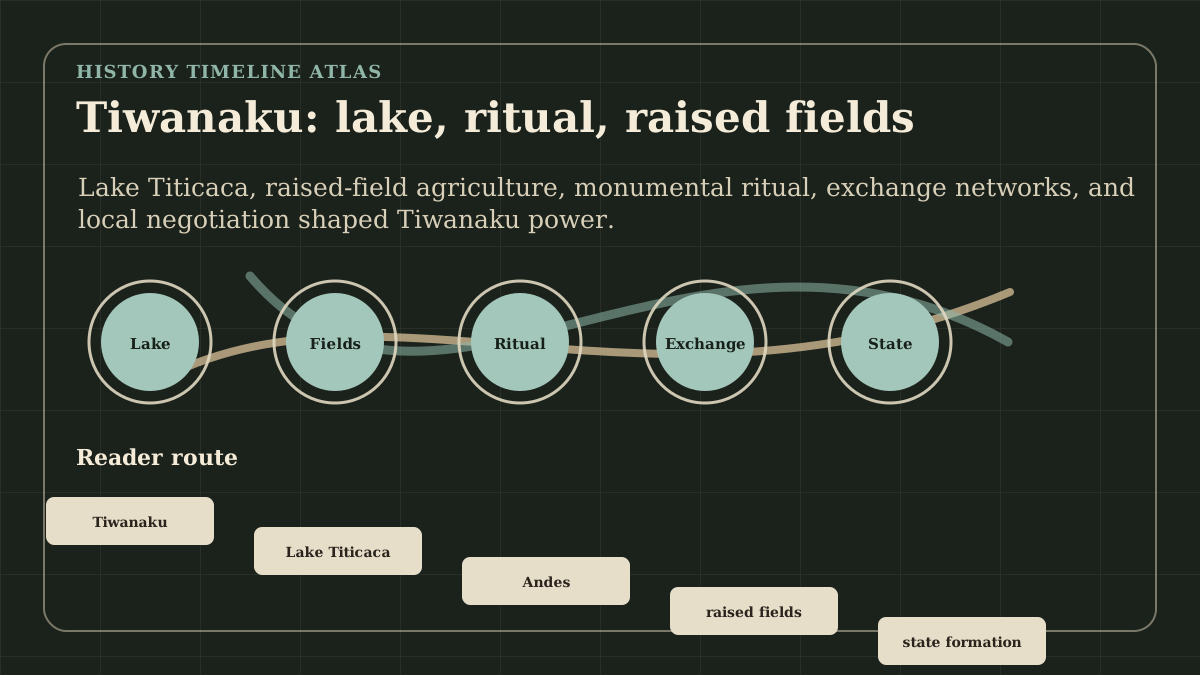
Tiwanaku expanded around Lake Titicaca, linking ritual authority, raised-field agriculture, architecture, and regional exchange.
c. 700 CE; place the event in Tiwanaku before comparing causes or consequences.
Tiwanaku gives the Andes route a middle chapter between early ceremonial centers and later imperial systems.
Tiwanaku elites / Lake Titicaca communities are the first names or groups to compare before widening the story.
The state became a major Andean power before the rise of the Inca Empire.
The state became a major Andean power before the rise of the Inca Empire.
Tiwanaku gives the Andes route a middle chapter between early ceremonial centers and later imperial systems.
Follow the threads from Tiwanaku to the later Andean world to see how forms of authority travel, endure, and transform.
Background
The western shore of Lake Titicaca was already a landscape of deep human investment by c. 700 CE: stone platforms, shrines, and patchworks of productive wetlands testified to long histories of social and ritual life. For centuries, communities had managed water and soils in a fragile highland environment; they also maintained ritual orders that anchored local identities. Into this setting, a set of actors commonly labeled 'Tiwanaku elites' began to expand influence outward from a central place. That expansion cannot be reduced to one factor. Environmental management — especially the development and intensification of raised-field agriculture — increased food stability and mobility of surplus. Monumental architecture and public ritual provided visible claims to sacred authority.
Growing exchange networks, linking highland resources and stylistic goods across valleys, created new economic opportunities. At the same time, local settlement patterns, memory, and everyday law and diplomacy shaped how communities experienced these pressures. Archaeology reveals traces of planning and craft, but it cannot fully record the negotiations, resistances, or accommodations performed by Lake Titicaca communities. Tiwanaku expansion is best read as highland history, not as a rehearsal for the later Inca. Around Lake Titicaca, altitude, frost risk, wetlands, herds, ritual places, and exchange routes shaped what power could look like. Political authority had to be built through landscape knowledge as much as command. Raised-field agriculture gives the event a concrete texture.
Fields, canals, labor coordination, water control, and seasonal risk made food production political. A ruler or ritual center that could organize labor and redistribute stability gained authority in a setting where climate and crop failure mattered. The evidence is mostly material rather than textual. Stone architecture, sculpture, ceramics, settlement patterns, causeways, and agricultural remains carry the argument. That makes interpretation careful work. Expansion may show influence, pilgrimage, alliance, colonization, style, or direct control depending on which evidence is emphasized.
The Turning Point
What changed during the Tiwanaku expansion was not only territory but the terms of authority. Tiwanaku elites consolidated a visible package of practices — raised-field agriculture that linked household labor to larger irrigation and soil projects, ceremonial architecture that staged public ritual, and exchange relations that carried goods and styles across the Andes. These elements were not mere tools of domination; they were political choices. Elites invested in earthworks and plazas that required coordinated labor and produced public spectacles, making ritual central to governance. They promoted or reorganized agricultural systems whose yields could sustain larger populations and specialist craft. Craftspeople and traders connected disparate valleys to Titicaca's circulation networks, giving the center leverage in diplomacy and alliance-making.
Lake Titicaca communities responded in varied ways: some integrated with the Tiwanaku polity, adopting architectural forms or participating in regional exchange; others retained autonomous rhythms or negotiated local rights through customary law. The result was a more articulated and regionally connected polity — a state in the making that combined ritual authority, economic reconfiguration, and architectural presence. The turning point was the joining of ritual authority with regional coordination. Monumental spaces made Tiwanaku visible as a sacred and political center, while exchange networks linked highland, valley, and possibly distant communities into a broader sphere of influence. This was not a simple story of armies taking territory. Tiwanaku power appears through architecture, ceremonies, objects, agricultural systems, and settlement changes.
Communities around the lake may have cooperated, adapted, resisted, or used Tiwanaku forms for their own purposes.
Consequences
In the near term, Tiwanaku's expansion rearranged political and economic maps around the lake. The coordination of raised-field agriculture and public architecture enabled denser settlement and more predictable provisioning, while regional exchange linked the central place to distant resource zones. These changes strengthened Tiwanaku's position as a regional power before the later rise of the Inca. In the longer term, Tiwanaku supplies a crucial middle chapter in Andean state formation: it is neither the earliest ceremonial nucleus nor the late imperial system of the Inca, but a formative intermediary that modeled how ritual, landscape engineering, and exchange could be combined into sustained regional authority. Importantly, interpretations of this outcome depend on whose evidence is centered.
Rulers and monumental records highlight sovereignty and cohesion; archaeology emphasizes infrastructural and stylistic integration; oral memories, local laws, and labor histories can reveal accommodation, negotiation, and continued local autonomy. These multiple strands complicate any single narrative of conquest or seamless state monopoly. Tiwanaku's legacy is therefore both structural — a template for regional power — and contested in practice, visible in stones, fields, and community memories. Tiwanaku became a major Andean reference point before the Inca, showing how state formation could emerge from ritual centers, engineered landscapes, and regional exchange. Its influence helped make the Andes readable as a long sequence of political experiments, not a sudden Inca beginning. The event also teaches readers how archaeology works.
Without long royal chronicles, the story depends on comparing objects, landscapes, dates, and local contexts. That makes uncertainty part of the page's value: readers can see how historians build strong claims while still marking what remains debated.
Interpretation Notes
Interpretations of Tiwanaku State Expands depend on whose evidence is centered: rulers and official records, affected communities, oral memory, archaeology, law, diplomacy, labor, and later public memory do not always tell the same story.
Why Keep Reading
Follow the threads from Tiwanaku to the later Andean world to see how forms of authority travel, endure, and transform. The next events trace how ritual centers consolidated networks, how agricultural engineering spread into new valleys, and how later polities borrowed and resisted Tiwanaku models. For readers interested in how landscapes become political instruments, or how local communities live inside and around expanding states, the succeeding timelines show the uneven rhythms of incorporation, resilience, and reinvention that define Andean history. Read Tiwanaku before Wari, Pachacuti, the Inca road system, and the Spanish conquest. The route shows how Andean authority developed through landscapes, ritual, labor, roads, and later empire.
Reading Path
Follow the story without losing the thread
Before This
- Taika Reforms645
- Sui Reunifies China589
- Gupta Empire Risesc. 320 CE
After This
Same Period
- Gupta Empire Risesc. 320 CE
- Mauryan Empire Foundedc. 322 BCE
- Kingdom of Kush Risesc. 1070 BCE
Wider Timeline
Mind Map
How to think about Tiwanaku State Expands
environmental innovation
Expansion of raised-field agriculture stabilized yields and supported larger, more concentrated populations
Map Layer
Where this event sits geographically
Gold pins mark the approximate locations of published event pages. This is a schematic locator map, not a historical border map.
Coordinates are approximate and are used to help readers orient themselves before opening a full event page.
References
Where to Check the Facts
- Encyclopaedia Britannica: TiwanakuReference for Tiwanaku archaeology, Lake Titicaca setting, and pre-Inca Andean state formation.
- Official UNESCO World Heritage Centre: Tiwanaku: Spiritual and Political Centre of the Tiwanaku CultureOfficial World Heritage reference for Tiwanaku's monumental center, ritual landscape, and cultural significance.