At a Glance
The shape of the event
- Date
- 1817
- Place
- Andes Mountains
- Type
- Military Campaign
Jose de San Martin led an army across the Andes to support Chilean independence and open a route toward Peru.
1817; place the event in Andes Mountains before comparing causes or consequences.
The event makes geography central to Latin American revolutionary warfare.
Jose de San Martin / Andean Army are the first names or groups to compare before widening the story.
The campaign helped defeat royalist forces in Chile and strengthened continental independence strategy.
The campaign helped defeat royalist forces in Chile and strengthened continental independence strategy.
The event makes geography central to Latin American revolutionary warfare.
Follow the campaign forward to see how the Andes crossing shaped the next military and political moves in the region, and to register how different witnesses tell different stories about the same moment.
Background
The late 1810s were a time of overlapping pressures: metropolitan Spain tried to hold fast to imperial rule while creole leaders and local assemblies pushed toward autonomy and independence. In the southern Andes, terrain and climate shaped political choices as much as politics themselves. San Martin, already a figure in the independence struggle, recognized that Chile was both a prize and a corridor: securing it would help break royalist strength in the south and provide a path northward to the viceroyalty of Peru, still a royalist bastion. The Andean Army was not a faceless mass; it depended on guides, mule trains, and the labor of people who lived in ravines and passes.
Logistics—routes, forage, timing, and the endurance of animals and men—were decisive. At the same time, local communities, Spanish officials, and military leaders maintained different records and memories of the same movements. Evidence drawn from official correspondence tells a different story from oral memory, archaeology, or labor contracts. Those divergent sources mean historians must weigh multiple kinds of testimony to understand why an 1817 mountain crossing mattered and what it cost to make a continental campaign possible. Practical politics met harsh nature and local economies. San Martin's crossing of the Andes should read as a continental campaign, not only as a heroic mountain scene.
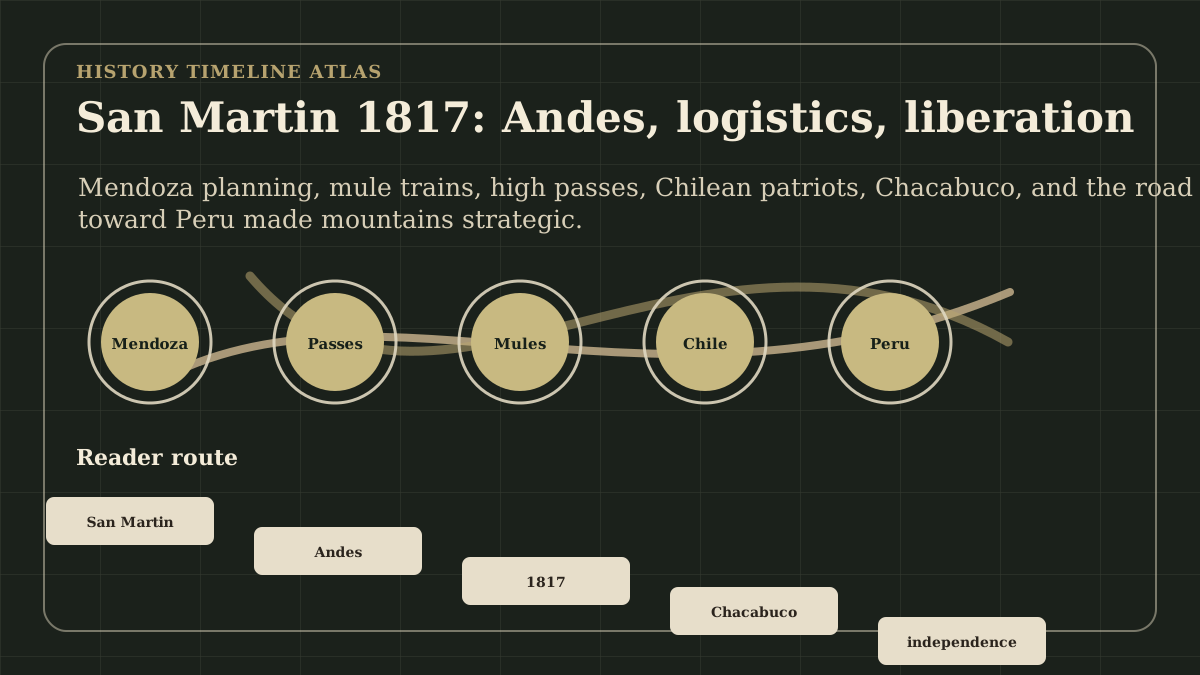
The army gathered in Mendoza, where planning, training, uniforms, intelligence, money, weapons, animals, and local labor had to be coordinated before any soldier entered the passes. The crossing mattered because it turned geography into strategy: Chile could be reached from the interior, and Peru could be imagined as the next objective. The campaign also depended on a wide social base. Enslaved and free men, artisans, women who sewed and supplied material, muleteers, guides, Black soldiers, local officials, merchants, and rural communities all helped make movement possible. A page that only names San Martin misses the fragile system that carried food, artillery pieces, ammunition, news, and bodies across cold altitude and narrow routes. The Andes were not a neutral backdrop.
Snow, altitude sickness, forage limits, pass selection, deception, and timing shaped what the army could do. The event belongs beside Latin American independence because it shows that revolution was fought through environment, logistics, and regional cooperation as much as through declarations.
The Turning Point
What changed during the 1817 crossing was not only the movement of troops but a strategic conversion: San Martin and the Andean Army turned the Andes into an axis of advance rather than an impassable barrier. The choice to attempt such a crossing—deciding routes, assembling mule trains, timing with seasons, and committing men to extreme altitude—was a concrete gamble by a leader and the people who followed him. Those choices forced responses from royalist commanders in Chile, weakened their immediate hold, and allowed patriot forces on the coast to press advantages that had been difficult to secure from the lowlands alone.
More than a single battle, the crossing shifted how war was fought across the region: campaigns began to account for highland logistics, local supplies, and the coordination of irregular units and regular troops. The act also foregrounded contested narratives: official dispatches would frame the crossing as a masterstroke of leadership, while oral memories and labor records record the hardships and contributions of muleteers, indigenous guides, and campesinos whose names rarely appear in dispatches. In that sense 1817 was a turning moment both militarily and in the politics of remembrance. The turning point was the conversion of Mendoza preparation into movement across multiple passes in early 1817.
By dividing forces and using the mountains as a screen, San Martin forced royalist commanders in Chile to respond to uncertainty instead of a single obvious route. Chacabuco made the crossing politically visible. The battle did not finish independence across South America, but it gave Chilean patriots a stronger position, elevated Bernardo O'Higgins, and opened the route toward later campaigns on the Pacific coast and in Peru.
Consequences
In the near term the campaign helped defeat royalist forces in Chile and strengthened a continental strategy aimed at removing Spanish authority from key coastal and highland centers. By opening a route toward Peru, San Martin's march created operational possibilities that other commanders and governments would follow, and it shifted the balance of initiative in the southern theater of the independence wars. Longer-term consequences were more diffuse: the crossing made geography a central element of revolutionary strategy across Spanish America, shaping how commanders planned logistics, sought local allies, and imagined the limits of power. It also affected how the episode was remembered and claimed.
Official histories emphasized decisive leadership and nation-building; local memories, archaeological traces, and records of labor and provisioning highlight the contributions and costs borne by non-elite actors. Diplomatic and legal claims about territory and sovereignty were influenced as new republics built legitimacy on military success. Yet scholars and descendants continue to disagree about causes, credit, and cost—interpretations change depending on whether one centers rulers' files, local testimony, court records, or material remains. That plurality of voices is itself a consequence: the crossing remains a contested site of memory as well as a military precedent. The immediate result was a shift of initiative in the southern independence war.
Royalist authority in Chile weakened, patriot government became more plausible, and San Martin's wider plan gained credibility because a campaign once considered almost impossible had succeeded. The longer consequence was a model of liberation built on coordination across regions. The crossing became a national memory in Argentina and Chile, but it also belongs to a wider South American story in which military victory, local sacrifice, diplomacy, and state formation remained unfinished and contested.
Interpretation Notes
Interpretations of San Martin Crosses the Andes depend on whose evidence is centered: rulers and official records, affected communities, oral memory, archaeology, law, diplomacy, labor, and later public memory do not always tell the same story.
Why Keep Reading
Follow the campaign forward to see how the Andes crossing shaped the next military and political moves in the region, and to register how different witnesses tell different stories about the same moment. The march toward Chile and the opened route to Peru link to diplomatic negotiations, shifting alliances, and the slow construction of new republics. Reading what comes next also reveals everyday histories—the labor of muleteers and guides, the disruption in mountain valleys, and the legal claims that emerged afterward. If you want to understand how geography became a weapon and a memory, the next entries will show campaigns, counters, and the tangled archives and oral traditions that keep the story alive.
Read the Andes crossing beside Paraguay's separate independence path, Boyaca, Brazil's independence, Ayacucho, and the dissolution of Gran Colombia. That route keeps Latin American independence from collapsing into one leader or one capital.
Reading Path
Follow the story without losing the thread
Before This
After This
Same Period
Wider Timeline
Mind Map
How to think about San Martin Crosses the Andes
Andes as barrier
High passes, climate, and scarce forage shaped movement and strategy
Map Layer
Where this event sits geographically
Gold pins mark the approximate locations of published event pages. This is a schematic locator map, not a historical border map.
Coordinates are approximate and are used to help readers orient themselves before opening a full event page.
References
Where to Check the Facts
- Primary Source Set: Latin American RevolutionariesPrimary-source set reference for Latin American revolutionary leaders, documents, and independence politics.
- Library of Congress: Hispanic Reading Room CollectionsArchive and collection reference for Latin America, the Caribbean, Iberian worlds, and related primary materials.
- Cambridge University Press: The Cambridge History of Latin AmericaSpecialist scholarly synthesis for colonial society, independence, republic-building, regional variation, and modern Latin American historiography.
- Oxford Research Encyclopedia of Latin American HistoryPeer-reviewed reference for Latin American history themes, regional debates, social history, and competing interpretations.
- John Carter Brown Library: Spanish America collectionPrimary-source collection reference for Spanish American independence, printed political culture, maps, and early republican debate.
- Encyclopaedia Britannica: Latin America independenceReference for Spanish American and Portuguese American independence movements.
- Encyclopaedia Britannica: History of Latin AmericaReference for Latin American colonial, independence, national, and modern history.
- Official UNESCO World Heritage Centre: City of PotosiInstitutional reference for Potosi's mining city, colonial extraction, and global silver economy.