At a Glance
The shape of the event
- Date
- 1811
- Place
- Asuncion
- Type
- Independence Declaration
Paraguayan leaders broke from Spanish authority and from Buenos Aires, creating a distinct independence path.
1811; place the event in Asuncion before comparing causes or consequences.
The event helps readers see Latin American independence as multiple regional projects rather than one movement.
Paraguayan revolutionaries / Jose Gaspar Rodriguez de Francia are the first names or groups to compare before widening the story.
Paraguay developed a separate political trajectory from neighboring revolutionary centers.
Paraguay developed a separate political trajectory from neighboring revolutionary centers.
The event helps readers see Latin American independence as multiple regional projects rather than one movement.
If the Paraguayan declaration of 1811 reframed independence as a local project, the next chapters show how that claim was defended, institutionalized, and remembered.
Background
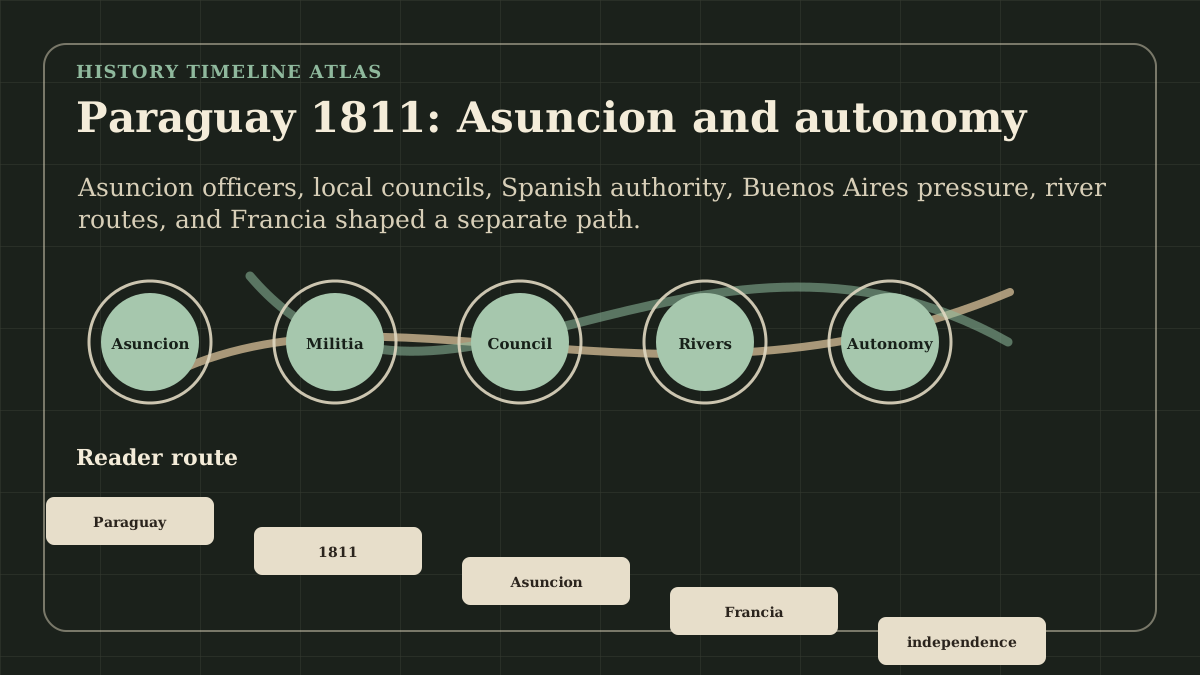
By 1811 the Iberian empire that had long governed the provinces of the Río de la Plata was unraveling. In that uncertain space, local leaders across the region confronted competing pressures: the collapse of metropolitan command, ambitions from emergent power centers, and the everyday needs of towns, ranches, and indigenous communities. In Asunción, those pressures met a distinct social landscape — a provincial capital distant from Buenos Aires both by river and by habit. Political authority here had always been negotiated among town councils, military officers, clergy, landholders, and laboring people. When Paraguayan leaders moved to break from Spanish authority, they did not simply accept the banner being waved from Buenos Aires.
Instead they asserted a separate course, reflecting local interests and fears about external domination as much as anti-colonial sentiment. Jose Gaspar Rodríguez de Francia appears in the cast of actors associated with that critical moment, part of a broader cohort of Paraguayan revolutionaries who shaped how the province would organize itself after the rupture. The result was an act of independence that must be read against multiple pressures — imperial decline, regional rivalry, and local strategies for order and survival. Paraguay's independence should not read as a small echo of revolutions elsewhere. Asuncion faced two pressures at once: the old Spanish imperial chain of command and the new revolutionary authority claimed from Buenos Aires.
The 1811 break mattered because Paraguay refused to let independence mean absorption into a neighboring center. Local politics made that choice possible. Military officers, town council figures, clergy, merchants, rural producers, river communities, and families tied to regional trade all had stakes in who would control taxes, militia command, land, and access to the Paraguay and Parana river systems. Independence was therefore a struggle over routes and jurisdiction as well as flags. The cast should stay wider than one founder. Fulgencio Yegros, Pedro Juan Caballero, Bernardo de Velasco, and Jose Gaspar Rodriguez de Francia represent different pieces of a volatile transition.
Francia's later centralization should not be read backward as inevitable, but it helps readers see why Paraguay's path diverged from more externally connected revolutionary centers.
The Turning Point
The decisive shift in 1811 was not merely a phrase on paper but a set of choices taken in Asunción by Paraguayan revolutionaries. Faced with the dislocation of imperial rule and the prospect of political absorption by Buenos Aires, local leaders deliberated and then severed formal ties to both Madrid and the emergent authority to the south. That double refusal mattered. It turned independence from an extension of another revolutionary capital’s agenda into an assertion of provincial sovereignty. The actors involved — municipal figures, military officers, and political entrepreneurs including Jose Gaspar Rodríguez de Francia among others — chose institutional separation: they refused to accept administration by Buenos Aires and instead claimed the right to self-government.
Those choices required immediate practical steps: reorganizing local governance, justifying the break diplomatically, and signalling to neighbors that Paraguay intended to chart its own course. In doing so the Paraguayan leaders created the conditions for a distinct state formation process, one that would develop its own legal practices, diplomatic priorities, and public memory. The moment in Asunción thus marks a turning point not only in a local calendar but in the map of Latin American independence, where regional projects could be autonomous and not simply chapters in a single narrative. The turning point was the local seizure of political initiative in Asuncion in May 1811.
Paraguayan actors moved before Buenos Aires could define the province's future for them, converting a crisis of monarchy into a claim of local sovereignty. A second turning point was the decision to maintain distance from Buenos Aires after the rupture with Spain. That choice gave Paraguay autonomy, but it also encouraged guarded politics, defensive diplomacy, and a more isolated state-building pattern.
Consequences
In the near term, the 1811 rupture left Paraguay on a trajectory separate from the revolutionary centers that dominated the Río de la Plata. The new political configuration meant different priorities in diplomacy and governance: Asunción had to secure recognition, manage relations with neighbors, and build institutions from within rather than under the direction of Buenos Aires. Over the longer term, that separate path shaped how Paraguay governed itself and how its leaders explained nationhood to later generations. Equally important, the event reframed how historians and publics interpret independence across Latin America. Paraguay’s example underlines that independence was not a monolithic process propelled by a single center; it was a mosaic of regional choices, compromises, and silences.
This leads to difficult methodological questions: political proclamations and official records tell one story; oral memory, local law, labour histories, archaeology, and diplomacy can tell others. Those different kinds of evidence do not always align, and the gaps between them remain productive sites for research. What looks like a clear political rupture in a government archive may look different in the lived experience of rural communities or in the diplomatic correspondence of neighboring states. The consequence is a richer, messier view of state formation and a reminder to weigh multiple evidentiary threads when reconstructing how nations emerged. The immediate consequence was a separate Paraguayan trajectory inside the wider collapse of Spanish rule in the Rio de la Plata.
The new political order had to manage legitimacy, militia loyalty, river access, and relations with neighboring powers that did not automatically accept Paraguay's preferred autonomy. The longer consequence was a distinctive national memory. Paraguay became a reminder that Latin American independence was not one uniform movement from colony to republic. It included small states, inland routes, defensive sovereignty, social discipline, and hard choices about isolation and survival.
Interpretation Notes
Interpretations of Paraguay Declares Independence depend on whose evidence is centered: rulers and official records, affected communities, oral memory, archaeology, law, diplomacy, labor, and later public memory do not always tell the same story.
Why Keep Reading
If the Paraguayan declaration of 1811 reframed independence as a local project, the next chapters show how that claim was defended, institutionalized, and remembered. Follow the story to see how Paraguayan leaders translated a political break into daily governance, how they negotiated with neighboring powers, and how subsequent generations would rework the memory of 1811. Exploring the administrative records, diplomatic exchanges, and competing memories that followed will reveal how a province turned itself into a state — and why different archives still disagree about what that transformation meant. Read Paraguay after Buenos Aires, San Martin's Andes campaign, Boyaca, and Brazil's independence, then continue to the Paraguayan War.
The route shows how independence choices could create later regional vulnerabilities as well as sovereignty.
Reading Path
Follow the story without losing the thread
Before This
- Grito de Dolores1810
- May Revolution1810
- Haitian Revolution Begins1791 CE
After This
Same Period
Wider Timeline
Mind Map
How to think about Paraguay Declares Independence
Local autonomy
Desire among Asunción’s leaders to govern provincial affairs independently from distant centers
Map Layer
Where this event sits geographically
Gold pins mark the approximate locations of published event pages. This is a schematic locator map, not a historical border map.
Coordinates are approximate and are used to help readers orient themselves before opening a full event page.
References
Where to Check the Facts
- Primary Source Set: Latin American RevolutionariesPrimary-source set reference for Latin American revolutionary leaders, documents, and independence politics.
- Library of Congress: Hispanic Reading Room CollectionsArchive and collection reference for Latin America, the Caribbean, Iberian worlds, and related primary materials.
- Cambridge University Press: The Cambridge History of Latin AmericaSpecialist scholarly synthesis for colonial society, independence, republic-building, regional variation, and modern Latin American historiography.
- Oxford Research Encyclopedia of Latin American HistoryPeer-reviewed reference for Latin American history themes, regional debates, social history, and competing interpretations.
- John Carter Brown Library: Spanish America collectionPrimary-source collection reference for Spanish American independence, printed political culture, maps, and early republican debate.
- Encyclopaedia Britannica: Latin America independenceReference for Spanish American and Portuguese American independence movements.
- Encyclopaedia Britannica: History of Latin AmericaReference for Latin American colonial, independence, national, and modern history.
- Official UNESCO World Heritage Centre: City of PotosiInstitutional reference for Potosi's mining city, colonial extraction, and global silver economy.