At a Glance
The shape of the event
- Date
- 1982
- Place
- Falkland Islands
- Type
- War
Argentina and the United Kingdom fought over the Falkland Islands, turning sovereignty claims into a short but consequential South Atlantic war.
1982; place the event in Falkland Islands before comparing causes or consequences.
The event links decolonization language, military rule, national memory, and South Atlantic geopolitics.
Argentine junta / Margaret Thatcher are the first names or groups to compare before widening the story.
Britain retained control, and Argentina's military dictatorship lost legitimacy.
Britain retained control, and Argentina's military dictatorship lost legitimacy.
The event links decolonization language, military rule, national memory, and South Atlantic geopolitics.
Follow the wider timelines and related events to see how a short war came to shape policies and memories across continents.
Background
The Falkland Islands occupied an uneasy place in late twentieth‑century geopolitics: a British overseas territory with a small local population, claimed by Argentina and invoked by both governments as a matter of national honour and legal right. In Britain, debates over overseas territory intersected with a Conservative government determined to project resolve. In Argentina, a military junta ruled in the name of national restoration at a time when internal and regional pressures tested its authority. The Cold War era and changing patterns of decolonisation provided a wider frame: other states and international institutions watched claims and counterclaims, while diplomats treated maps, legal documents and historical arguments as evidence.
For the islanders themselves, everyday life and political identity mattered as much as abstract legal theory. Interpretations of the crisis have long depended on whose sources are foregrounded: official records and diplomatic dispatches tell a different story from the oral memories of residents, from later archaeological traces on the islands, or from law and labour histories that foreground different grievances and entitlements. The Falklands War is best understood as a short conflict with long histories behind it. Sovereignty claims, islander identity, British imperial legacies, Argentine nationalism, military dictatorship, and international law all shaped the dispute before troops landed. Distance made the war concrete.
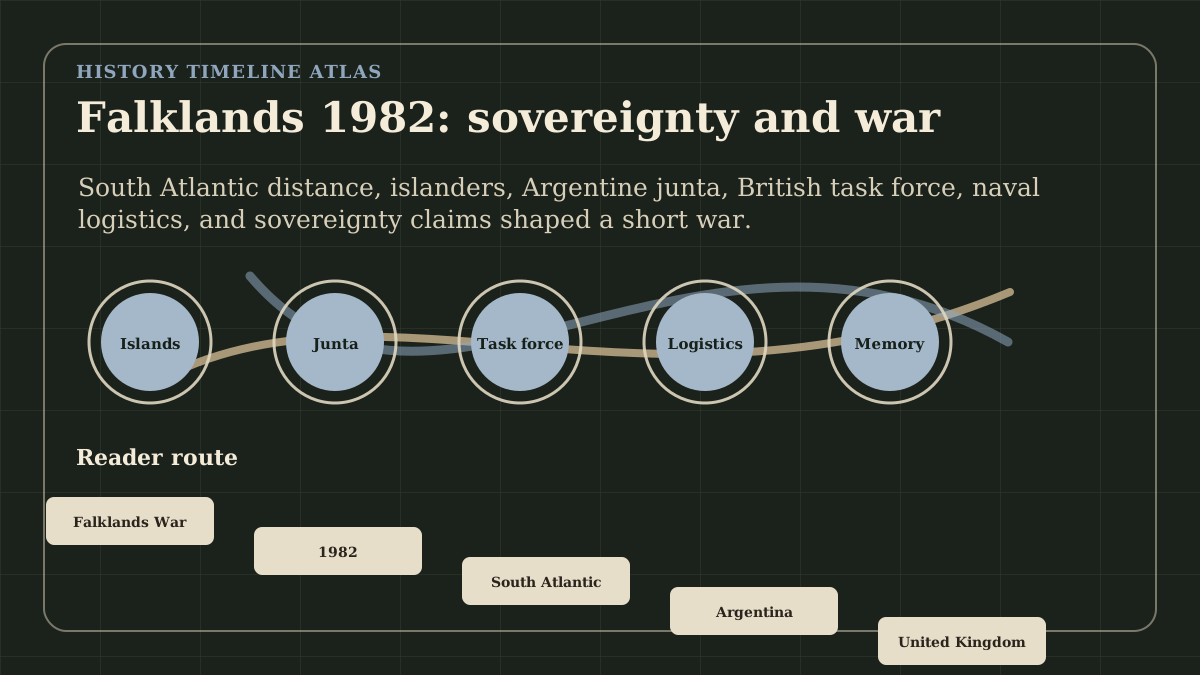
The South Atlantic setting forced both sides to think about ships, weather, airfields, sea lanes, intelligence, logistics, and the vulnerability of soldiers far from home. A legal dispute became a military problem measured in fuel, carriers, landing zones, casualties, and time. Domestic politics mattered on both sides. Argentina's junta sought legitimacy amid repression and economic trouble, while the British government faced the question of whether to fight for a distant territory and its inhabitants. Neither public memory can be reduced to one leader or one speech.
The Turning Point
What changed decisively in 1982 was the conversion of a long-standing sovereignty dispute into an armed contest that demanded rapid political choices. Argentina’s ruling military junta moved to assert its claim over the Falkland Islands in a manner that turned a diplomatic quarrel into direct confrontation. The United Kingdom, led by Prime Minister Margaret Thatcher, faced a decision about how to respond to such a challenge to British jurisdiction and to the safety and wishes of the islanders. Those choices—by military leaders in Buenos Aires and by elected ministers in London—removed the disagreement from the realm of lawyers, lobbyists and exchanges at the United Nations and placed it under the immediate pressures of command, logistics and political optics.
The conflict was short in duration but intense in consequence: it compelled rulers to make irreversible operational and public decisions, forced communities into wartime realities, and transformed questions about sovereignty into urgent matters of survival, negotiation and post‑war settlement. The turning point was the shift from claim to armed occupation and then to a British task force response. Once the conflict moved from diplomacy to military action, governments had less room to retreat without political cost. Islanders also belong inside the turning point. Their status, wishes, fears, and postwar security made the sovereignty dispute more than a map argument between capitals. The war's meaning changes when the local community is treated as historical actor rather than scenery.
Consequences
In the near term the outcome left Britain in continued control of the Falkland Islands and it eroded the Argentine military junta’s claim to legitimacy at home and abroad. That immediate result had ripple effects: British policy toward overseas territories and the security arrangements of the South Atlantic were reassessed, while Argentine politics—already brittle under military rule—entered a period of intensified scrutiny and contestation that affected how the regime was judged by its own people. In the longer view, the Falklands War complicated narratives of decolonisation by showing how claims framed as anti‑colonial could be pursued through force, and how imperial legacies and local self‑identification could clash.
Public memory developed unevenly—veterans’ experiences, islanders’ civic life, diplomatic archives, legal contestation and later archaeological work each retained different aspects of the story. Economies, veteran communities and international relations around the South Atlantic bore the conflict’s imprint for decades, and historians now treat the episode as a hinge between questions of sovereignty, military rule and contested memory rather than as a single, unambiguous turning point. Britain retained control of the islands, and Argentina's military dictatorship lost legitimacy, accelerating pressure toward civilian rule. Veterans, families, islanders, diplomats, and later governments carried different memories of what the war had meant. The conflict also complicates simple decolonization language.
Argentina framed the islands through anti-colonial claim and territorial integrity; Britain emphasized self-determination and defense of the islanders. Those arguments continue because sovereignty, identity, and imperial history do not line up neatly.
Interpretation Notes
Interpretations of Falklands War depend on whose evidence is centered: rulers and official records, affected communities, oral memory, archaeology, law, diplomacy, labor, and later public memory do not always tell the same story.
Why Keep Reading
Follow the wider timelines and related events to see how a short war came to shape policies and memories across continents. Tracing the Falklands story leads into threads of post‑imperial sovereignty debates, the decline of military regimes in Latin America, British defence and diplomacy in the late twentieth century, and the ways communities rebuild and remember after conflict. Each path—diplomatic correspondence, oral histories from the islands, veterans’ testimony, legal claims and material remains on the islands—offers a different window. Read on to compare those windows and to weigh what kinds of evidence you find most persuasive. Read the Falklands War beside Argentina's dictatorship, decolonization, the Cold War, British post-imperial politics, and Latin American democratization routes.
The path connects sovereignty claims to military rule, memory, and international law.
Reading Path
Follow the story without losing the thread
Before This
- Guinea Votes No to the French CommunitySeptember 28, 1958
- Battle of BritainJuly-October 1940
- Overthrow of the Hawaiian Kingdom1893
After This
- INF Treaty SignedDecember 8, 1987
- Tiananmen Square Protests1989
Same Period
- Tiananmen Square Protests1989
- INF Treaty SignedDecember 8, 1987
- Battle of BritainJuly-October 1940
Wider Timeline
Mind Map
How to think about Falklands War
Sovereignty claims
Longstanding territorial claims by Argentina and Britain set the legal and rhetorical stage for confrontation
Map Layer
Where this event sits geographically
Gold pins mark the approximate locations of published event pages. This is a schematic locator map, not a historical border map.
Coordinates are approximate and are used to help readers orient themselves before opening a full event page.
References
Where to Check the Facts
- Encyclopaedia Britannica: Falkland Islands WarReference for the 1982 Falklands War, Argentine invasion, British task force, outcome, and political consequences.
- Imperial War Museums: What was the Falklands War?Museum reference for the South Atlantic campaign, service experience, and British military context.
- U.S. National Archives: The Cold WarArchive reference hub for Cold War records, federal documentation, and research guidance.
- Office of the Historian: The Early Cold War, 1945-1952Official diplomatic history reference for early Cold War foreign-policy context.