At a Glance
The shape of the event
- Date
- 1989
- Place
- Beijing
- Type
- Protest Movement
Pro-democracy demonstrations centered on Tiananmen Square called for political reform before the Chinese government used force to suppress the movement.
1989; place the event in Beijing before comparing causes or consequences.
The event became a major reference point in global discussions of Chinese politics, memory, censorship, and state power.
Chinese student protesters are the first names or groups to compare before widening the story.
The protests were crushed, and political controls tightened while economic reforms continued.
The protests were crushed, and political controls tightened while economic reforms continued.
The event became a major reference point in global discussions of Chinese politics, memory, censorship, and state power.
Follow this episode to understand both immediate sequences — timelines of protest, negotiation attempts and state response — and longer threads: how memory is preserved or erased, how censorship operates, and how poli...
Background
The protests did not appear out of nowhere. In the years leading into 1989 China was experiencing fast social and economic change that created new expectations as well as uncertainties. Urban universities produced a visibly political youth whose horizons were expanding through altered economic policies and broader exposure to ideas. At the same time, the ruling Chinese Communist Party faced persistent questions about legitimacy, governance and the pace of reform. Some leaders argued for controlled political adjustments alongside market-oriented economic policies; others warned that loosened political controls could threaten stability. These tensions played out in universities, workplaces and city streets. Public grief and outrage over specific incidents catalyzed a wider set of demands for transparency and accountability.
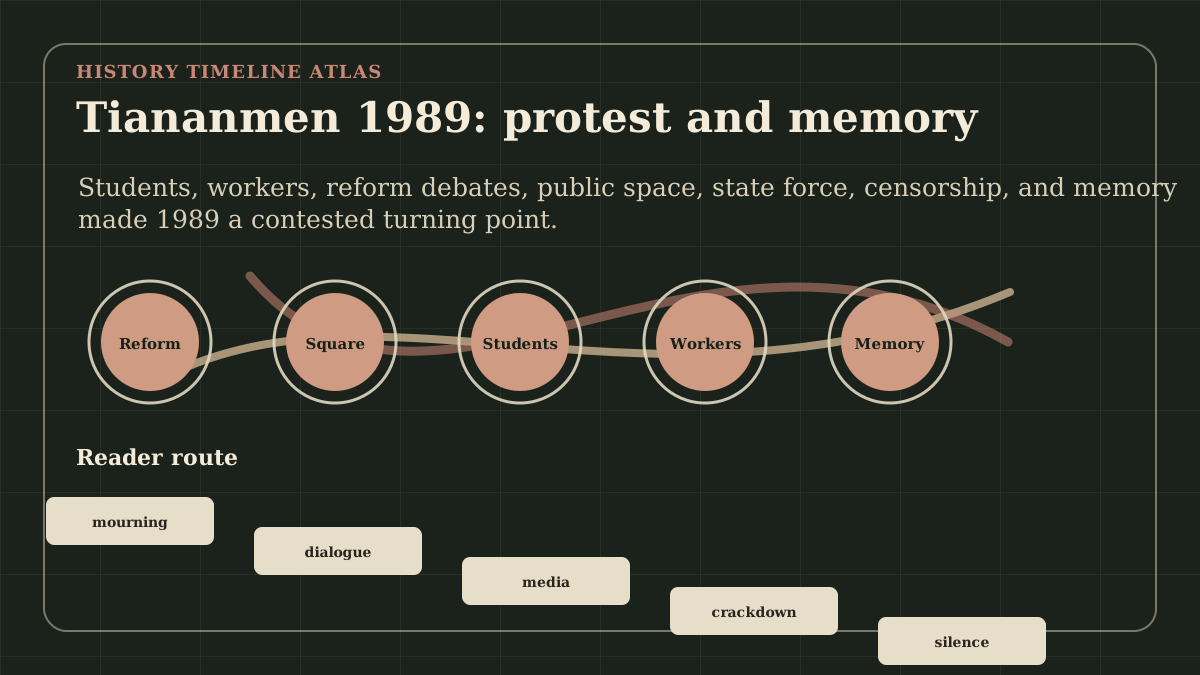
Rather than attributing the protests to a single cause, historians point to the interaction of generational change, political debate within the party, and public frustrations — a set of pressures that made a mass demonstration at Tiananmen Square both possible and momentous. Tiananmen 1989 should be read as a protest movement inside a larger argument about reform, corruption, inflation, public voice, and the limits of political opening in the People's Republic of China. Students were highly visible, but they were not the whole story. Workers, journalists, residents, intellectuals, officials, and families also shaped how the movement spread, how it was interpreted, and why it became such a sensitive memory. The square mattered because it turned politics into public space.
Mourning for Hu Yaobang, hunger strikes, banners, speeches, encampments, negotiations, and media attention made Beijing's center a stage where competing ideas of legitimacy became visible. The movement's language included patriotism, reform, dignity, anti-corruption, and accountability; reducing it to one slogan makes the event harder to understand. A careful page also needs to mark the evidence problem. State censorship, survivor testimony, foreign media, official accounts, personal memory, and later commemoration do not line up neatly. That tension is part of the history. Readers should see why the event is remembered globally and restricted domestically without turning the page into a simple certainty machine.
The Turning Point
The decisive shift occurred when a broad, mostly student-led movement occupying Tiananmen Square confronted the state with sustained public presence and organized calls for political reform. Student protesters turned the square into a visible forum for petitions, speeches and assemblies that drew journalists, residents and sympathetic workers. The authorities faced difficult choices: to negotiate, to tolerate limited dissent, or to reassert control. In 1989 those choices tilted toward repression. The central leadership authorized a forceful response; military units were sent into the streets of Beijing to clear demonstrators from the square and nearby avenues. That deployment was a concrete exercise of state power — a deliberate decision to prioritize order and regime survival over accommodation.
For participants, the crackdown abruptly ended mass demonstrations and scattered organizing networks. For observers inside and outside China, the use of force transformed what some had hoped would be a negotiated political opening into a decisive rupture, one that reshaped political calculation on both sides and lodged the episode as a touchstone in debates about dissent and state authority. The turning point was the movement's shift from campus protest and public mourning into a national crisis over authority. Hunger strikes, widening sympathy, and the presence of workers and residents made the issue harder to contain. Party leaders disagreed about how to respond, and the declaration of martial law changed the stakes from negotiation to coercive restoration of control.
The use of military force around Beijing and the square turned a reform-era protest into a lasting rupture in memory. It ended the public occupation, but it did not end the questions the movement had raised about accountability, speech, corruption, and the relationship between economic reform and political participation.
Consequences
In the immediate aftermath the protests were crushed and the government moved to reassert political control: arresting and disciplining organizers, tightening public expression, and increasing surveillance of dissenting voices. Official rhetoric emphasized stability and unity; institutions linked to the protests were marginalized. At the same time the state maintained and in many areas deepened economic reforms, separating political liberalization from the path of market change. Over the longer term the 1989 events have had multiple, sometimes competing, legacies. Internationally, the crackdown altered foreign perceptions of the Chinese leadership and complicated diplomatic relations.
Domestically, the episode became a focal point for memory and suppression alike: it is remembered by survivors, relatives and diaspora communities while being actively censored in official discourse and many public platforms within China. Scholars and citizens continue to debate whether the outcome hinged more on the choices of particular leaders and protest leaders, or on deeper structural forces — the institutional priorities of the party, the trajectory of economic policy, and the risks associated with large-scale mobilization. That unresolved argument is part of the event’s continuing significance. The immediate consequence was repression, grief, arrests, exile, censorship, and a reshaping of political boundaries.
The longer consequence was a pattern in which economic growth continued while open discussion of the event remained tightly limited inside China. That combination makes the page important for understanding the post-1989 Chinese state. Tiananmen's afterlife also lives outside formal politics. Families, former participants, journalists, archives, diasporic communities, annual commemorations, and digital censorship struggles all keep the event historically active. A strong page helps readers understand both what happened and why memory itself became a field of power.
Interpretation Notes
The memory of Tiananmen Square Protests often depends on who tells the story. A court, army, religious community, merchant network, or later nation can emphasize different causes and make Beijing stand for different lessons.
Why Keep Reading
Follow this episode to understand both immediate sequences — timelines of protest, negotiation attempts and state response — and longer threads: how memory is preserved or erased, how censorship operates, and how policy choices shaped China’s later development. Readers who move from this page to related timelines will trace how the tension between political control and economic change influenced subsequent Chinese governance, how activists and communities kept memory alive outside official channels, and how international reactions to the crackdown informed later relationships. If you want to see how individual decisions met structural pressures, the linked narratives and personal accounts offer concrete entry points.
Read Tiananmen beside the 1989 year page, China's reform and opening, the fall of the Berlin Wall, and post-Cold War globalization. That route shows why 1989 did not have one global meaning: some states liberalized, some collapsed, and some combined market reform with tighter political control.
Reading Path
Follow the story without losing the thread
Before This
- Brazil's Democratic Constitution1988
- INF Treaty SignedDecember 8, 1987
- Falklands War1982
After This
- Nelson Mandela ReleasedFebruary 11, 1990
- Fall of Apartheid1994
- Hong Kong Handover1997
Same Period
- Falklands War1982
- INF Treaty SignedDecember 8, 1987
- Qin Unification of China221 BCE
Wider Timeline
Mind Map
How to think about Tiananmen Square Protests
calls for reform
students and others publicly demanded political reform and greater openness
Map Layer
Where this event sits geographically
Gold pins mark the approximate locations of published event pages. This is a schematic locator map, not a historical border map.
Coordinates are approximate and are used to help readers orient themselves before opening a full event page.
References
Where to Check the Facts
- U.S. National Archives: The Cold WarArchive reference hub for Cold War records, federal documentation, and research guidance.
- Office of the Historian: The Early Cold War, 1945-1952Official diplomatic history reference for early Cold War foreign-policy context.