At a Glance
The shape of the event
- Date
- 1831
- Place
- Northern South America
- Type
- State Dissolution
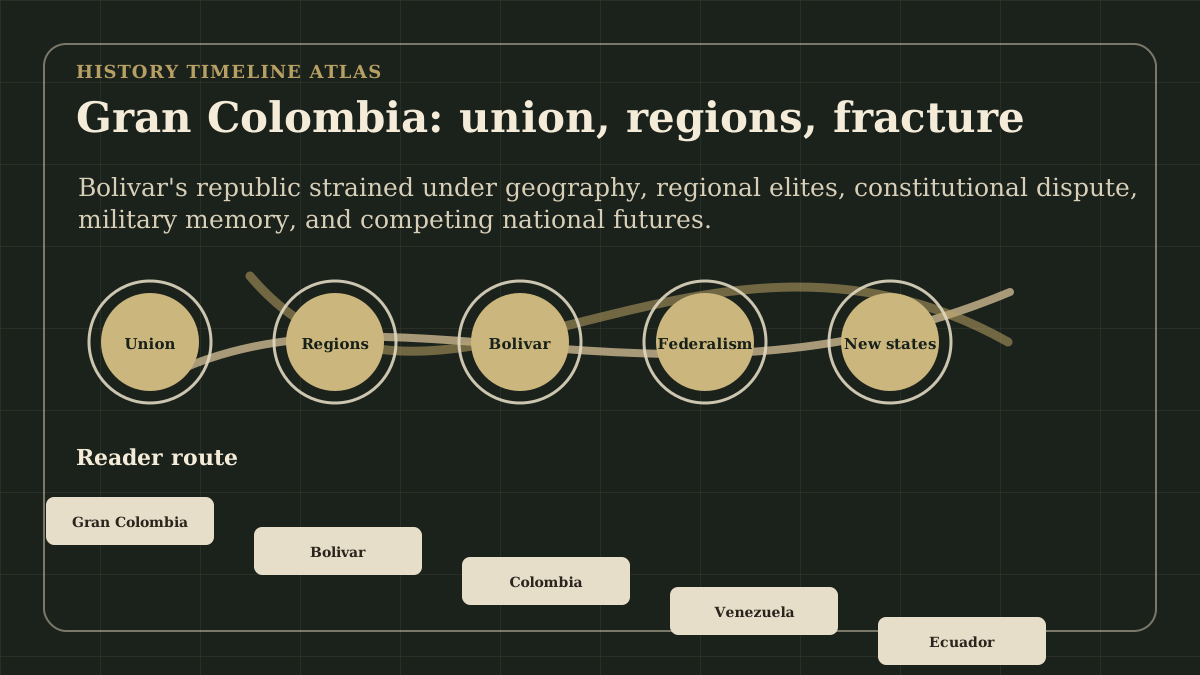
Gran Colombia fractured into separate states as regional interests, geography, factionalism, and institutional disputes overwhelmed Bolivar's union.
1831; place the event in Northern South America before comparing causes or consequences.
The event keeps post-independence fragmentation inside the same route as liberation.
Simon Bolivar / Regional leaders are the first names or groups to compare before widening the story.
New republics followed separate paths after the collapse of the larger federation.
New republics followed separate paths after the collapse of the larger federation.
The event keeps post-independence fragmentation inside the same route as liberation.
Follow the subsequent timelines to see how the separate republics handled the problems that had undone the union: how they built constitutions, how regional elites negotiated power with emerging national institutions,...
Background
Gran Colombia emerged from the wars of independence as an ambitious attempt to bind the Spanish colonies of northern South America into a single state. The impulse behind the union mixed ideals of continental solidarity and practical hopes for mutual defence, economic integration, and diplomatic weight. Yet the terrain that the republic tried to hold together was vast and varied—coastlines, highlands, and rivers that shaped different economies, societies, and local power networks. Institutional designs—how authority was to be shared between a central government and regional authorities—became persistent friction. Regional leaders, who had their own bases of support and local priorities, often found national directives remote or damaging to local interests.
Factionalism grew as political leaders and military commanders disagreed about federalism, governance, and the scope of executive power. Over time, the pressures of geography, competing interests, and institutional dispute compounded: what began as a shared project of liberation became strained by the practical limits of administering a wide, diverse territory from a single center. Gran Colombia's collapse makes the independence story harder and more useful. Liberation from Spain did not automatically create a durable republic. Northern South America had mountain corridors, river systems, coastal cities, regional armies, church influence, merchant interests, local loyalties, and different memories of war. Those forces made a single constitutional map difficult to hold together after the emergency of independence passed.
Bolivar's reputation can hide the institutional problem. A charismatic liberator could imagine a continental republic, but laws, elections, taxation, military command, provincial authority, and capital-city distance had to work every day. Venezuela, New Granada, Ecuador, and the isthmus that later became Panama did not experience the union from the same vantage point. The page matters because many readers search independence as if victory were the ending. Gran Colombia shows the next question: after empire breaks, who writes the constitution, who controls the army, who gets revenue, and which region feels governed rather than absorbed?
The Turning Point
By 1831 the balance between union and division shifted decisively. The turning point was not a single battle or decree but a sequence of choices and withdrawals by concrete actors—Simon Bolivar, who had led the independence cause and the idea of a united republic; regional leaders who prioritized local stability and authority; and political factions that could not reconcile visions of a centralized state with demands for regional autonomy. Institutional disputes—over how much power the central government could exercise, how law and taxation would operate across distant provinces, and how military authority should be organized—made compromise harder. Geography magnified these conflicts: mountain ranges and long coastlines made communication slow and enforcement uneven, giving regional elites room to act independently.
As ties frayed, leaders and communities began to reorient loyalty toward more immediate, local structures of governance. The cumulative effect of these actors’ choices was to transform a fragile federation into separate governing arrangements. The formal collapse of Gran Colombia in 1831 thus reflected a decisive reallocation of authority from a hopeful national blueprint to competing local and regional projects. The turning point was not a single dramatic battle but the failure of union as a working political habit. Resignations, regional separation, constitutional disagreement, elite rivalry, and military exhaustion made the republic less able to convert shared independence into shared administration. Bolivar's death in 1830 sharpened the fracture, but the union was already under strain.
The problem was structural: geography and regional interest made political trust expensive, and the new republic lacked enough accepted institutions to make compromise feel safer than separation.
Consequences
In the near term, the dissolution produced new political units that set out on distinct institutional paths. Administrative systems, constitutions, and alliances were remade to fit regional priorities, sometimes reinforcing local elites and their governance models. For people on the ground, the end of the larger federation meant renegotiated legal regimes, altered trade patterns, and shifting military obligations. In the longer term, the breakup established a pattern that shaped post-independence northern South America: liberation from imperial rule did not automatically generate durable political unity. Instead, fragmentation and the creation of independent republics became one common trajectory alongside independence.
That legacy affected diplomacy, economic development, and the law across the region, as states pursued divergent strategies for building legitimacy and managing internal diversity. Historians and other observers continue to debate what mattered most—official records, the aims of rulers like Bolivar, or the lived experiences recorded in oral memory and local institutions—because different kinds of evidence offer different stories about who benefited, who lost, and why federating efforts could not hold. The immediate result was a set of successor republics with their own political paths. Colombia, Venezuela, Ecuador, and later Panama carried parts of the same independence inheritance, but state formation now happened through separate constitutions, armies, parties, borders, and foreign relationships.
The afterlife is powerful because Gran Colombia became both warning and dream. Later readers could remember it as a lost Bolivarian project, a failed federation, or evidence that postcolonial sovereignty requires more than heroic leadership. That ambiguity makes the page a bridge from revolution to republic-building.
Interpretation Notes
Interpretations of Gran Colombia Dissolves depend on whose evidence is centered: rulers and official records, affected communities, oral memory, archaeology, law, diplomacy, labor, and later public memory do not always tell the same story.
Why Keep Reading
Follow the subsequent timelines to see how the separate republics handled the problems that had undone the union: how they built constitutions, how regional elites negotiated power with emerging national institutions, and how diplomatic relations among the new states shaped trade and security. Reading on reveals how the same people who had fought for liberation confronted the practical work of governing, and how choices made in the 1830s set patterns that affected politics, law, and memory for decades. Exploring those next chapters shows the aftermath of dissolution as a complex process, not a single conclusion. Read Gran Colombia after Boyaca, Ayacucho, and Bolivar, then continue to Paraguay's war, the War of the Pacific, Mexican constitutionalism, and twentieth-century Latin American democracy.
The route keeps independence connected to the harder work of governing.
Reading Path
Follow the story without losing the thread
Before This
After This
- Eritrea Becomes IndependentMay 24, 1993
Same Period
- Gupta Empire Risesc. 320 CE
- Mauryan Empire Foundedc. 322 BCE
- Kingdom of Kush Risesc. 1070 BCE
Wider Timeline
Mind Map
How to think about Gran Colombia Dissolves
Geography
Mountain ranges and long coastlines made communication and enforcement difficult across the federation
Map Layer
Where this event sits geographically
Gold pins mark the approximate locations of published event pages. This is a schematic locator map, not a historical border map.
Coordinates are approximate and are used to help readers orient themselves before opening a full event page.
References
Where to Check the Facts
- Encyclopaedia Britannica: Gran ColombiaReference for Gran Colombia's creation, Bolivar's project, regional strain, and dissolution into successor republics.
- Primary Source Set: Latin American RevolutionariesPrimary-source set reference for Bolivar, Latin American revolutionary leaders, documents, and independence politics.
- Cambridge University Press: The Cambridge History of Latin AmericaSpecialist synthesis for independence, early republic-building, federalism, regionalism, and post-independence fragmentation.