How to Read the Year
How did victory in World War II become the beginning of a new global order?
The year 1945 is not only the end of World War II. It is also the beginning of a world shaped by nuclear weapons, occupation, reconstruction, war-crimes reckoning, decolonization pressure, refugee crises, and new institutions. The atomic bombing of Hiroshima and the founding of the United Nations make that double meaning visible.
A year page helps readers hold triumph and catastrophe together. Military victory ended one kind of war, but the human and political aftermath did not settle neatly. The same year contains liberation, destruction, diplomacy, moral argument, and the first architecture of the postwar order.
On 8 May 1945, crowds in London and New York celebrated while survivors in Europe searched for missing relatives, food, papers, and transport. In August, Hiroshima turned one city's morning into the start of the nuclear age. In Java, Vietnam, India, and across colonized regions, wartime victory also sharpened a different question: if freedom had been worth fighting for, why should empire continue?
The year also belongs to people outside the conference rooms: a displaced person in a camp queue, a liberated prisoner trying to testify, a Tokyo family after firebombing, a Korean household facing the end of Japanese rule and the start of division, a Soviet soldier in occupied eastern Europe, and an Indonesian youth hearing independence proclaimed. Their experiences do not form one memory, which is why 1945 has to be read from more than one region.
Concrete places hold the moral weight. Bergen-Belsen and Auschwitz became sites of liberation, testimony, and unbearable evidence; Hiroshima and Nagasaki became destroyed cities before they became symbols of nuclear strategy; Nuremberg became a courtroom where documents, witnesses, and defendants turned atrocity into legal record. None of those scenes can be reduced to a neat victory caption.
Memory diverges sharply. In Western Europe, 1945 can mean liberation; in parts of Eastern Europe, it can also mean Soviet occupation and new repression. In Korea and Vietnam, Japanese defeat opened questions of division, revolution, and colonial return. In Indonesia, August 1945 became an independence proclamation followed by struggle. The same year can be anniversary, warning, mourning, and unfinished argument.
A short event spine helps keep the year clear: Yalta in February, Germany's surrender in May, the United Nations Charter in June, Potsdam in July and August, Hiroshima and Nagasaki in August, Japan's surrender in September, and Nuremberg in November. The dates do not tell one victory story. They show surrender, institution-building, nuclear violence, occupation planning, and legal reckoning unfolding in the same crowded year.
A deeper reading of 1945 has to hold several endings at once. Germany surrendered, Japan surrendered, concentration camps were liberated, cities lay in ruins, displaced people searched for homes, colonial subjects demanded that wartime language of freedom apply to them, and new institutions tried to prevent another catastrophe. The year is crowded because victory did not produce one simple settlement.
Yalta and Potsdam show diplomacy under battlefield pressure. The Allies were partners against Axis powers, but they did not share the same security needs, political systems, or expectations for Eastern Europe and Germany. Military position shaped bargaining power. The Soviet army's presence in Eastern Europe, American economic and military capacity, British imperial concerns, and the continuing war against Japan all affected what leaders could demand.
Hiroshima and Nagasaki give 1945 its nuclear rupture. The bombings were human catastrophes in Japanese cities and strategic acts in a war nearing its end. They force readers to hold civilian suffering, military calculation, scientific mobilization, Soviet entry into the war against Japan, and later moral debate in the same frame. Historians and publics still argue over necessity, alternatives, racial attitudes, surrender timing, and the display of power. The nuclear age did not begin as an abstract arms race; it began with destroyed urban life and a new scale of fear.
The United Nations represents a different response to catastrophe. States tried to build a forum for security, diplomacy, and international legitimacy after the League of Nations had failed to prevent aggression. The UN did not erase power politics, vetoes, empire, or war, but it changed the language and architecture through which states argued about peace, sovereignty, human rights, and intervention.
Nuremberg added a legal memory to the year. Trials after total war asked how leaders, officials, soldiers, and institutions could be held responsible for aggressive war and mass atrocity. The trials were imperfect and selective, but they changed the public vocabulary of accountability. They also linked World War II to later human-rights law and debates over genocide, occupation, and command responsibility.
Decolonization pressure belongs inside 1945, not after it. India, Indonesia, Vietnam, Korea, China, Ghanaian and Pan-African activists, Arab nationalists, and many others saw that European and Japanese empires had been weakened materially and morally. Soldiers from colonized societies had fought in a war framed around freedom. The contradiction between anti-fascist victory and imperial rule became harder to contain.
The year also changed everyday life. Reconstruction meant food shortages, housing crises, missing relatives, returning soldiers, medical trauma, occupation authorities, currency problems, black markets, refugee camps, and new political parties. A reader who sees only treaties misses the lived aftermath. Peace had to be made in kitchens, schools, train stations, factories, courtrooms, and border zones.
1945 also asks readers to compare public memory with administrative reality. Victory speeches and photographs of surrender are easy to remember. Occupation policy, food supply, refugee screening, demobilization, public health, currency reform, and border settlement are harder to imagine but just as important. The postwar world was built through meetings and declarations, but also through queues, camps, courts, schools, ration books, and rebuilding plans.
The year is also a moral archive. Survivors of genocide, forced labor, bombing, occupation, sexual violence, imprisonment, and displacement carried experiences that public institutions struggled to name. Museums, trials, testimonies, memorials, and school curricula later turned parts of that suffering into public memory. The process was uneven and political, but it explains why 1945 remains a date of mourning as well as victory.
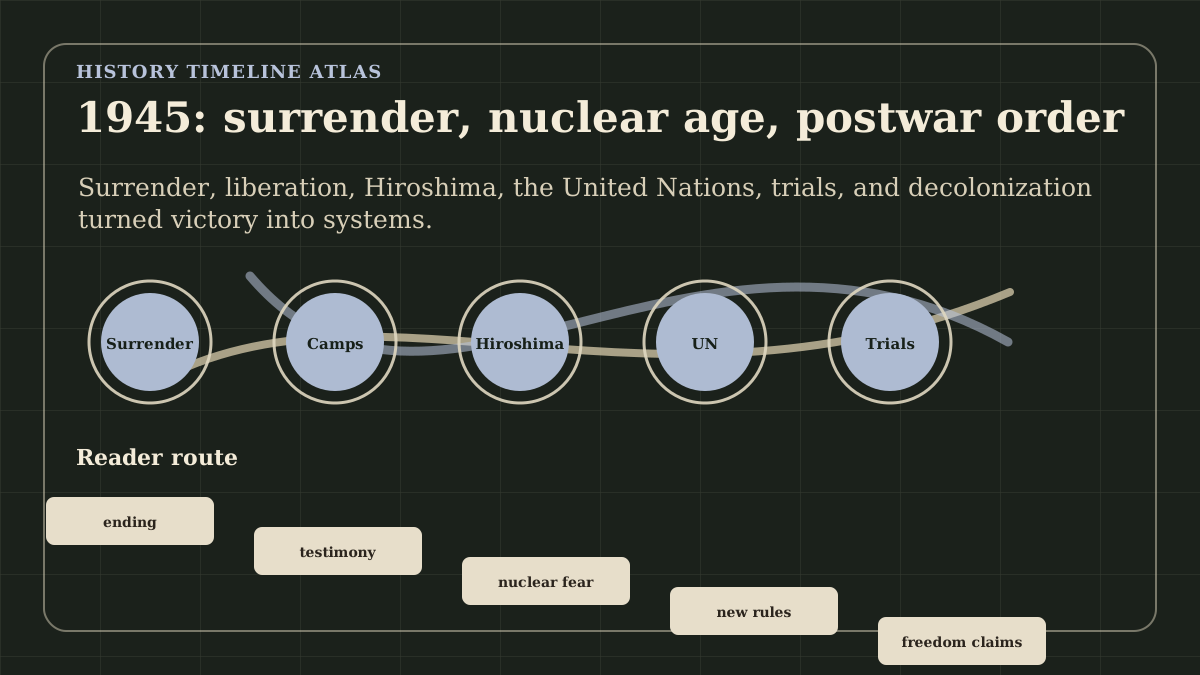
A good route through 1945 moves outward from endings to systems. Surrender leads to occupation. Liberation leads to testimony and trial. Nuclear bombing leads to deterrence and arms control. The United Nations leads to arguments over sovereignty and human rights. Decolonization leads to new states and new conflicts. The date becomes a map of postwar problems.
The best next route moves from 1945 into Cold War, decolonization, human rights, nuclear politics, and rebuilding. The year matters because it is not only a finish line. It is the hinge where total war became postwar order, and where many unresolved conflicts changed vocabulary rather than disappeared.
1945 matters because it turns the reader from battlefield outcomes toward the rules, fears, and institutions that followed. The year connects the end of fascist expansion with the nuclear age, the United Nations, Cold War rivalry, human rights language, occupation politics, and the long project of rebuilding societies after total war. 1945 matters because it made the modern world legible in several linked forms: nuclear danger, international institutions, occupation, war-crimes law, refugee politics, reconstruction, and anti-colonial pressure. The date is famous as an ending, but its deeper value is that it shows how endings generate new systems. Victory closed the war while opening the Cold War, the UN era, decolonization, and debates over memory that still shape public history.
Reader Lenses
Ask what military victory solved and what it left unresolved.
Read Hiroshima as a human catastrophe and a strategic rupture.
Follow why states tried to build a diplomatic forum after global war.
Notice how 1945 is remembered differently across countries and communities.
Separate German surrender, Japanese surrender, liberation, occupation, and legal reckoning instead of treating the year as one event.
Follow how the UN, occupation systems, trials, and reconstruction tried to turn catastrophe into rules.
Track why anti-colonial movements treated wartime language as leverage after victory.
How This Year Connects
1945 CE in History is anchored by Atomic Bombing of Hiroshima, United Nations Founded, Yalta Conference, and End of World War II. Read those pages together and the year stops being a date label; it becomes a crossroads where immediate choices met older pressures and opened later consequences.
The setting matters as much as the date. The year moves through Hiroshima, San Francisco and New York, Yalta, and Global and belongs to Twentieth Century and World War II. That combination helps readers avoid treating the year as isolated; geography, institutions, conflict, belief, economy, and communication all shape what a date can mean.
The year also opens into people and themes. Figures such as Harry S. Truman, Representatives of founding states, Franklin D. Roosevelt, Winston Churchill, and Joseph Stalin appear because their choices made the year visible, while themes such as World War II, Nuclear Weapons, Japan, United Nations, Diplomacy, and Postwar Order explain why the consequences outlived the moment. A useful next step is usually an event page, then a topic route, then a timeline.
Evidence changes the way a date reads. A treaty, battle report, inscription, newspaper, census, court record, memoir, photograph, or archaeological trace does not answer the same question. Looking at source type helps separate what happened in the year from how later people remembered it.
A year page is most useful when it keeps two scales open at once. The first scale is immediate: what happened, where, and who was involved. The second scale is interpretive: why later readers use this date to organize a wider story. Holding both scales together makes the page a starting point for deeper reading rather than a dead-end answer.
The before-and-after frame matters too. A date rarely begins the forces it reveals. Earlier pressures made the linked event possible, while later pages show which effects were temporary, which became institutions, and which turned into memory. Reading the year this way helps students avoid the false impression that history changes only when the calendar flips.
Use this page as a junction. If the event feels too brief, follow the topic route for background; if the cause feels too abstract, open the event page for sequence; if the consequence feels larger than the date, move into the timeline. The value of a year page is that it lets readers change scale without losing their place.
Events in This Year
- August 6, 1945Atomic Bombing of Hiroshima
The United States dropped an atomic bomb on Hiroshima, causing massive civilian destruction and introducing nuclear weapons into war.
- October 24, 1945United Nations Founded
The United Nations came into force after World War II as states tried to build a stronger framework for peace, security, and cooperation.
- February 1945Yalta Conference
Allied leaders met at Yalta to discuss military coordination, postwar Europe, Germany, and the emerging international order before the war had fully ended.
- 1945End of World War II
World War II ended with the defeat of Nazi Germany and Imperial Japan, closing a global conflict while opening urgent questions of occupation and reconstruction.
- 1945-1946Nuremberg Trials
The Allies tried leading Nazi officials at Nuremberg, creating a legal record of aggression, war crimes, and crimes against humanity.
- October 1945Fifth Pan-African Congress
The Fifth Pan-African Congress brought activists and future leaders together in Manchester, sharpening demands for African independence and anti-colonial solidarity.
- August 17, 1945Indonesia Proclaims Independence
Sukarno and Mohammad Hatta proclaimed Indonesian independence after Japan's surrender, opening a revolutionary struggle against the return of Dutch colonial rule.
- October 1945Fifth Pan-African Congress
The Fifth Pan-African Congress gathered activists who linked anti-colonial demands, labor politics, diaspora organizing, and future African independence movements.
- April 1-June 22, 1945Battle of Okinawa
U.S. forces fought Japanese defenders on Okinawa in a destructive campaign that exposed civilians to intense ground combat, bombardment, suicide attacks, and mass death.
- July 17-August 2, 1945Potsdam Conference
Allied leaders met at Potsdam after Germany's defeat to negotiate occupation policy, borders, reparations, Japan, and the unsettled balance of power after the war.
Map Layer
1945 CE in History geography
Gold pins mark the approximate locations of published event pages. This is a schematic locator map, not a historical border map.
Coordinates are approximate and are used to help readers orient themselves before opening a full event page.
References
Where to Check the Facts
- U.S. National Archives: Surrender of GermanyArchive reference for Germany's May 1945 surrender document and the European endgame.
- U.S. National Archives: Surrender of JapanArchive reference for Japan's September 1945 surrender document and the Pacific endgame.
- The National WWII Museum: The End of World War II 1945Museum reference for 1945 as a year of Allied victory, surrender, and transition to postwar order.
- Encyclopaedia Britannica: World War IISpecific reference for the 1945 CE anchor event, chronology, and historical setting.