At a Glance
The shape of the event
- Date
- April 1-June 22, 1945
- Place
- Okinawa
- Type
- Battle
U.S. forces fought Japanese defenders on Okinawa in a destructive campaign that exposed civilians to intense ground combat, bombardment, suicide attacks, and mass death.
April 1-June 22, 1945; place the event in Okinawa before comparing causes or consequences.
Okinawa shaped calculations about the end of the Pacific War and left a lasting memory of civilian trauma, military occupation, and the strategic value of the island.
U.S. forces / Japanese defenders / Okinawan civilians are the first names or groups to compare before widening the story.
U.S. forces captured Okinawa after heavy military and civilian casualties.
U.S. forces captured Okinawa after heavy military and civilian casualties.
Okinawa shaped calculations about the end of the Pacific War and left a lasting memory of civilian trauma, military occupation, and the strategic value of the island.
The next useful step is to follow the linked events, people, topic routes, and timelines.
Background
By 1945 Allied forces were approaching Japan's home islands. Okinawa mattered because it could support airfields, staging areas, and planning for any possible invasion of Japan. Before Battle of Okinawa, the surrounding world already contained unresolved tensions over authority, resources, belief, strategy, or legitimacy. Those pressures mattered because they shaped what different actors thought was possible. Single-cause explanations flatten the background, which was usually a mix of long-running structures and immediate decisions. The location in East Asia also matters, because events there connected local choices to wider routes of diplomacy, war, trade, reform, or memory. This context prepares the reader to see the event as part of a sequence rather than as an isolated headline.
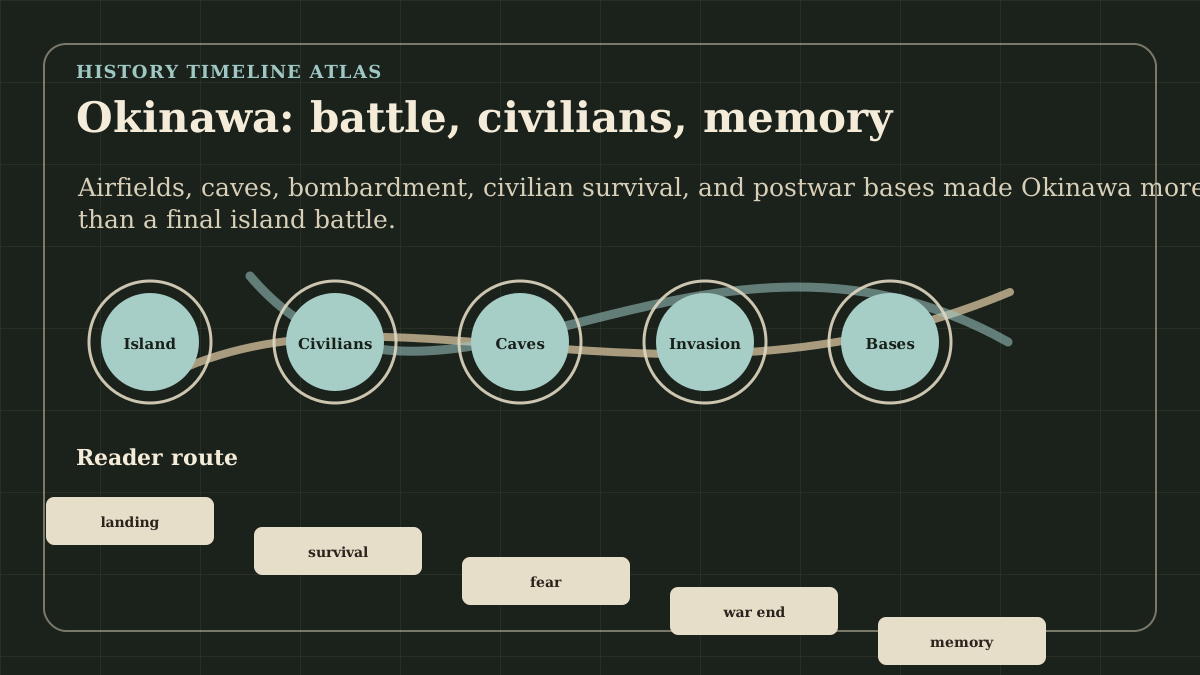
Okinawa forces the Pacific War onto civilian ground. The island mattered militarily because it could support airfields and staging areas near Japan, but that strategic value collided with villages, caves, families, coerced movement, bombardment, and Japanese defensive plans. The campaign shows how an island could become both a military platform and a place of intense civilian catastrophe. The page needs to keep two maps together. One is the Allied military map: airfields, staging areas, naval anchorage, kamikaze attacks, and the possibility of an invasion of Japan. The other is the Okinawan social map: households, caves, language, local authorities, forced movement, fear of both armies, and the terrible choices civilians faced as the front passed through their communities.
Without the second map, the battle becomes only a prelude to Hiroshima. With it, Okinawa becomes a history of lived war. Japanese defensive planning also changed the character of the campaign. Rather than meeting U. S. forces only at the beaches, defenders used prepared positions, caves, ridges, and attrition. That made progress slow and made civilian exposure worse. The terrain turned strategy into intimate danger: bombardment, hunger, hiding, surrender, coercion, and rumor all shaped survival.
The Turning Point
The campaign combined amphibious landings, fortified defenses, artillery, caves, naval attacks, kamikaze missions, and severe civilian suffering. It revealed the expected cost of fighting closer to Japan itself. The turning point was not simply that the event occurred, but that it changed the range of options available afterward. People connected to U. S. forces, Japanese defenders, Okinawan civilians acted inside constraints created by earlier conflicts, institutions, and expectations. Some choices were deliberate; others were responses to pressure, fear, opportunity, or failed compromise. The event's form as battle also shaped how consequences unfolded.
It made certain outcomes easier to imagine, gave later actors new evidence or symbols to use, and forced communities to adapt to a situation that could no longer be treated as temporary. The turning point was not a clean breakthrough but the grinding collapse of organized defense under overwhelming pressure. U. S. forces eventually took the island, yet the cost made leaders imagine what fighting on the Japanese home islands might look like. Okinawa therefore became evidence inside later debates about surrender, invasion planning, blockade, bombing, and nuclear use. For Okinawans, however, the turning point cannot be reduced to Allied decision-making. The battle transformed local memory and postwar politics.
The same geography that made the island strategically useful in 1945 helped make it central to later U. S. bases, security disputes, and arguments over who bears the burden of regional defense.
Consequences
U. S. forces captured Okinawa after heavy military and civilian casualties. Okinawa shaped calculations about the end of the Pacific War and left a lasting memory of civilian trauma, military occupation, and the strategic value of the island. The immediate result mattered, but the longer effect came from how later people interpreted and reused the event. Some consequences were institutional: laws, borders, offices, alliances, or systems of rule changed. Others were social or cultural: public memory, political language, religious identity, or expectations about power shifted. Read the event on two clocks at once. One clock follows the immediate aftermath; the other follows the slower movement of influence into later crises, reforms, debates, and historical comparisons.
Its consequences reach beyond June 1945. The battle influenced expectations about a possible invasion of Japan, shaped debates around the war's ending, and left Okinawa with a long postwar burden of bases, memory, and contested security. Reading Okinawa before Hiroshima helps readers see why the final months of the Pacific War were saturated with fear, calculation, and civilian suffering. The event is also a strong page for readers looking for causes and effects because the chain is unusually visible. Strategic geography made the island valuable. Defensive choices and Allied firepower made the battle catastrophic. The human cost shaped postwar memory. The base system made the war's afterlife part of everyday politics.
Okinawa is therefore not only an ending battle; it is a bridge between wartime destruction and postwar security.
Interpretation Notes
Military narratives often emphasize invasion planning, while Okinawan memory stresses civilian suffering, coercion, displacement, and the long afterlife of bases.
Why Keep Reading
The next useful step is to follow the linked events, people, topic routes, and timelines. Battle of Okinawa becomes clearer when it is compared with what came before and after it, especially events in Twentieth Century and related pages about World War II and Pacific War. The map helps locate the event, the mind map separates causes from effects, and the source list gives readers a way to check the factual spine. Keep reading to see whether this event was a beginning, a turning point, an ending, or a symbol that later generations kept reworking. Read Okinawa beside Iwo Jima, Hiroshima, Japan's surrender, and the postwar U. S. -Japan security order.
That route keeps military planning, civilian suffering, nuclear decision-making, and base politics in one connected Pacific War story.
Reading Path
Follow the story without losing the thread
Before This
- Atomic Bombing of HiroshimaAugust 6, 1945
- Yalta ConferenceFebruary 1945
- End of World War II1945
After This
- Indian Independence and PartitionAugust 1947
- Founding of the People's Republic of ChinaOctober 1, 1949
Same Period
- Assassination of Archduke Franz FerdinandJune 28, 1914
- Russian Revolution1917 CE
- Treaty of VersaillesJune 28, 1919
Wider Timeline
Mind Map
How to think about Battle of Okinawa
Pressure
By 1945 Allied forces were approaching Japan's home islands. Okinawa mattered because it could support airfields, staging areas, and planning for any possible invasion of Japan.
Map Layer
Where this event sits geographically
Gold pins mark the approximate locations of published event pages. This is a schematic locator map, not a historical border map.
Coordinates are approximate and are used to help readers orient themselves before opening a full event page.
References
Where to Check the Facts
- Encyclopaedia Britannica: Battle of OkinawaReference for the campaign chronology and outcome.
- Imperial War Museums: The Battle of OkinawaMuseum reference for the battle and civilian stakes.
- The National WWII Museum: Battle of OkinawaMuseum reference for Okinawa's campaign chronology, invasion, and civilian-military stakes.
- National WWI Museum and Memorial: All About WWIMuseum reference hub for World War I chronology, maps, articles, and educational context.
- U.S. National Archives: World War I CentennialArchive reference hub for World War I records, photographs, documents, and educational resources.
- The National WWII Museum: Explore By TopicMuseum reference hub for World War II theaters, battles, home fronts, aftermath, and memory.
- Imperial War Museums: What You Need to Know About the Second World WarMuseum reference for the global war, civilian experience, military fronts, and consequences.