At a Glance
The shape of the event
- Date
- 1945
- Place
- Global
- Type
- War End
World War II ended with the defeat of Nazi Germany and Imperial Japan, closing a global conflict while opening urgent questions of occupation and reconstruction.
1945; place the event in Global before comparing causes or consequences.
The end of the war reshaped borders, security politics, decolonization pressures, nuclear strategy, and global memory.
Allied powers / Axis powers are the first names or groups to compare before widening the story.
The Axis powers surrendered, and Allied states began managing occupation, trials, relief, and new institutions.
The Axis powers surrendered, and Allied states began managing occupation, trials, relief, and new institutions.
The end of the war reshaped borders, security politics, decolonization pressures, nuclear strategy, and global memory.
Follow the immediate aftermath to see how wartime mobilization turned into peacetime governance: the establishment of occupation authorities, the legal processes for wartime accountability, and the institutions that a...
Background
The closing of the global war in 1945 was the product of years of sustained military and political pressure on the Axis powers and of complex collaboration among the Allied states. Economies and societies had been mobilized on an unprecedented scale: armies grew, civilians were drawn into industrial production and relief, and governments assumed new authority to direct resources. The Axis states pursued expansionist aims that provoked coalitions of resistance across continents. At the same time, the Allied partnership was itself a fraught coalition of states with different aims and visions for the postwar order.
By the final year of conflict, military defeats had brought Axis capacity to resist to a crisis point, but the end of fighting did not settle competing plans for occupation, reconstruction, or justice. Refugee flows, ruined infrastructure and contested sovereignties confronted occupying forces and local populations. Scholars debate how much weight to give immediate decisions by political and military leaders versus longer-running structural forces—economic mobilization, imperial decline, and ideological rivalry—in explaining why the war ended as it did and how the world was reordered afterward. The end of World War II should not read as one clean victory scene.
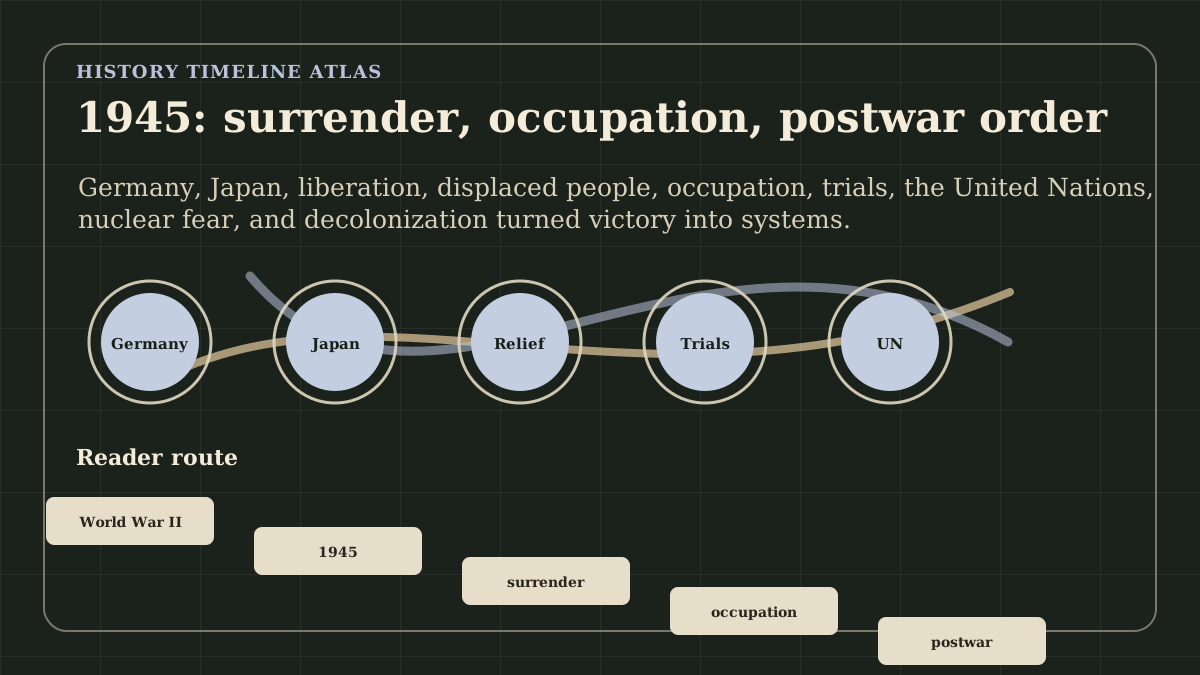
It was a sequence: Germany's surrender in May, the liberation of camps and occupied territories, continuing war in Asia, the atomic bombings of Hiroshima and Nagasaki, Japan's surrender in August and September, and the immediate work of occupation, relief, repatriation, and accountability. The page also needs civilians at its center. Displaced people, liberated prisoners, forced laborers, Holocaust survivors, bombed cities, soldiers waiting for demobilization, colonial troops, women managing households and work, and children separated by war all faced different versions of 'the end.' Peace arrived unevenly, and many people met it through hunger, ruins, uncertainty, or new political control. The postwar order was not simply planned at conference tables.
It was built through Allied occupation zones, food shipments, refugee camps, trials, new constitutions, border transfers, the United Nations, the beginning of nuclear fear, and pressure on empires that had claimed to fight for freedom while ruling colonies.
The Turning Point
What changed in 1945 was not only the cessation of major combat operations but the transition from wartime coalition to instruments of peace and control. The Axis powers surrendered; the military reality of defeat left political vacuums in Germany, Japan and occupied territories. Allied states moved quickly to fill those vacuums with occupation authorities, military governments and administrative teams charged with keeping order, delivering relief and beginning reconstruction. Those choices were concrete: which governments to install or dissolve, how to administer justice for wartime crimes, where to place occupation forces, and how to ration scarce resources. The Allies also faced diplomatic choices about institutions for international cooperation and mechanisms to manage security.
These were not abstract moves: they required personnel, legal frameworks and logistical systems to house displaced people, reopen ports and rebuild transport. The moment exposed sharp differences among Allies about sovereignty, punishment and reconstruction. Historians continue to argue about how much the course of the postwar settlement reflected individual wartime decisions by leaders and negotiators, and how much it reflected underlying shifts—industrial capacity, the decline of empires and the emergence of new military technologies—that had been building for decades. The turning point was the shift from destroying Axis military power to governing the consequences of destruction.
Surrender created administrative problems: who would police streets, reopen schools, punish crimes, feed cities, remove mines, manage records, and decide which local authorities could be trusted? A second turning point was the opening of a new security world. The wartime alliance did not become a stable peace coalition. Soviet, American, British, French, Chinese, and other interests moved from shared enemy to competing visions of reconstruction, borders, ideology, and military power.
Consequences
In the near term the end of hostilities produced a scramble to stabilize devastated regions. Occupation administrations assumed responsibility for food distribution, public health, and basic governance while displaced populations sought return or refuge. Allied trials and legal processes began to address responsibility for wartime crimes, even as practical limits—logistics, politics, and the need for reconstruction—shaped outcomes. In the longer run the cessation of global war precipitated fundamental shifts. Borders were redrawn in some regions; security politics were transformed as states rethought alliances, force projection and deterrence. Pressure for decolonization accelerated as wartime strains exposed imperial vulnerabilities and nationalist movements pushed for independence.
The strategic logic of armed conflict also changed, with new attention to the implications of advanced weapons and state capacity for deterrence. Cultural and political memory—how societies remembered victims, collaborators and resistance—became a lasting field of contest. These consequences unfolded unevenly and remain subject to debate; different places experienced occupation and reconstruction in varied ways, and historians weigh differently the role of contingency versus structural change in producing the postwar map. The immediate consequences were occupation, trials, relief, demobilization, and the search for missing people. Nuremberg and Tokyo made legal accountability visible, but justice was incomplete and uneven. Reconstruction promised order, yet it also involved censorship, purges, political bargaining, and hard choices about expertise and guilt.
The longer consequences defined the second half of the twentieth century: the Cold War, decolonization, European integration, U. S. and Soviet superpower rivalry, nuclear strategy, war memory, human rights language, and institutions meant to prevent another world war.
Interpretation Notes
End of World War II raises a debate about scale: did the decisive change come from the visible war end, or from older pressures around World War II and Postwar Order that had already narrowed what people could do?
Why Keep Reading
Follow the immediate aftermath to see how wartime mobilization turned into peacetime governance: the establishment of occupation authorities, the legal processes for wartime accountability, and the institutions that aimed to prevent future global conflict. Tracing those next steps reveals why some borders held and others did not, how military alliances hardened into rival blocs, and how the rhetoric of liberation intersected with the demands of empire and national self-determination. If you want to understand the long arc from battlefield to ballot box, or from ruined cities to new security architectures, the next pages on occupation policies, international tribunals and early Cold War diplomacy will show how 1945 became the launching point for the second half of the twentieth century.
Read 1945 beside Hiroshima, Nuremberg, the United Nations, decolonization after World War II, the Berlin blockade, and the Cold War timeline. That path shows how ending a war created the systems that shaped the next era.
Reading Path
Follow the story without losing the thread
Before This
- Atomic Bombing of HiroshimaAugust 6, 1945
- United Nations FoundedOctober 24, 1945
- Yalta ConferenceFebruary 1945
After This
- Marshall Plan AnnouncedJune 1947
- Universal Declaration of Human RightsDecember 10, 1948
- NATO FoundedApril 4, 1949
Same Period
- Battle of BritainJuly-October 1940
- Operation BarbarossaJune 22, 1941
- Battle of MidwayJune 1942
Wider Timeline
Mind Map
How to think about End of World War II
Total war mobilization
Industrial-scale mobilization and prolonged combat eroded Axis capacity to sustain the war
Map Layer
Where this event sits geographically
Gold pins mark the approximate locations of published event pages. This is a schematic locator map, not a historical border map.
Coordinates are approximate and are used to help readers orient themselves before opening a full event page.
References
Where to Check the Facts
- National WWI Museum and Memorial: All About WWIMuseum reference hub for World War I chronology, maps, articles, and educational context.
- U.S. National Archives: World War I CentennialArchive reference hub for World War I records, photographs, documents, and educational resources.
- The National WWII Museum: Explore By TopicMuseum reference hub for World War II theaters, battles, home fronts, aftermath, and memory.
- Imperial War Museums: What You Need to Know About the Second World WarMuseum reference for the global war, civilian experience, military fronts, and consequences.
- United Nations: History of the United NationsOfficial institutional reference for United Nations founding, charter drafting, and postwar aims.