Historical Role
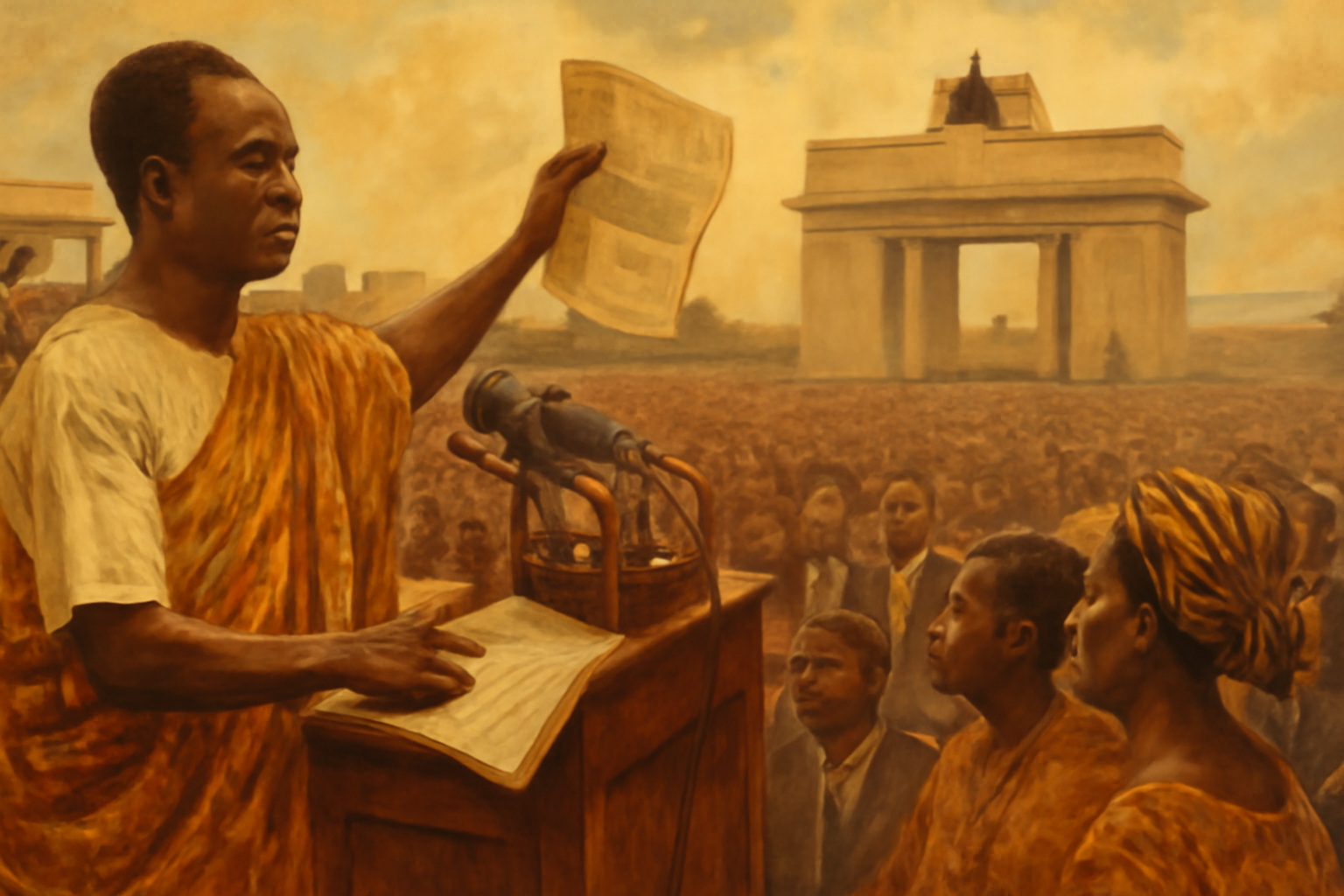
Kwame Nkrumah belongs at the center of any serious route through African decolonization because his biography joins party organizing, mass politics, state independence, pan-African ambition, and the difficult afterlife of liberation. Ghana's independence in 1957 was not only a constitutional transfer. It was a public claim that African sovereignty could become immediate, modern, and internationally visible at a moment when many colonial governments still expected gradual reform.
The Fifth Pan-African Congress gives the page its wider frame. Nkrumah's politics grew through Atlantic and African networks: students, labor organizers, anti-colonial intellectuals, newspapers, veterans, unions, and activists who treated colonial rule as a global system rather than a local administrative problem. That matters because Ghanaian independence became a signal to other movements, not simply a national story inside the Gold Coast.
The Convention People's Party made that politics practical. Positive Action, rallies, newspapers, youth organizers, market women, cocoa farmers, trade unions, and detention campaigns turned constitutional argument into a mass movement. Nkrumah's strength was not only charisma; it was the ability to translate anti-colonial impatience into disciplined organization that colonial officials could not easily absorb.
Independence then tested a different kind of skill. Schools, roads, media, industrial plans, the Volta River project, party structures, and security laws all became tools for building a state that promised modern development. The same machinery that projected confidence also narrowed political competition, which is why the biography has to connect liberation energy with the risks of party-state rule.
Nkrumah's pan-Africanism was more than a slogan after 1957. Accra became a meeting point for activists, exiles, diplomats, and liberation movements, while Ghana navigated the United Nations, nonalignment, OAU debates, and Cold War pressure. Those networks explain why Nkrumah's fall mattered beyond Ghana: it exposed how difficult continental solidarity became when new states faced debt, security threats, ideological rivalry, and domestic opposition.
Nkrumah's later rule also needs to stay in view. A rich biography moves past independence ceremonies, flags, and speeches into one-party pressure, preventive detention, state-led development, the Volta River project, Cold War diplomacy, debts, opposition, and the coup that removed him. The point is not to cancel his importance. It is to show why liberation leaders often faced the hard problem of converting movement legitimacy into accountable institutions.
Kwame Nkrumah helps connect individual action with wider historical change in Ghana. The biography works best when it keeps the surrounding world visible: authority, conflict, belief, reform, or discovery moved through decisions made under pressure.
The related events show how roles such as Ghanaian leader, Pan-Africanist can be read through dates, places, institutions, and consequences rather than through reputation alone. The biography explains why this person matters, while the linked events explain what changed around them.
A richer reading starts with the limits around the person. Some figures acted through offices, armies, courts, laboratories, churches, parties, ships, trade networks, or protest movements; others became important because later communities turned their lives into symbols. The page therefore asks what this person could actually change, what was already moving before them, and which consequences later readers attached to the name.
Read the biography against absence as well. Many lives around Kwame Nkrumah are less visible in the record: opponents, collaborators, family members, workers, soldiers, students, subjects, victims, translators, scribes, or local communities. Keeping those surrounding people in view makes the page less like a name card and more like an entry point into historical systems.
Kwame Nkrumah also works as a navigation point. Open the linked event pages to see where the biography becomes chronology, then use the topic routes to test whether the same pattern appears beyond one life. That extra step matters because historical importance is rarely contained inside a single decision; it usually spreads through institutions, witnesses, opponents, imitators, and later arguments over memory.
Sources and Method
Source method: read Nkrumah through the Fifth Pan-African Congress and Ghana independence pages, then test the biography against decolonization, Cold War, and postcolonial state-building routes so the page does not become either celebration or dismissal.
Evidence Notes
How Sensitive Claims Are Sourced
- 1
Pan-Africanism before state power
The biography treats Nkrumah's organizing world as transnational, linking students, labor, print culture, congress politics, and anti-colonial thought before Ghana became independent.
- 2
Independence and governing strain
Ghana's independence anchors the page, but the later frame keeps development planning, one-party rule, opposition, Cold War pressure, and the 1966 coup visible.
Why This Person Matters
Kwame Nkrumah matters because the connected events make a larger historical pattern easier to follow. The page links biography to consequences so readers can move from a life story into the wider atlas, compare the person with contemporaries, and understand why later memory kept returning to this figure. Kwame Nkrumah matters because his career makes African decolonization visible as mass politics, Pan-African imagination, state-building, development planning, and political contradiction. The biography helps readers understand why independence was a beginning rather than the end of colonial history.
How did Nkrumah make Ghana's independence a continental signal, and why was that achievement so hard to turn into durable democratic government?
How to Read This Life
Kwame Nkrumah is easiest to understand when the biography is read beside Fifth Pan-African Congress, Ghana Independence. Those events show the historical setting in motion: dates, places, institutions, conflict, and consequences give the life a structure that a short biography alone cannot provide.
The surrounding route crosses Decolonization and locations such as Manchester, Accra. That matters because influence rarely stays inside one person. It moves through offices, armies, movements, laws, texts, speeches, institutions, and later memory.
A useful reading path starts with the role labels, then opens the event pages to see what changed, and finally compares this person with other actors facing similar pressures.
For readers who arrive on a biography first, this page is meant to become a doorway rather than a stop. Read one paragraph for the answer, then use the turning points, topic routes, and event links to test whether the person's reputation matches the wider evidence.
Read Nkrumah beside the Fifth Pan-African Congress, Ghana independence, Bandung, decolonization, the Cold War, and African Union/OAU routes. That path makes independence a continental and diplomatic story.
Then compare him with Nasser, Nyerere, Nehru, Sukarno, Lumumba, and Mandela where available. The comparison asks how anti-colonial leaders turned moral authority into parties, states, international coalitions, and contested memories.
Read Kwame Nkrumah through the roles of Ghanaian leader, Pan-Africanist rather than as reputation alone.
Place the biography inside Ghana and the wider events linked below.
Ask which choices were personal and which were constrained by institutions or crisis.
Follow how later memory simplified, contested, or reused this person's role.
Follow congresses, students, workers, newspapers, and international networks before reading state power.
Ask how parties, development projects, security law, and opposition changed the meaning of liberation.
Hold founder status and authoritarian controversy together instead of choosing one simplified image.
Legacy, Limits, and Memory
A useful biography keeps scale in view. Kwame Nkrumah mattered because individual choices met a wider structure: institutions, enemies, allies, audiences, technologies, beliefs, and inherited conflicts. The related event pages help separate personal agency from conditions that no single person controlled.
Memory is part of the biography too. Later readers often simplify a figure into a hero, villain, founder, reformer, conqueror, prophet, scientist, or symbol. Those labels can be helpful, but they become misleading when they hide conflict, compromise, exclusion, uncertainty, or the experiences of people outside the main biography.
For the next step, compare this life with a topic route rather than stopping at the name. If the same pattern appears across several figures, the reader has found a historical structure; if this person breaks the pattern, the contrast is usually where the most interesting question begins.
The main risk is writing Nkrumah as a symbol instead of as a historical actor inside institutions. Pan-African language mattered, but so did party machinery, state finance, police power, public works, opposition, and international bargaining.
A second risk is treating authoritarian drift as an unrelated footnote. The page becomes more useful when readers see how fears of sabotage, development urgency, Cold War rivalry, and personal authority interacted after independence.
Turning Points to Read Next
Fifth Pan-African Congress
The Fifth Pan-African Congress brought activists and future leaders together in Manchester, sharpening demands for African independence and anti-colonial solidarity.
Ghana Independence
Ghana became independent from British colonial rule, with Kwame Nkrumah framing the new state as part of a broader African liberation project.
Related Timeline
- October 1945Fifth Pan-African Congress
The Fifth Pan-African Congress brought activists and future leaders together in Manchester, sharpening demands for African independence and anti-colonial solidarity.
- March 6, 1957Ghana Independence
Ghana became independent from British colonial rule, with Kwame Nkrumah framing the new state as part of a broader African liberation project.
References
Where to Check the Facts
- Encyclopaedia Britannica: Kwame NkrumahBiographical reference for Kwame Nkrumah's life dates, roles, institutions, and historical setting.
- Encyclopaedia BritannicaBackground reference for chronology, names, and historical context.
- WikidataStructured reference for dates, places, alternate names, and entity links.