Historical Role
Joseph Stalin's page needs a double frame: Soviet wartime leadership and coercive dictatorship. The Soviet Union's survival against Nazi invasion depended on industrial capacity, mobilization, sacrifice, command decisions, Allied coordination, and the extraordinary suffering of soldiers and civilians. But that wartime story cannot be separated from purges, forced labor, famine memory, political terror, deportations, censorship, and the concentration of power around Stalin.
Operation Barbarossa and Stalingrad show why the biography cannot be only a Kremlin story. The war moved through factories, railways, evacuation, farms, cities, front lines, partisan zones, hospitals, prisons, and households. Stalin's decisions mattered, but millions of people carried the war's cost. A useful biography keeps leadership, state machinery, and human loss visible at the same time.
Yalta moves the biography into postwar order. Stalin negotiated as leader of a victorious power while Eastern Europe, Germany, Poland, borders, security fears, and ideology were being reorganized. The Cold War did not come from one personality alone, but Stalin's state, suspicion, territorial aims, and security system shaped the early postwar settlement.
The biography also needs the 1930s before the battlefield. Collectivization, famine, industrialization, party discipline, show trials, purges, and the growth of the security state shaped the Soviet Union that later fought the war. Those policies created factories and command capacity, but they also destroyed lives, narrowed truth, and made fear part of ordinary political behavior.
Stalingrad should therefore be read on two levels. On one level, it was a military and psychological turning point against Nazi Germany. On another, it revealed how a state built through coercion could mobilize people at enormous human cost. Soldiers, workers, women, evacuees, prisoners, commanders, and civilians all sit behind the leader's name.
A careful Stalin page also explains memory politics. Soviet victory became a founding memory after 1945, while terror was suppressed, justified, or selectively remembered. Later debates over Stalin repeatedly return to the same tension: victory over fascism was real, but it cannot be used to erase state violence against Soviet citizens and occupied peoples.
A reader-facing Stalin biography also separates command from society. Stalin issued orders and shaped priorities, but Soviet survival depended on engineers, railway workers, commanders, nurses, prisoners, peasants, industrial laborers, and families enduring evacuation and loss. That wider view keeps the biography from turning millions of lives into background scenery.
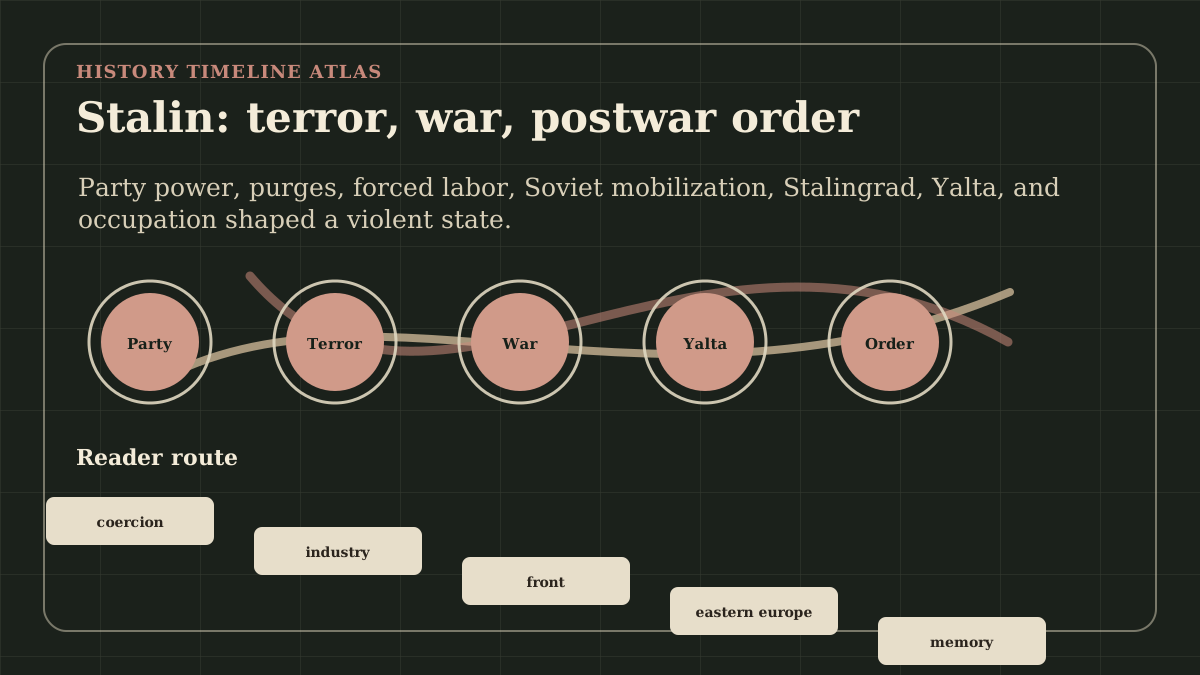
For a reader arriving through a Stalin biography search, the useful path is not only birth-to-death chronology. It is a route through Leninism, collectivization, terror, Nazi invasion, wartime alliance, Eastern Europe, and Cold War memory. The biography becomes a guide through those connected problems.
The borderlands make the story still harder. Ukrainians, Belarusians, Baltic communities, Poles, Jews, Tatars, Caucasus peoples, and Central Asian populations encountered Stalinist power through famine, deportation, occupation, collaboration accusations, partisan war, and postwar security policy in very different ways. That geography prevents a Moscow-only account from flattening the Soviet Union into one political experience.
Joseph Stalin helps connect individual action with wider historical change in Soviet Union. The biography works best when it keeps the surrounding world visible: authority, conflict, belief, reform, or discovery moved through decisions made under pressure.
The related events show how roles such as Soviet leader can be read through dates, places, institutions, and consequences rather than through reputation alone. The biography explains why this person matters, while the linked events explain what changed around them.
A richer reading starts with the limits around the person. Some figures acted through offices, armies, courts, laboratories, churches, parties, ships, trade networks, or protest movements; others became important because later communities turned their lives into symbols. The page therefore asks what this person could actually change, what was already moving before them, and which consequences later readers attached to the name.
Read the biography against absence as well. Many lives around Joseph Stalin are less visible in the record: opponents, collaborators, family members, workers, soldiers, students, subjects, victims, translators, scribes, or local communities. Keeping those surrounding people in view makes the page less like a name card and more like an entry point into historical systems.
Joseph Stalin also works as a navigation point. Open the linked event pages to see where the biography becomes chronology, then use the topic routes to test whether the same pattern appears beyond one life. That extra step matters because historical importance is rarely contained inside a single decision; it usually spreads through institutions, witnesses, opponents, imitators, and later arguments over memory.
Sources and Method
Source method: use Operation Barbarossa, Stalingrad, and Yalta as checkpoints. The biography explains Stalin's agency while refusing to let leader-centered history erase Soviet society, victims of terror, occupied peoples, or Allied and German decisions.
Why This Person Matters
Joseph Stalin matters because the connected events make a larger historical pattern easier to follow. The page links biography to consequences so readers can move from a life story into the wider atlas, compare the person with contemporaries, and understand why later memory kept returning to this figure. Joseph Stalin matters because his career shows how revolutionary state power, terror, industrialization, total war, alliance diplomacy, and Cold War security politics could combine inside one regime. The page helps readers study victory and violence together rather than choosing a simplified memory.
How can Stalin's wartime importance be explained without hiding the coercive state and human cost that made his rule historically devastating?
How to Read This Life
Joseph Stalin is easiest to understand when the biography is read beside Operation Barbarossa, Battle of Stalingrad, Yalta Conference. Those events show the historical setting in motion: dates, places, institutions, conflict, and consequences give the life a structure that a short biography alone cannot provide.
The surrounding route crosses World War II and locations such as Eastern Front, Stalingrad, Yalta. That matters because influence rarely stays inside one person. It moves through offices, armies, movements, laws, texts, speeches, institutions, and later memory.
A useful reading path starts with the role labels, then opens the event pages to see what changed, and finally compares this person with other actors facing similar pressures.
For readers who arrive on a biography first, this page is meant to become a doorway rather than a stop. Read one paragraph for the answer, then use the turning points, topic routes, and event links to test whether the person's reputation matches the wider evidence.
Read Stalin beside Hitler, Roosevelt, Churchill, Operation Barbarossa, Stalingrad, Yalta, World War II, and Cold War pages. That route keeps dictatorship, total war, alliance diplomacy, and postwar division connected.
Then compare him with Mao, Lenin, Hitler, and Churchill where available. The comparison should separate revolutionary legitimacy, party-state power, wartime leadership, terror, and public memory.
Read Joseph Stalin through the roles of Soviet leader rather than as reputation alone.
Place the biography inside Soviet Union and the wider events linked below.
Ask which choices were personal and which were constrained by institutions or crisis.
Follow how later memory simplified, contested, or reused this person's role.
Keep purges, forced labor, deportation, censorship, and fear visible beside state mobilization.
Read Stalingrad and Barbarossa through soldiers, civilians, industry, logistics, and command.
Follow how victory, security fears, ideology, and occupation shaped the early Cold War.
Legacy, Limits, and Memory
A useful biography keeps scale in view. Joseph Stalin mattered because individual choices met a wider structure: institutions, enemies, allies, audiences, technologies, beliefs, and inherited conflicts. The related event pages help separate personal agency from conditions that no single person controlled.
Memory is part of the biography too. Later readers often simplify a figure into a hero, villain, founder, reformer, conqueror, prophet, scientist, or symbol. Those labels can be helpful, but they become misleading when they hide conflict, compromise, exclusion, uncertainty, or the experiences of people outside the main biography.
For the next step, compare this life with a topic route rather than stopping at the name. If the same pattern appears across several figures, the reader has found a historical structure; if this person breaks the pattern, the contrast is usually where the most interesting question begins.
The interpretive rule is no normalization. Explaining Stalin's role in victory does not excuse mass repression, forced labor, famine policy, purges, deportations, or the destruction of political freedom.
The biography should avoid both one-man omnipotence and one-man alibi. Stalin mattered enormously, but institutions, party cadres, security organs, military commanders, workers, soldiers, and local officials made the system work.
Turning Points to Read Next
Operation Barbarossa
Nazi Germany invaded the Soviet Union in the largest land campaign of World War II, turning the conflict into a vast war of ideology, occupation, and survival.
Battle of Stalingrad
Soviet forces encircled and defeated a German army at Stalingrad after months of brutal urban combat and strategic overreach.
Yalta Conference
Allied leaders met at Yalta to discuss military coordination, postwar Europe, Germany, and the emerging international order before the war had fully ended.
Related Timeline
- June 22, 1941Operation Barbarossa
Nazi Germany invaded the Soviet Union in the largest land campaign of World War II, turning the conflict into a vast war of ideology, occupation, and survival.
- 1942-1943Battle of Stalingrad
Soviet forces encircled and defeated a German army at Stalingrad after months of brutal urban combat and strategic overreach.
- February 1945Yalta Conference
Allied leaders met at Yalta to discuss military coordination, postwar Europe, Germany, and the emerging international order before the war had fully ended.
References
Where to Check the Facts
- Encyclopaedia Britannica: Joseph StalinBiographical reference for Joseph Stalin's life dates, roles, institutions, and historical setting.
- Encyclopaedia BritannicaBackground reference for chronology, names, and historical context.
- WikidataStructured reference for dates, places, alternate names, and entity links.