How to Read the Year
Why does 1989 mean liberation in some places and repression in others?
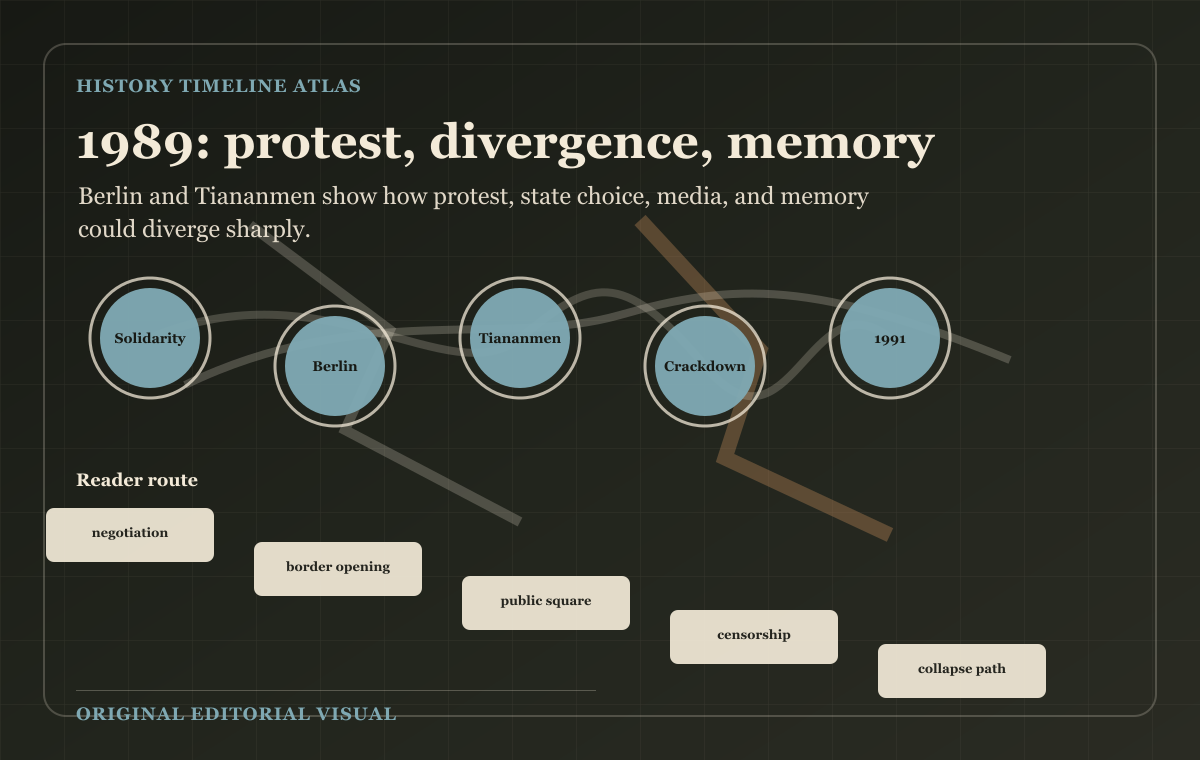
1989 is often remembered through the fall of the Berlin Wall, but the year also includes the Tiananmen Square protests and crackdown. Reading both together prevents a triumph-only story of the late Cold War. In Europe, communist regimes lost legitimacy and borders opened. In China, protest for reform met state violence and party control survived.
The year therefore teaches comparison. Berlin shows pressure from civic protest, East German crisis, Soviet restraint, media confusion, and public crossing. Tiananmen shows student and citizen mobilization, reform hopes, elite division, martial law, and violent suppression. Both involved crowds, broadcasts, symbolism, and state decisions; their outcomes diverged sharply.
A strong page keeps memory uneven. For many Europeans, 1989 became a shorthand for democratic opening and reunification. For many Chinese citizens, the same year remains marked by censorship, mourning, exile, and unresolved public memory. The global lesson is not that history naturally moved toward freedom, but that regimes made choices under pressure.
Eastern Europe gives 1989 its sequence rather than a single image. Poland's Solidarity negotiations, Hungary's border opening, East German demonstrations, Czechoslovakia's Velvet Revolution, and Romania's violent rupture show that communist rule weakened through different combinations of protest, negotiation, party fracture, economic strain, and Soviet nonintervention. The Berlin Wall was the most famous scene, not the only mechanism.
China gives the comparison its warning. Economic reform had loosened parts of society without creating political pluralism, and students, workers, intellectuals, journalists, and citizens used public space to demand accountability, reform, and an end to corruption. The crackdown showed that a party-state could choose coercive survival even when protest had become globally visible.
The next route should move from 1989 to 1991, German reunification, Soviet dissolution, Chinese reform, globalization, and human-rights memory. The year is useful for SEO because many readers search for 'what happened in 1989,' but the better answer is comparative: several systems faced legitimacy crisis, and they did not all break in the same direction.
The method is comparative: protest, elite division, security-force choice, outside pressure, and media visibility explain more than a slogan about freedom winning or repression winning.
The media layer makes the contrast sharper. Television images, rumors, official announcements, photographs, foreign reporting, and later digital memory helped turn both events into global reference points. Public visibility did not guarantee the same outcome; it changed how people argued over legitimacy afterward.
1989 CE in History gathers events that help readers move from a single date into wider historical patterns. A useful year entry does more than answer what happened; it shows why people keep using the year as a marker for change.
The connected events show how decisions, institutions, conflicts, ideas, and consequences crossed beyond one location or one person. The event links explain the immediate story, while the topic routes and timelines show what came before and after.
The year also helps organize broad questions. It gives readers a concise answer and a direct path into deeper event pages where causes, turning points, consequences, maps, and references are easier to inspect.
Read the date in three passes. First ask what happened inside the year itself. Then ask which older pressures made the event possible. Finally ask which later pages reuse the same vocabulary, institutions, borders, technologies, or memories. That sequence keeps the page from becoming a trivia answer.
Even when only one event is currently attached, the year still has a job: it gives students and curious visitors a stable chronological doorway into the atlas. The page makes the doorway useful by pointing to the event, the topic route, the timeline, the map, and the evidence trail that can turn a date into a broader explanation.
This year matters because it connects Fall of the Berlin Wall, Tiananmen Square Protests to a wider sequence of causes and consequences. It gives the reader a chronological anchor while still pointing outward to people, places, institutions, and later effects. A thin year page would only name the event; a useful year page explains why this date is a handle for a larger route through history. 1989 matters because it gives readers a powerful entry into the end of the Cold War while warning against a single victory narrative. The year connects protest, state legitimacy, media, borders, reform, repression, memory, and the different paths taken by communist states at the end of the twentieth century.
Reader Lenses
Look for the pressures that made change possible.
Identify who acted and what options were available.
Follow what changed after the event.
Ask why this date still appears in historical summaries.
Compare why protest helped open one political order while another state preserved control.
Ask why Berlin became public celebration while Tiananmen remains censored and contested.
Track elite decisions, security forces, media signals, and international constraints under pressure.
How This Year Connects
1989 CE in History is anchored by Fall of the Berlin Wall and Tiananmen Square Protests. Read those pages together and the year stops being a date label; it becomes a crossroads where immediate choices met older pressures and opened later consequences.
The setting matters as much as the date. The year moves through Berlin and Beijing and belongs to Cold War and Late Cold War. That combination helps readers avoid treating the year as isolated; geography, institutions, conflict, belief, economy, and communication all shape what a date can mean.
The year also opens into people and themes. Figures such as East German citizens and Chinese student protesters appear because their choices made the year visible, while themes such as Cold War, Germany, Communism, China, Protest, and Democracy explain why the consequences outlived the moment. A useful next step is usually an event page, then a topic route, then a timeline.
Evidence changes the way a date reads. A treaty, battle report, inscription, newspaper, census, court record, memoir, photograph, or archaeological trace does not answer the same question. Looking at source type helps separate what happened in the year from how later people remembered it.
A year page is most useful when it keeps two scales open at once. The first scale is immediate: what happened, where, and who was involved. The second scale is interpretive: why later readers use this date to organize a wider story. Holding both scales together makes the page a starting point for deeper reading rather than a dead-end answer.
The before-and-after frame matters too. A date rarely begins the forces it reveals. Earlier pressures made the linked event possible, while later pages show which effects were temporary, which became institutions, and which turned into memory. Reading the year this way helps students avoid the false impression that history changes only when the calendar flips.
Use this page as a junction. If the event feels too brief, follow the topic route for background; if the cause feels too abstract, open the event page for sequence; if the consequence feels larger than the date, move into the timeline. The value of a year page is that it lets readers change scale without losing their place.
Read 1989 beside the Berlin Wall, Tiananmen, Cold War, Soviet collapse, Chinese reform, Eastern Europe, and globalization routes.
Then compare 1989 with 1956, 1968, 1979, 1980, and 1991. The comparison asks when protest becomes reform, crackdown, collapse, or controlled continuity.
Events in This Year
- November 9, 1989Fall of the Berlin Wall
East German authorities opened border crossings in Berlin after months of protest and pressure, allowing people to cross the wall freely.
- 1989Tiananmen Square Protests
Pro-democracy demonstrations centered on Tiananmen Square called for political reform before the Chinese government used force to suppress the movement.
Map Layer
1989 CE in History geography
Gold pins mark the approximate locations of published event pages. This is a schematic locator map, not a historical border map.
Coordinates are approximate and are used to help readers orient themselves before opening a full event page.
References
Where to Check the Facts
- Encyclopaedia Britannica: Berlin WallSpecific reference for the 1989 CE anchor event, chronology, and historical setting.
- Encyclopaedia BritannicaBackground reference for chronology, names, and historical context.
- WikidataStructured reference for dates, places, alternate names, and entity links.