Fast Answer
Use World War I to study crisis escalation among alliances and industrial empires; use World War II to study expansionist regimes, occupation, genocide, air and naval war, and the post-1945 settlement. The link between them is real, but their causes, methods, civilian dangers, and aftermaths differ sharply.
World War I and World War II belong on the same route because the second war grew partly from the unresolved settlement, memory, and instability left by the first. Collapsing them into one story hides the sharp difference between escalation and deliberate expansion. This comparison does not rank suffering or treat atrocities as interchangeable. World War I exposed the destructive capacity of industrial states and imperial alliances; World War II fused territorial expansion, racial ideology, total occupation, genocide, air power, and a new postwar institutional order.
Reading Paths
Choose a reading path
World War I vs World War II becomes clearer when the broad answer stays tied to sequence, place, and concrete next pages.
Follow the comparison through dated examples before returning to the grid.
Assassination of Archduke Franz Ferdinand
Gavrilo Princip assassinated Archduke Franz Ferdinand in Sarajevo, setting off a diplomatic crisis among Europe's alliance systems.
First Battle of the Marne
French and British forces stopped the German advance near the Marne, preventing a quick German victory and helping turn the Western Front into a long war of attrition.
Battle of the Somme
British and French forces attacked along the Somme in one of World War I's largest battles, gaining limited ground at immense human cost.
Treaty of Versailles
The Treaty of Versailles ended formal war between Germany and the Allied powers while assigning responsibility, reparations, and territorial changes.
Invasion of Poland
Germany invaded Poland, using speed, air power, and coordinated ground forces to begin the European phase of World War II.
Comparison Grid
World War I
The assassination of Archduke Franz Ferdinand triggered a wider crisis among alliances and empires.
World War II
The invasion of Poland followed years of revisionist aggression, appeasement, and institutional failure.
The first war escalated from crisis; the second followed deliberate expansion by aggressive regimes.World War I
Attrition, trenches, artillery, blockade, colonial manpower, and mass mobilization shaped the fighting.
World War II
Mechanized campaigns, occupation, air power, genocide, carrier warfare, and nuclear weapons shaped the war.
Industrial capacity mattered in both, but World War II widened how states targeted societies.World War I
The League of Nations and treaty system promised stability but lacked enough enforcement and legitimacy.
World War II
The United Nations, occupation regimes, war-crimes trials, reconstruction, and Cold War blocs reshaped world politics.
Both settlements tried to prevent another catastrophe; only the second built the institutions of the modern order.The Same Route, Not the Same War
Two short phrases show how memory differs. World War I is often remembered through words such as 'over the top' and 'the war to end war.' World War II is often remembered through liberation, occupation, genocide, and nuclear fear. The phrases are not evidence by themselves, but they show how later publics turned different experiences into shorthand.
The easiest mistake is to treat the two world wars as one long disaster with a pause in the middle. The connection is real: Versailles, reparations debates, borders, veterans, economic crisis, political violence, and memory all shaped the world in which the second war became possible. But a trench near the Somme, a carrier deck at Midway, a Chinese family under Japanese occupation, a Soviet worker in Stalingrad, a colonial soldier in East Africa, a Jewish family facing deportation, and a Japanese civilian in Hiroshima did not live the same war. The comparison becomes useful only when continuity and difference are both kept visible.
World War I was driven by alliance commitments, imperial rivalry, nationalist crisis, military timetables, and decisions made after the assassination of Archduke Franz Ferdinand. It became a war of attrition because industrial states could mobilize men, shells, railways, credit, and food at a scale that outran their political imagination. World War II was driven more directly by revisionist regimes that used aggression as policy: Nazi Germany in Europe, Fascist Italy in Africa and the Mediterranean, and Imperial Japan in East Asia and the Pacific.
This difference matters for readers. If World War I asks how a regional crisis escaped control, World War II asks how expansionist states used violence after earlier restraints failed. The first comparison point is therefore agency. Leaders, generals, diplomats, voters, party militants, industrialists, colonial subjects, and occupied civilians all mattered, but the distribution of responsibility and the structure of danger were not identical.
Causes and Triggers
World War I has a clearer immediate trigger: the Sarajevo assassination in June 1914. The trigger mattered because it activated older tensions among Austria-Hungary, Serbia, Russia, Germany, France, Britain, and their imperial systems. The deeper causes include alliance logic, arms competition, nationalist politics, imperial anxiety, and military plans that rewarded speed over restraint. A good answer separates the spark from the fuel.
World War II has no single equivalent trigger. The invasion of Poland in September 1939 opened the European war, but Japan's war in China, Italy's invasion of Ethiopia, Germany's remilitarization, Austria's annexation, the Munich Agreement, and the failure of collective security had already weakened peace. The causes include fascist and Nazi ideology, economic crisis, resentment of the post-1919 order, appeasement, militarism, and the limited enforcement power of international institutions.
The comparison shows why causes are not just lists. World War I demonstrates how many governments can make short-term choices that produce a catastrophe none of them fully controls. World War II demonstrates how regimes can make catastrophe a policy tool. That difference changes the moral and political shape of each war.
Geography and War Systems
World War I is often remembered through the Western Front, but its geography was wider: Eastern Europe, the Balkans, the Ottoman fronts, Africa, the Middle East, sea lanes, and colonial manpower all mattered. The trench line in France and Belgium became the symbol because it concentrated the war's industrial stalemate, but the map of the war was never only western Europe.
World War II was even more spatially expansive. It included blitzkrieg and occupation in Europe, mass murder in Nazi-controlled territories, carrier warfare in the Pacific, submarine war in the Atlantic, desert campaigns in North Africa, the Eastern Front's vast land war, strategic bombing, island campaigns, and the atomic bombings of Hiroshima and Nagasaki. The map changed because technologies, empires, and ideologies made civilians and production systems central targets.
Geography also changes memory. Verdun, the Somme, Gallipoli, and the Marne invite readers to think about endurance, trenches, command decisions, and national sacrifice. Stalingrad, Midway, Warsaw, Normandy, Pearl Harbor, Auschwitz, Hiroshima, and Berlin invite questions about occupation, genocide, air and naval power, intelligence, surrender, and the boundary between military victory and civilian catastrophe.
Civilians, Empires, and Affected Groups
Both wars depended on civilians, but in different ways. World War I brought rationing, conscription, censorship, labor shifts, colonial recruitment, refugee movement, genocide against Armenians in the Ottoman Empire, and grief on a scale European societies had not expected. The home front became part of the war machine because armies needed shells, food, loans, nurses, workers, propaganda, and public endurance.
World War II made civilian vulnerability even more central. Occupation regimes, forced labor, mass deportation, starvation policies, strategic bombing, genocide, anti-partisan warfare, nuclear attack, and prisoner abuse made the distinction between front and rear far less stable. The Holocaust was not a side effect of battle; it was a central project of Nazi rule and racial ideology within the wider war.
Atrocity comparison needs caution. The Armenian genocide is named as genocide by many historians and governments even though the term remains politically contested by the Turkish state. The Holocaust was a Nazi project of racial extermination. The Nanjing massacre, strategic bombing, starvation policies, forced labor, and atomic bombing belong to different systems of intent, command, ideology, target selection, and memory. Placing them on one page is not a claim that they are interchangeable.
Strategic bombing and atomic bombing need their own careful frame. Allied leaders argued at the time that bombing could weaken enemy capacity, hasten surrender, or reduce the need for invasion. Critics then and later pointed to civilian death, firestorms, nuclear trauma, racialized wartime language, and the moral danger of treating cities as targets. The page keeps those justifications and costs visible together.
Colonial and non-European experiences also prevent a narrow comparison. Indian, African, Caribbean, Southeast Asian, Arab, Pacific, Chinese, Korean, and other communities were drawn into both wars through labor, military service, resource extraction, occupation, nationalism, and postwar political claims. A world-war comparison that only lists European leaders misses how global war changed expectations about citizenship, empire, sovereignty, and independence.
Postwar Settlements and Afterlives
World War I ended with armistice, treaties, border changes, collapsed empires, the League of Nations, reparations, mandates, and new states. It also left unresolved grievances. The postwar order was ambitious but fragile: it promised self-determination unevenly, punished some powers, disappointed others, and lacked the enforcement strength to prevent later aggression.
World War II ended with occupation, trials, reconstruction, the United Nations, the division of Germany, nuclear strategy, the beginning of the Cold War, and stronger human rights language. Its settlement was not peaceful in a simple sense. It produced new institutions and defeated Axis regimes, but it also divided Europe, intensified superpower rivalry, and left many colonial peoples asking why anti-fascist language did not immediately mean independence.
The strongest comparison is therefore not which war was worse. It is how each war rearranged the future. World War I shattered older imperial confidence and made mass politics more dangerous. World War II created the basic architecture of the post-1945 world: the UN, U.S.-Soviet rivalry, decolonization pressure, war-crimes law, reconstruction politics, and nuclear fear.
Evidence, Memory, and Moral Comparison
The two wars also leave different kinds of evidence. World War I comes through trench diaries, casualty lists, letters, propaganda, diplomatic records, battlefield archaeology, photographs, monuments, and veterans' memory. World War II adds those forms but also forces readers into occupation files, camp records, transport lists, aerial photographs, trial testimony, survivor accounts, intelligence records, bombing surveys, and film. The source base changes the comparison because it changes what can be seen.
Memory after 1918 often turned on grief, disillusionment, national sacrifice, victory, mutilation, and the question of whether the war had meaning. Memory after 1945 had to carry liberation and guilt, resistance and collaboration, genocide and denial, nuclear destruction and reconstruction, imperial victory and anti-colonial expectation. That heavier moral vocabulary does not make the first war simple. It shows that the second war left more visible legal and ethical institutions for judging mass violence.
A careful comparison also asks what each war taught states. After World War I, leaders tried treaty revision, collective security, disarmament language, mandates, and a League of Nations without enough shared enforcement. After World War II, leaders built occupation regimes, the UN, Bretton Woods institutions, human-rights declarations, war-crimes trials, NATO, and later Cold War security systems. The second settlement learned from the first, but it also created new risks through nuclear weapons and bloc politics.
The colonial layer keeps the comparison global. Colonial soldiers and workers served in both wars, while colonial economies supplied food, raw materials, ports, and labor. After 1918, self-determination language raised hopes unevenly and often disappointed colonized peoples. After 1945, anti-colonial claims became harder for European empires to dismiss, even when independence still required struggle. The wars connect because empire helped fight them; they differ because the second war made imperial legitimacy far more fragile.
The moral comparison cannot flatten victims into a single category. A soldier killed by artillery, an Armenian deportee, a Jewish child facing extermination, a Chinese civilian under occupation, a forced laborer, a bombed city resident, and a colonial veteran returning home each belongs to a different structure of violence and memory. The comparison is stronger when it names those structures rather than counting suffering as if numbers alone could explain meaning.
Technology is another bridge with a difference. World War I made machine guns, artillery, poison gas, rail mobilization, submarines, and aircraft part of industrial mass death. World War II added radar, codebreaking, carriers, strategic bombing, rockets, mechanized encirclement, medical logistics, and nuclear weapons. The shift was not only new machines. It was a deeper fusion of science, industry, intelligence, state planning, and civilian production.
A good reader route moves from evidence to judgment. Ask what documents show, what they hide, who created them, who survived to testify, and which voices entered public memory late. Then return to the comparison. The first war helps explain how modern states could mobilize destruction beyond political control. The second shows what happened when some regimes made conquest, racial hierarchy, and extermination explicit projects of rule. That distinction gives the comparison durable analytical force.
How to Use This Comparison
Historians argue over the causes of 1914, the harshness and weakness of Versailles, the social roots of fascism, the relationship between empire and war aims, and how genocide belongs inside World War II rather than beside it as a separate tragedy. Those debates are caution signs: where scholars disagree, a good comparison slows down instead of smoothing the dispute away.
A student answer begins with the shared problem: industrialized states and empires could turn crisis into global war. Then it separates the causes. For World War I, emphasize alliance logic, mobilization plans, imperial rivalry, nationalism, and crisis decisions. For World War II, emphasize revisionist regimes, fascism, Nazism, militarism, economic shock, appeasement, and institutional failure. The comparison is strongest when the causes are parallel but not identical.
The second move is to compare scale and method. Both wars were global, but World War II linked ideology, occupation, genocide, air power, and total mobilization more directly. World War I made mass death and state mobilization visible; World War II turned those capacities into a wider system of conquest, extermination, liberation, and reconstruction. That is why the event route moves from the Marne and the Somme to Stalingrad, Midway, D-Day, Hiroshima, and Nuremberg.
The final move is to end with afterlife. World War I shaped the interwar crisis. World War II shaped the Cold War and the postwar order. Reading both wars together makes each more understandable, but only if the page resists the lazy claim that history simply repeated itself. It did not repeat; actors learned, mislearned, exploited memory, and made new choices under inherited pressure.
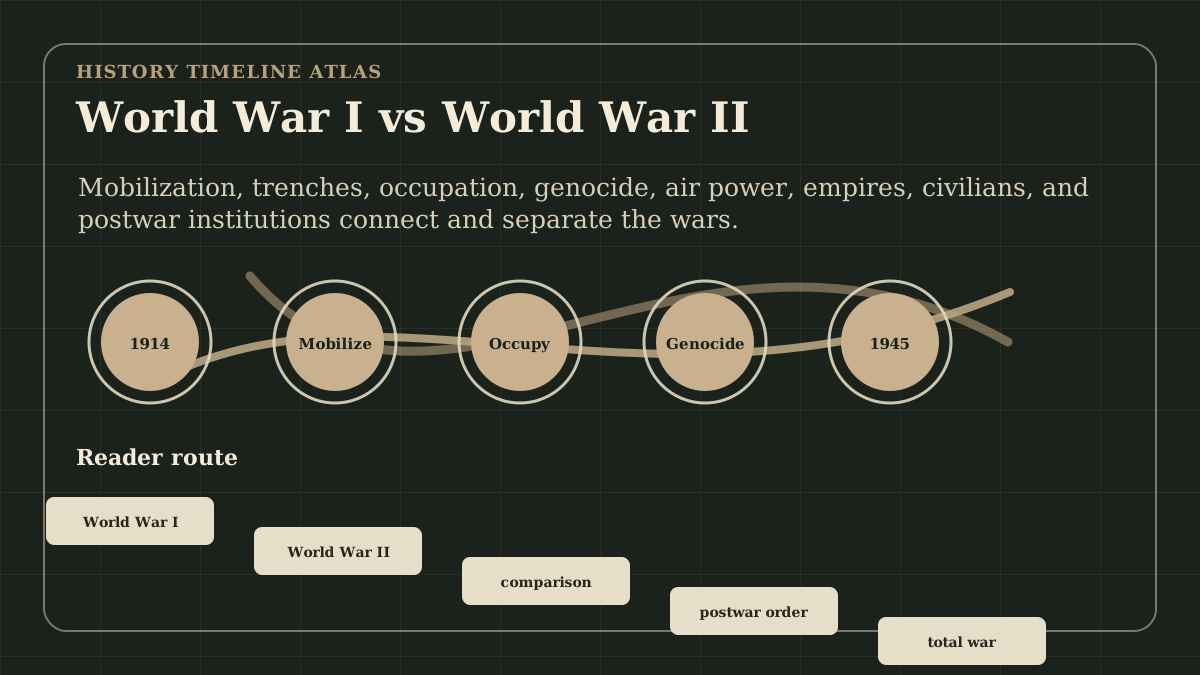
The route also helps readers understand why dates alone are not enough. 1914, 1918, 1939, and 1945 are useful anchors, but the real comparison sits between them: mobilization, home fronts, empires, technologies, ideologies, and settlements. A timeline gives order; a comparison explains why the order mattered.
For deeper reading, ask who had room to choose. A cabinet minister, a soldier at Verdun, a Jewish family under Nazi occupation, a colonial worker, a Japanese naval commander, a Soviet factory worker, and a diplomat at Yalta all stood inside different structures of power. The comparison becomes more human when it keeps those unequal positions visible.
That human scale keeps the page readable. The wars were too large for one memory, so the comparison moves between cabinet decisions and lived experience. The route gives readers a way to hold strategy, ideology, geography, and grief in the same frame without pretending that one battlefield can stand for the whole world.
The comparison stays useful because it keeps asking what changed.
Reader Lenses
World War I shows crisis escalation; World War II shows aggressive revisionist regimes exploiting a weakened order.
Both wars were global, but World War II linked Europe, Asia, oceans, occupation zones, and air power more tightly.
Both wars reached civilians, but World War II made occupation, genocide, bombing, and forced labor central to the conflict.
World War I left a fragile settlement; World War II created the post-1945 order and the Cold War divide.
Map Layer
World War I vs World War II geography
Gold pins mark the approximate locations of published event pages. This is a schematic locator map, not a historical border map.
Coordinates are approximate and are used to help readers orient themselves before opening a full event page.
Linked Events
Read the Evidence Trail
Assassination of Archduke Franz Ferdinand
Gavrilo Princip assassinated Archduke Franz Ferdinand in Sarajevo, setting off a diplomatic crisis among Europe's alliance systems.
First Battle of the Marne
French and British forces stopped the German advance near the Marne, preventing a quick German victory and helping turn the Western Front into a long war of attrition.
Battle of the Somme
British and French forces attacked along the Somme in one of World War I's largest battles, gaining limited ground at immense human cost.
Treaty of Versailles
The Treaty of Versailles ended formal war between Germany and the Allied powers while assigning responsibility, reparations, and territorial changes.
Invasion of Poland
Germany invaded Poland, using speed, air power, and coordinated ground forces to begin the European phase of World War II.
Battle of Stalingrad
Soviet forces encircled and defeated a German army at Stalingrad after months of brutal urban combat and strategic overreach.
End of World War II
World War II ended with the defeat of Nazi Germany and Imperial Japan, closing a global conflict while opening urgent questions of occupation and reconstruction.
References
Where to Check the Facts
- The National Archives: First World WarArchive reference for First World War records, chronology, fronts, and public memory.
- Encyclopaedia Britannica: World War IReference for World War I chronology, causes, campaigns, and peace settlement.
- Encyclopaedia Britannica: World War IIReference for World War II chronology, theaters, belligerents, and consequences.
- Imperial War Museums: First World WarMuseum reference for public-history framing of World War I experience and memory.
- The National WWII Museum: The End of World War II 1945Museum reference for World War II's end, Allied victory, surrender, and postwar transition.