At a Glance
The shape of the event
- Date
- July-November 1916
- Place
- Somme River
- Type
- Battle
British and French forces attacked along the Somme in one of World War I's largest battles, gaining limited ground at immense human cost.
July-November 1916; place the event in Somme River before comparing causes or consequences.
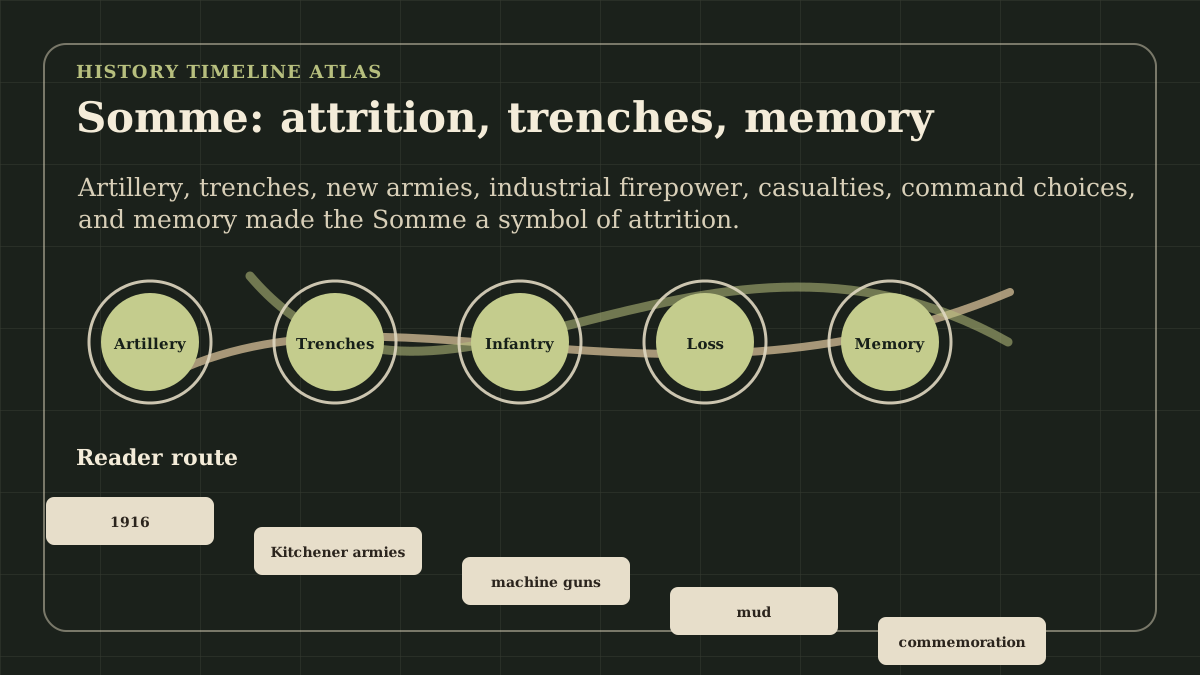
The Somme became a defining image of trench warfare, mass mobilization, artillery, and the gap between strategic plans and battlefield reality.
Douglas Haig / Ferdinand Foch are the first names or groups to compare before widening the story.
The offensive produced heavy casualties and only partial territorial gains.
The offensive produced heavy casualties and only partial territorial gains.
The Somme became a defining image of trench warfare, mass mobilization, artillery, and the gap between strategic plans and battlefield reality.
If the Somme raises questions about how commanders tried to turn material advantage into victory, follow-up reading will show how those questions spread across 1916–1918.
Background
By mid-1916 the Western Front had settled into a grim rhythm: lines of trenches, fortified positions, and repeated, costly attempts to dislodge an enemy. Political and military leaders on both sides confronted a persistent problem: how to transform mass mobilization and industrial firepower into a decisive result. The Somme offensive grew out of that pressure. British and French forces prepared a coordinated attack intended to break German lines, relieve pressure elsewhere on the front, and exploit superiority in men and material. The campaign took place within a broader pattern of attrition that characterized 1916—an era when artillery, entrenchments, and defensive technology made breakthroughs elusive.
Contemporary planners hoped that concentrated fire and massed infantry would succeed; critics would later point to rigid plans, misunderstandings of battlefield conditions, and the gulf between strategic aims and tactical realities. Historians still debate how much responsibility lies with individual commanders versus the larger structural forces of industrial warfare. This account keeps those tensions visible rather than settling the debate. The Somme becomes much clearer when it is read as a system of industrial war rather than only a day of slaughter. Commanders planned artillery preparation, infantry advances, mining, logistics, medical evacuation, railway supply, and coordination with French forces inside a wider Allied need to relieve pressure at Verdun.
The battle was not senseless in the simple meaning of having no military purpose; it was horrifying because a military purpose ran through methods that produced mass casualties. The human layer needs more than numbers. British volunteer formations, French units, German defenders, colonial labor, stretcher bearers, nurses, artillery crews, signalers, families waiting at home, and soldiers moving through wire, shell holes, mud, and machine-gun fire all belonged to the event. Casualty totals matter, but the page should help readers imagine how industrial firepower changed time, bodies, command, and memory. Technology also deserves nuance. Tanks appeared late in the battle, artillery dominated planning, machine guns shaped defense, aerial observation improved targeting, and trenches made movement difficult.
None of these tools worked as simple solutions. The Somme shows readers why innovation in war can increase destructive capacity before it produces operational clarity.
The Turning Point
The Somme’s decisive shift was not a single moment but a sequence of choices that altered both tempo and expectations. In the opening phase, commanders ordered massive preparatory barrages and planned tightly synchronized infantry advances; those decisions framed the battle’s initial character. Douglas Haig and other senior officers committed to sustained pressure on the German positions, interpreting massed attacks as the best means to exploit artillery efforts and to keep the enemy engaged. French forces and their leaders — including Ferdinand Foch among the senior French figures involved in the campaign — shaped coordination and the allocation of resources where Allied cooperation mattered.
As fighting progressed, the reality on the ground — intact deep defenses, effective German fire, and the limits of artillery suppression — forced adaptations: attacks were re-ordered, reserves moved forward, and operational aims shifted from rapid breakthrough to wearing the opponent down. Those choices transformed the Somme from a hoped-for decisive stroke into an attritional campaign. The continual decision to press on, despite mounting losses and only local gains, defined the battle’s character and its place in public memory. The turning point was the opening attack and its collision with surviving German defenses. The gap between artillery expectations and battlefield reality made the first day especially devastating for British forces.
That moment fixed the Somme in public memory, even though the battle continued for months and changed in tactics, weather, objectives, and command assumptions. A second turning point was the gradual learning process. Armies adjusted artillery methods, small-unit tactics, creeping barrages, aviation, and coordination, but those adaptations came at immense human cost. The page should make clear that learning happened and that learning did not redeem the losses.
Consequences
In the near term the offensive produced heavy casualties and only partial territorial gains. The front moved in places, villages and ridges changed hands, and the battlefield showed the limits of pre-war assumptions about offensive dominance. Politically and militarily, the Somme intensified debates among Allied leaders about how to win: continue grinding attrition, restructure tactics, or rethink command arrangements. In the longer term the Somme became a defining image of modern industrialized warfare. It reinforced the idea that trench systems, machine guns, and artillery together created a new kind of lethal inertia on the Western Front. For soldiers and civilians alike, the Somme entered national memory as an emblem of sacrifice and bewilderment.
Strategically, the campaign fed into later changes—tactical experiments with creeping barrages, improved coordination between infantry and artillery, and evolving command doctrines—but historians continue to dispute how directly those later innovations owed to lessons learned at the Somme. Importantly, the battle exposed a persistent tension: the gap between ambitious strategic plans and the fragmented, chaotic realities of front-line combat. That ambiguity keeps the Somme central to interpretations of World War I rather than allowing a single, settled explanation. The immediate consequence was attrition on both sides and a deepening of the Western Front's logic: break the enemy's capacity by spending shells, men, morale, and time.
The battle helped shape later Allied tactics, but it also became a symbol of command failure, grief, and the terrible gap between planning maps and battlefield experience. The longer consequence belongs to memory. The Somme entered British, French, German, Newfoundland, Irish, and Commonwealth remembrance in different ways. Cemeteries, memorials, memoirs, family stories, poetry, and battlefield tourism turned the event into a public argument about sacrifice, futility, duty, and modern war.
Interpretation Notes
The memory of Battle of the Somme often depends on who tells the story. A court, army, religious community, merchant network, or later nation can emphasize different causes and make Somme River stand for different lessons.
Why Keep Reading
If the Somme raises questions about how commanders tried to turn material advantage into victory, follow-up reading will show how those questions spread across 1916–1918. Explore related offensives to see whether later commanders adapted effectively, and examine political responses at home as societies digested prolonged loss. Tracing tactics, command changes, and shifts in public memory after the Somme illuminates how battlefield experience and national expectations interacted through the rest of the war. Read the Somme after Verdun and before the Armistice, then compare it with World War II battles such as Stalingrad and Kursk. That path helps readers see how attrition, logistics, morale, technology, and memory changed between the two world wars.
Reading Path
Follow the story without losing the thread
Before This
- Battle of VerdunFebruary-December 1916
- Gallipoli Campaign1915-1916
- Armenian Genocide Begins, 1915: Deportation, Violence, and Evidence1915 CE
After This
- Russian Revolution1917 CE
- Zimmermann TelegramJanuary 1917
- Armistice of 1918November 11, 1918
Same Period
- First Battle of the MarneSeptember 1914
- Gallipoli Campaign1915-1916
- Battle of VerdunFebruary-December 1916
Wider Timeline
Mind Map
How to think about Battle of the Somme
Artillery focus
Allied reliance on massed artillery bombardments intended to break defenses and prepare infantry advances
Map Layer
Where this event sits geographically
Gold pins mark the approximate locations of published event pages. This is a schematic locator map, not a historical border map.
Coordinates are approximate and are used to help readers orient themselves before opening a full event page.
References
Where to Check the Facts
- National WWI Museum and Memorial: All About WWIMuseum reference hub for World War I chronology, maps, articles, and educational context.
- U.S. National Archives: World War I CentennialArchive reference hub for World War I records, photographs, documents, and educational resources.