At a Glance
The shape of the event
- Date
- February-December 1916
- Place
- Verdun
- Type
- Battle
German forces attacked Verdun in a battle designed around endurance and attrition, while French defense turned the city into a symbol of national resistance.
February-December 1916; place the event in Verdun before comparing causes or consequences.
Verdun became one of the clearest examples of industrialized attrition and the emotional burden of World War I memory.
Philippe Petain / Erich von Falkenhayn are the first names or groups to compare before widening the story.
France held Verdun after months of brutal fighting and enormous losses on both sides.
France held Verdun after months of brutal fighting and enormous losses on both sides.
Verdun became one of the clearest examples of industrialized attrition and the emotional burden of World War I memory.
If Verdun draws you in, follow the wider arcs of the Western Front next: how commanders tried to break stalemates, how artillery and logistics reshaped fighting, and how societies coped with prolonged mass casualties.
Background
By early 1916 the Western Front had been locked in a harsh standoff for more than a year. Trench lines, artillery, railways and industrialised logistics shaped what commanders could attempt and what soldiers could endure. Against that structural backdrop, German planners sought ways to break the strategic deadlock; one approach was to make the French pay for every metre taken. Verdun lay on a defensive line of forts and roads that mattered for symbolism and supply. Its loss, German strategists calculated, might compel France to commit disproportionate resources and reveal the limits of French endurance. For the French, holding Verdun was not only a matter of territory but of national will.
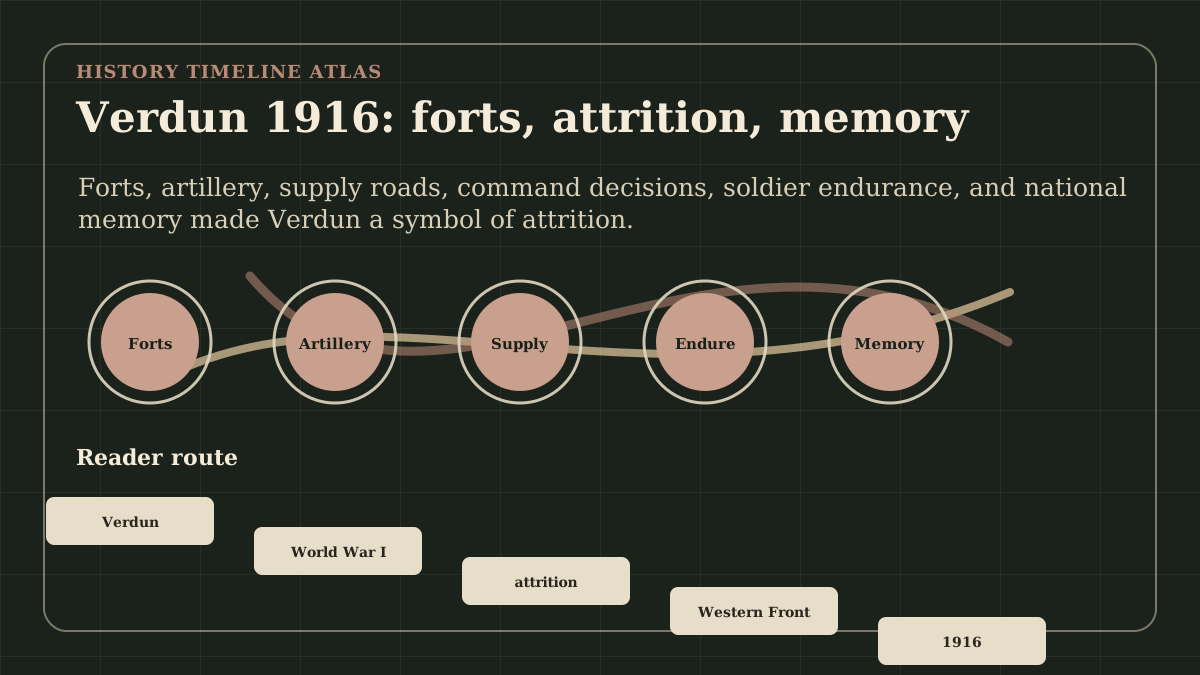
That intersection of strategic calculation and deep structural pressures—technology, supply, political expectations and the sheer scale of modern armies—set the scene for the battle that opened in February 1916. Verdun is not only a battle name. It is a way to understand how industrial war could convert terrain, roads, forts, artillery, shells, reserves, and national morale into one continuous test. The battlefield mattered because it carried strategic value and symbolic weight at the same time. The fort system gives the event its geography. Places such as Douaumont, Vaux, surrounding heights, ravines, and supply routes made the battle a landscape of endurance.
The French defense depended not only on courage but also on rotation, transport, artillery response, command choices, and the ability to keep men and material moving. The soldiers' experience prevents the page from becoming a command chart. Mud, shellfire, gas, fatigue, burial, fear, rumors, letters, wounds, and memory shaped what Verdun meant. The battle's scale is measured in logistics and casualties, but its afterlife is carried by human testimony and commemoration.
The Turning Point
The battle began with a deliberate German push against the Verdun sector in February 1916. Under Erich von Falkenhayn’s strategic framework, the offensive was crafted around a single logic: bleed the French by forcing them to defend a place they could not afford to lose. What changed as the fighting unfolded were the choices made on both sides in response to escalating costs. German commanders maintained pressure to exhaust French reserves; French leaders, including Philippe Petain, prioritized keeping Verdun from falling and sustaining the army’s cohesion. Tactics and tempo shifted into endurance: artillery barrages, counter-attacks, steady reinforcement and continuous resupply became measures of success.
The field of battle ceased to be a place for decisive manoeuvre and became, instead, a crucible in which industrial firepower, command decisions and soldierly stamina determined outcomes. Over months the accumulated weight of those choices transformed a local offensive into a defining episode of attritional warfare. The turning point was the failure of attrition to produce decisive advantage. German planners expected pressure at Verdun to drain French strength. Instead, both sides became tied to a battle whose costs grew while the strategic result remained limited. French defense became a political and emotional fact.
Petain's emphasis on supply and endurance, the route remembered as the Voie Sacree, and the refusal to abandon Verdun helped turn the battlefield into a national symbol. Symbolic value made withdrawal harder even when military costs were immense.
Consequences
In the near term the immediate result was that France held Verdun after months of brutal fighting and enormous losses on both sides. The front lines around the city were not dramatically altered in territorial terms, but the human and material toll was vast and irrevocable. Militarily, Verdun confirmed that industrialised attrition could be a deliberate method of warfare, shaping how commanders planned subsequent operations on the Western Front. Politically and socially, the siege and its defence fed powerful narratives: for France Verdun became a symbol of resistance and national sacrifice; for Germany it tested the limits of a strategy that valued attrition. Long-term, Verdun has loomed large in memory and historiography.
It is invoked as a clear example of the industrialisation of war and as an emotional touchstone for the costs of 20th‑century conflict. Interpretations remain contested: historians debate how much the battle resulted from individual decisions by commanders versus deeper technological and organisational forces. This page preserves those differing perspectives rather than presenting a single definitive cause. Verdun confirmed that modern armies could sustain destruction without restoring movement. The battle shaped later decisions on the Western Front because commanders learned that artillery, reserves, and logistics could create pressure, but not necessarily a decisive breakthrough. The memory consequence was just as strong.
Verdun became a French symbol of sacrifice, endurance, and mourning, while also standing for the futility many readers associate with World War I. Its meaning depends on whether the focus is command strategy, soldier survival, national memory, or the broader war of attrition.
Interpretation Notes
Battle of Verdun raises a debate about scale: did the decisive change come from the visible battle, or from older pressures around World War I and Western Front that had already narrowed what people could do?
Why Keep Reading
If Verdun draws you in, follow the wider arcs of the Western Front next: how commanders tried to break stalemates, how artillery and logistics reshaped fighting, and how societies coped with prolonged mass casualties. Understanding Verdun alongside contemporaneous offensives shows how attrition became doctrine and how memory and politics grew from battlefield choices. For readers who want to trace decisions to consequences, examining the months that followed—other offensives, home-front strains and the evolving debates among leaders—offers a clearer sense of why 1916 mattered so decisively. Read Verdun beside the Somme, Gallipoli, the Russian Revolution, the Armistice, and Versailles. The path shows how battlefield endurance, imperial strain, political collapse, and postwar settlement fit together.
Reading Path
Follow the story without losing the thread
Before This
- Battle of the SommeJuly-November 1916
- Gallipoli Campaign1915-1916
- Armenian Genocide Begins, 1915: Deportation, Violence, and Evidence1915 CE
After This
- Russian Revolution1917 CE
- Zimmermann TelegramJanuary 1917
- Armistice of 1918November 11, 1918
Same Period
- First Battle of the MarneSeptember 1914
- Gallipoli Campaign1915-1916
- Battle of the SommeJuly-November 1916
Wider Timeline
Mind Map
How to think about Battle of Verdun
Attrition strategy
German attack at Verdun was designed around endurance and the deliberate infliction of losses to weaken France over time.
Map Layer
Where this event sits geographically
Gold pins mark the approximate locations of published event pages. This is a schematic locator map, not a historical border map.
Coordinates are approximate and are used to help readers orient themselves before opening a full event page.
References
Where to Check the Facts
- Encyclopaedia Britannica: Battle of VerdunSpecific reference for the 1916 Battle of Verdun, commanders, attrition, outcome, and World War I setting.
- Imperial War Museums: What was the Battle of Verdun?Museum reference for Verdun's battlefield conditions, forts, casualties, and memory of attritional war.
- National WWI Museum and Memorial: All About WWIMuseum reference hub for World War I chronology, maps, articles, and educational context.
- U.S. National Archives: World War I CentennialArchive reference hub for World War I records, photographs, documents, and educational resources.