How to Read the Year
Why does 1942 feel like a global hinge inside World War II?
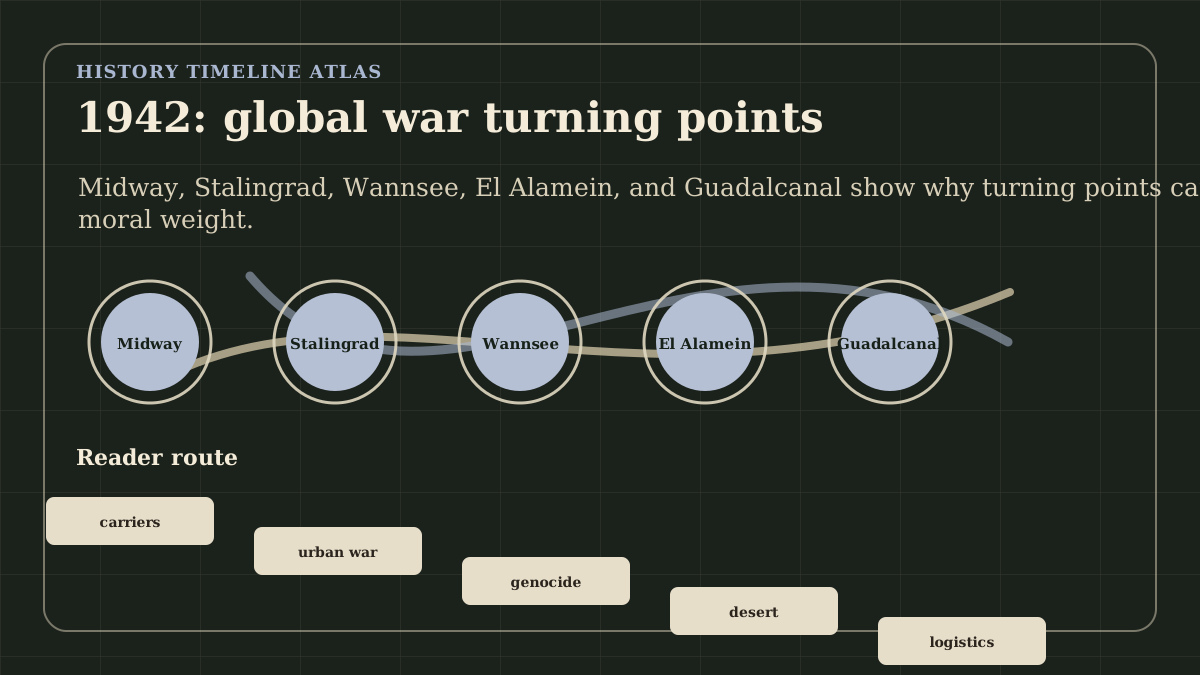
1942 links Midway, Stalingrad, the Coral Sea, Wannsee, Guadalcanal, and El Alamein. The year shows World War II at several scales at once: carrier war in the Pacific, urban catastrophe on the Eastern Front, genocide planned through bureaucracy, island campaigns, and the North African struggle over Egypt and imperial routes.
Midway and the Coral Sea revealed how aircraft carriers, intelligence, range, and logistics changed naval warfare. Guadalcanal turned island control, airfields, sea lanes, disease, supply, and local landscapes into a prolonged campaign. Stalingrad showed the cost of strategic overreach and urban combat, while El Alamein helped shift the North African campaign toward Allied advance.
Wannsee requires a different moral frame. It was not just another wartime meeting. Senior Nazi officials coordinated the bureaucratic implementation of genocide across occupied Europe. A responsible 1942 page keeps military turning points beside the administrative machinery of mass murder without letting either one erase the other.
The word turning point can mislead if it sounds like a single switch. In 1942, initiative shifted unevenly. Japan's expansion met limits in the Pacific, Germany's advance ran into Soviet depth and urban resistance, North Africa began to turn toward Allied momentum, and Nazi genocide became more systematized. The year changed possibilities before it guaranteed outcomes.
Civilian experience gives the year its moral weight. Occupied communities faced deportation, forced labor, hunger, reprisal, ghettoization, and racial law; Pacific islanders and North African civilians lived through bombardment, displacement, and military occupation; Soviet civilians endured siege, evacuation, and destruction. The war's direction changed through bodies and homes, not only through maps.
The next route moves from 1942 to 1943, D-Day, the Holocaust, Hiroshima, postwar trials, and the World War II timeline. That path helps readers understand why a year page can hold battle, bureaucracy, logistics, atrocity, and memory together instead of reducing global war to a list of campaigns.
The year matters because it makes global war legible without making it simple. Strategy, industry, intelligence, transport, ideology, racism, occupation, civilians, and soldiers all shaped the year. 1942 is not one turning point; it is a cluster of turning points across theaters and human experiences.
1942 CE in History gathers events that help readers move from a single date into wider historical patterns. A useful year entry does more than answer what happened; it shows why people keep using the year as a marker for change.
The connected events show how decisions, institutions, conflicts, ideas, and consequences crossed beyond one location or one person. The event links explain the immediate story, while the topic routes and timelines show what came before and after.
The year also helps organize broad questions. It gives readers a concise answer and a direct path into deeper event pages where causes, turning points, consequences, maps, and references are easier to inspect.
Read the date in three passes. First ask what happened inside the year itself. Then ask which older pressures made the event possible. Finally ask which later pages reuse the same vocabulary, institutions, borders, technologies, or memories. That sequence keeps the page from becoming a trivia answer.
Even when only one event is currently attached, the year still has a job: it gives students and curious visitors a stable chronological doorway into the atlas. The page makes the doorway useful by pointing to the event, the topic route, the timeline, the map, and the evidence trail that can turn a date into a broader explanation.
This year matters because it connects Battle of Midway, Battle of Stalingrad, Battle of the Coral Sea, Wannsee Conference, Guadalcanal Campaign Begins, Second Battle of El Alamein to a wider sequence of causes and consequences. It gives the reader a chronological anchor while still pointing outward to people, places, institutions, and later effects. A thin year page would only name the event; a useful year page explains why this date is a handle for a larger route through history. 1942 matters because it shows World War II becoming global in operational, moral, and administrative terms. The year links Pacific carrier battles, Stalingrad, North Africa, Guadalcanal, Wannsee, the Holocaust, logistics, civilians, and the slow shift in initiative toward the Allies.
Reader Lenses
Look for the pressures that made change possible.
Identify who acted and what options were available.
Follow what changed after the event.
Ask why this date still appears in historical summaries.
Move between Pacific, Eastern Front, North Africa, and occupied Europe rather than treating the war as one front.
Look for carriers, railways, oil, airfields, supply lines, factories, and intelligence.
Keep Wannsee and the Holocaust visible beside battlefield turning points.
How This Year Connects
1942 CE in History is anchored by Battle of Midway, Battle of Stalingrad, Battle of the Coral Sea, and Wannsee Conference. Read those pages together and the year stops being a date label; it becomes a crossroads where immediate choices met older pressures and opened later consequences.
The setting matters as much as the date. The year moves through Midway Atoll, Stalingrad, Coral Sea, and Wannsee, Berlin and belongs to World War II. That combination helps readers avoid treating the year as isolated; geography, institutions, conflict, belief, economy, and communication all shape what a date can mean.
The year also opens into people and themes. Figures such as Chester W. Nimitz, Isoroku Yamamoto, Joseph Stalin, Friedrich Paulus, and Allied naval commanders appear because their choices made the year visible, while themes such as World War II, Pacific War, Naval Warfare, Eastern Front, and Urban Warfare explain why the consequences outlived the moment. A useful next step is usually an event page, then a topic route, then a timeline.
Evidence changes the way a date reads. A treaty, battle report, inscription, newspaper, census, court record, memoir, photograph, or archaeological trace does not answer the same question. Looking at source type helps separate what happened in the year from how later people remembered it.
A year page is most useful when it keeps two scales open at once. The first scale is immediate: what happened, where, and who was involved. The second scale is interpretive: why later readers use this date to organize a wider story. Holding both scales together makes the page a starting point for deeper reading rather than a dead-end answer.
The before-and-after frame matters too. A date rarely begins the forces it reveals. Earlier pressures made the linked event possible, while later pages show which effects were temporary, which became institutions, and which turned into memory. Reading the year this way helps students avoid the false impression that history changes only when the calendar flips.
Use this page as a junction. If the event feels too brief, follow the topic route for background; if the cause feels too abstract, open the event page for sequence; if the consequence feels larger than the date, move into the timeline. The value of a year page is that it lets readers change scale without losing their place.
Read 1942 beside Midway, Stalingrad, Coral Sea, Wannsee, Guadalcanal, El Alamein, Holocaust pages, World War II timeline, and Pacific War routes.
Then compare 1942 with 1939, 1941, 1943, 1944, and 1945. The comparison asks when a war's direction changes and when moral catastrophe becomes administratively organized.
Events in This Year
- June 1942Battle of Midway
United States naval forces defeated a Japanese carrier attack near Midway, damaging Japan's offensive capacity in the Pacific.
- 1942-1943Battle of Stalingrad
Soviet forces encircled and defeated a German army at Stalingrad after months of brutal urban combat and strategic overreach.
- May 1942Battle of the Coral Sea
The Battle of the Coral Sea checked Japanese expansion toward Port Moresby and showed how aircraft carriers could decide naval battles without surface fleets directly meeting.
- January 20, 1942Wannsee Conference
Senior Nazi officials met at Wannsee to coordinate the bureaucratic implementation of the so-called Final Solution, linking genocide to administrative planning across occupied Europe.
- August 7, 1942Guadalcanal Campaign Begins
Allied forces landed on Guadalcanal, beginning a hard-fought campaign that contested airfields, sea lanes, supply paths, and island control in the South Pacific.
- October 23-November 11, 1942Second Battle of El Alamein
British-led forces defeated Axis troops at El Alamein, stopping the drive toward Egypt and shifting the North African campaign toward Allied advance.
Map Layer
1942 CE in History geography
Gold pins mark the approximate locations of published event pages. This is a schematic locator map, not a historical border map.
Coordinates are approximate and are used to help readers orient themselves before opening a full event page.
References
Where to Check the Facts
- Encyclopaedia Britannica: Battle of the Coral SeaSpecific reference for the 1942 CE anchor event, chronology, and historical setting.
- Encyclopaedia BritannicaBackground reference for chronology, names, and historical context.
- WikidataStructured reference for dates, places, alternate names, and entity links.