How to Read the Year
Why does 1869 make infrastructure feel like world history?
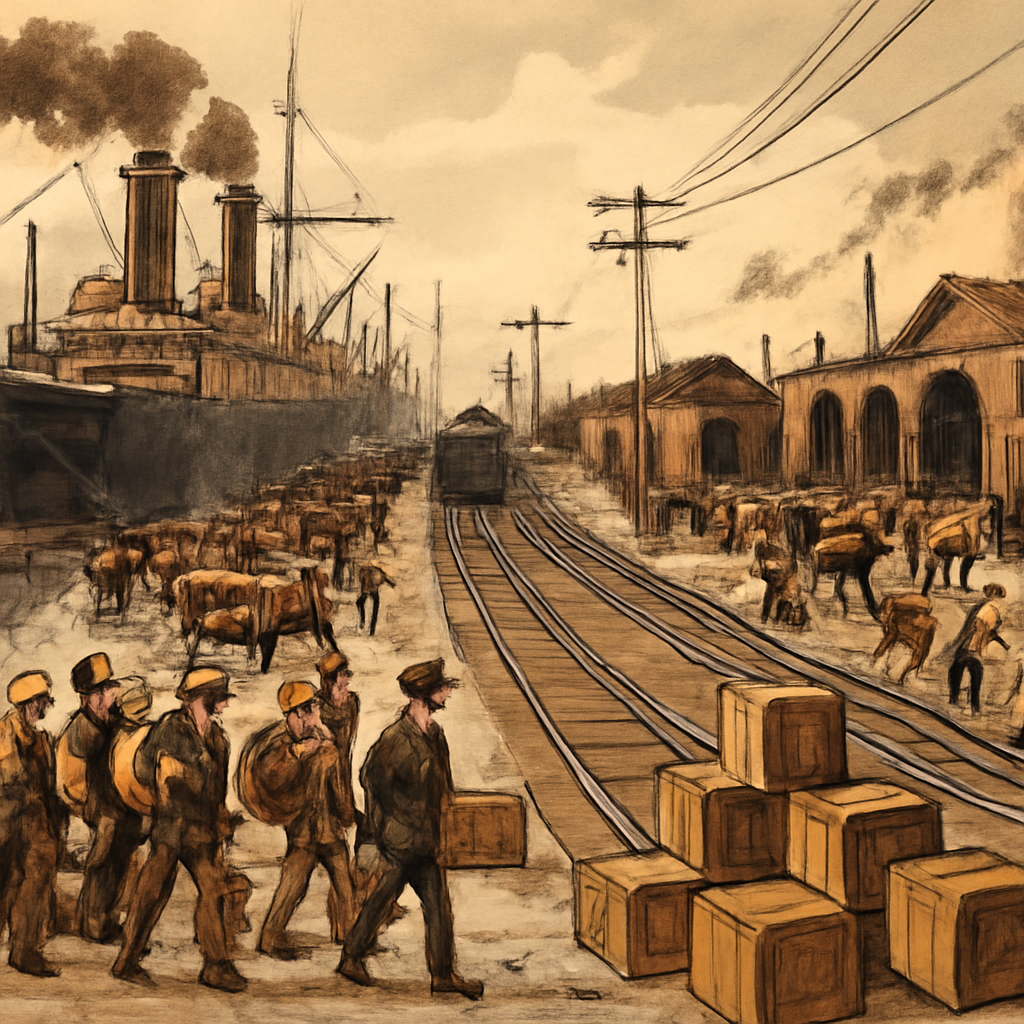
1869 links the opening of the Suez Canal with the completion of the first transcontinental railroad in the United States. The pairing makes the year about infrastructure as power. A canal and a railroad shortened routes, reorganized trade, moved people and goods faster, and made distant places feel more governable to states, companies, militaries, investors, and settlers.
The benefits were uneven. The Suez Canal became a strategic hinge for European-Asian shipping, imperial rivalry, Egyptian debt, labor history, and later military crisis. The American railroad connected coasts while relying on immigrant labor, federal land grants, corporate finance, military protection, and the violent displacement of Native peoples. Speed and connection were not neutral improvements.
A strong reading of 1869 asks who paid for connection and who gained leverage from it. Engineers, financiers, workers, shippers, officials, passengers, soldiers, settlers, canal pilots, and displaced communities experienced infrastructure differently. The year therefore becomes a doorway into industrial capitalism, empire, settler expansion, labor, and environmental change.
The map becomes physical through cuttings, rails, bridges, ports, deserts, tunnels, telegraph lines, coal stations, and survey teams. Geography was turned into a managed system. That material detail helps readers understand why infrastructure could look like progress to one audience and dispossession or dependency to another.
Suez also ties infrastructure to finance. Egyptian rulers sought modernization and prestige, European investors sought profit and route control, and imperial governments quickly understood the canal's strategic value. Debt, shares, ports, shipping insurance, coal supply, and naval planning turned a waterway into a political lever.
The U.S. railroad adds another moral layer. Chinese laborers, Irish laborers, Mormon workers, railroad corporations, federal land policy, military campaigns, buffalo destruction, and Native dispossession all belonged to the same story of connection. The year becomes richer when readers see that a route can bind a nation while breaking other peoples' worlds.
The two projects also changed time itself. Timetables, mail, telegraph coordination, shipping schedules, passenger expectations, and commodity prices all became more tightly synchronized. That practical compression of time is one reason infrastructure belongs in cultural and political history, not only in engineering history.
1869 CE in History gathers events that help readers move from a single date into wider historical patterns. A useful year entry does more than answer what happened; it shows why people keep using the year as a marker for change.
The connected events show how decisions, institutions, conflicts, ideas, and consequences crossed beyond one location or one person. The event links explain the immediate story, while the topic routes and timelines show what came before and after.
The year also helps organize broad questions. It gives readers a concise answer and a direct path into deeper event pages where causes, turning points, consequences, maps, and references are easier to inspect.
Read the date in three passes. First ask what happened inside the year itself. Then ask which older pressures made the event possible. Finally ask which later pages reuse the same vocabulary, institutions, borders, technologies, or memories. That sequence keeps the page from becoming a trivia answer.
Even when only one event is currently attached, the year still has a job: it gives students and curious visitors a stable chronological doorway into the atlas. The page makes the doorway useful by pointing to the event, the topic route, the timeline, the map, and the evidence trail that can turn a date into a broader explanation.
This year matters because it connects Opening of the Suez Canal, First Transcontinental Railroad Completed to a wider sequence of causes and consequences. It gives the reader a chronological anchor while still pointing outward to people, places, institutions, and later effects. A thin year page would only name the event; a useful year page explains why this date is a handle for a larger route through history. 1869 matters because it shows that modern globalization was built through physical corridors. Canals and railroads changed distance, but they also concentrated power, debt, labor discipline, land claims, and strategic vulnerability. The year helps readers see infrastructure as political history, not just technology.
Reader Lenses
Look for the pressures that made change possible.
Identify who acted and what options were available.
Follow what changed after the event.
Ask why this date still appears in historical summaries.
Ask how a canal or railroad changes distance, cost, military planning, and political imagination.
Look for workers, debt, land grants, dispossession, discipline, and risk behind the route.
Follow why infrastructure that speeds movement can also create strategic dependence.
How This Year Connects
1869 CE in History is anchored by Opening of the Suez Canal and First Transcontinental Railroad Completed. Read those pages together and the year stops being a date label; it becomes a crossroads where immediate choices met older pressures and opened later consequences.
The setting matters as much as the date. The year moves through Suez Canal and Promontory Summit and belongs to Modern World and Nineteenth Century. That combination helps readers avoid treating the year as isolated; geography, institutions, conflict, belief, economy, and communication all shape what a date can mean.
The year also opens into people and themes. Figures such as Ferdinand de Lesseps and Railroad workers appear because their choices made the year visible, while themes such as Trade, Empire, Shipping, Technology, Railroads, and Expansion explain why the consequences outlived the moment. A useful next step is usually an event page, then a topic route, then a timeline.
Evidence changes the way a date reads. A treaty, battle report, inscription, newspaper, census, court record, memoir, photograph, or archaeological trace does not answer the same question. Looking at source type helps separate what happened in the year from how later people remembered it.
A year page is most useful when it keeps two scales open at once. The first scale is immediate: what happened, where, and who was involved. The second scale is interpretive: why later readers use this date to organize a wider story. Holding both scales together makes the page a starting point for deeper reading rather than a dead-end answer.
The before-and-after frame matters too. A date rarely begins the forces it reveals. Earlier pressures made the linked event possible, while later pages show which effects were temporary, which became institutions, and which turned into memory. Reading the year this way helps students avoid the false impression that history changes only when the calendar flips.
Use this page as a junction. If the event feels too brief, follow the topic route for background; if the cause feels too abstract, open the event page for sequence; if the consequence feels larger than the date, move into the timeline. The value of a year page is that it lets readers change scale without losing their place.
Read 1869 beside Suez, railroads, industrial revolution, U.S. expansion, imperial trade, and globalization routes. The path follows material systems rather than only inventions.
Then compare 1869 with 1498, 1602, 1760, 1884, 1956, and 2021-style supply-chain questions where available. The comparison asks how chokepoints and corridors reorganize the world.
Events in This Year
- November 17, 1869Opening of the Suez Canal
The Suez Canal opened a direct water path between the Mediterranean and Red Sea, shortening sea travel between Europe and Asia.
- May 10, 1869First Transcontinental Railroad Completed
The first transcontinental railroad in the United States linked eastern and western rail networks after years of construction.
Map Layer
1869 CE in History geography
Gold pins mark the approximate locations of published event pages. This is a schematic locator map, not a historical border map.
Coordinates are approximate and are used to help readers orient themselves before opening a full event page.
References
Where to Check the Facts
- Encyclopaedia Britannica: Suez CanalSpecific reference for the 1869 CE anchor event, chronology, and historical setting.
- Encyclopaedia BritannicaBackground reference for chronology, names, and historical context.
- WikidataStructured reference for dates, places, alternate names, and entity links.