At a Glance
The shape of the event
- Date
- August 25, 1944
- Place
- Paris
- Type
- Liberation
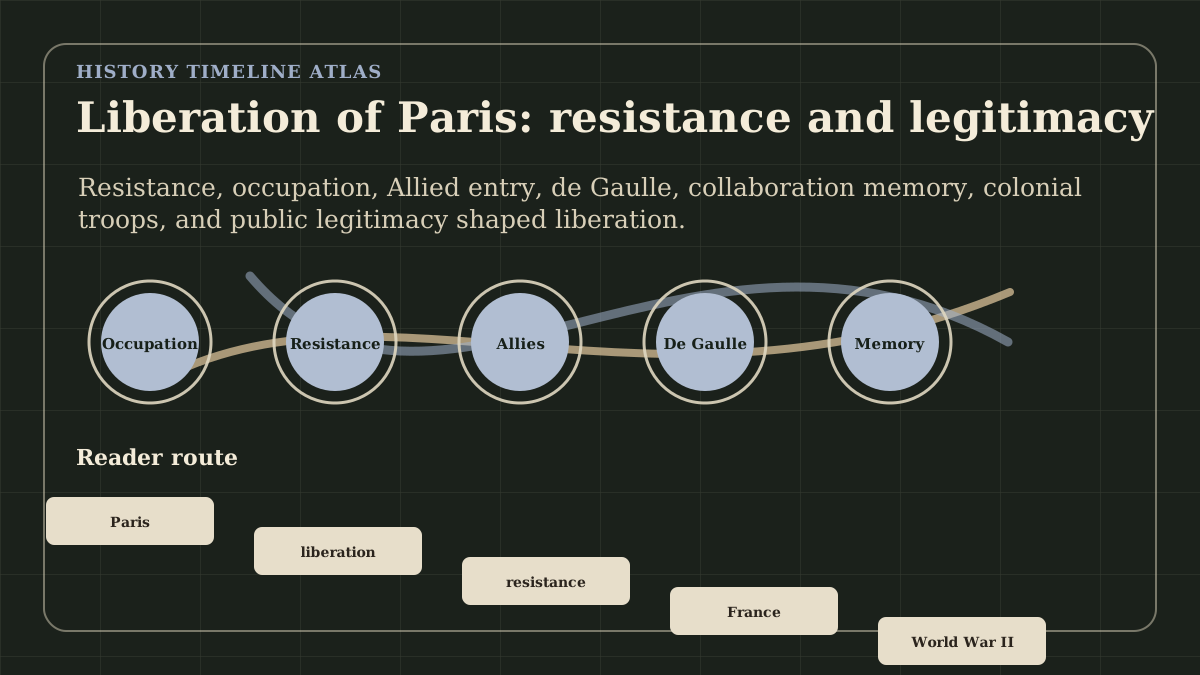
Paris was liberated after resistance actions, German withdrawal, and Allied entry into the city, turning occupation, national legitimacy, and liberation memory into one public moment.
August 25, 1944; place the event in Paris before comparing causes or consequences.
The event strengthened the public legitimacy of Free France and made resistance, occupation, collaboration, and national memory central to postwar French politics.
French Resistance / Charles de Gaulle / Allied forces are the first names or groups to compare before widening the story.
German occupation of Paris ended, and the city became a symbol of liberation in western Europe.
German occupation of Paris ended, and the city became a symbol of liberation in western Europe.
The event strengthened the public legitimacy of Free France and made resistance, occupation, collaboration, and national memory central to postwar French politics.
The next useful step is to follow the linked events, people, topic routes, and timelines.
Background
After D-Day, Allied forces advanced across France while resistance networks, civilians, and political leaders prepared for the end of German occupation and the question of who would represent liberated France. Before Liberation of Paris, the surrounding world already contained unresolved tensions over authority, resources, belief, strategy, or legitimacy. Those pressures mattered because they shaped what different actors thought was possible. Single-cause explanations flatten the background, which was usually a mix of long-running structures and immediate decisions. The location in Western Europe also matters, because events there connected local choices to wider routes of diplomacy, war, trade, reform, or memory. This context prepares the reader to see the event as part of a sequence rather than as an isolated headline.
The liberation of Paris is not only a military stop after Normandy. It is a political drama about occupation, resistance, collaboration, legitimacy, and national restoration. Armed resistance inside the city, Allied movement across France, German command decisions, and Charles de Gaulle's public entry all shaped how liberation would be remembered. The event turned control of a capital into a claim about who represented France. The city setting matters. Streets, police stations, barricades, public buildings, rail links, churches, newspapers, and crowds made liberation visible in ways a rural battlefield could not. A capital is a military objective, but it is also a stage where people argue about authority.
That is why the event belongs beside D-Day and Free France, not only after them. Resistance was plural. Communists, Gaullists, local networks, police factions, workers, students, printers, couriers, and ordinary residents did not all share one politics or one level of risk. The uprising inside Paris made occupation fragile, but it also raised the question of who would claim credit and legitimacy when German control collapsed.
The Turning Point
Resistance fighters rose in the city, German forces faced collapsing control, and Allied units entered Paris. De Gaulle's arrival helped frame liberation as both military victory and national political restoration. The turning point was not simply that the event occurred, but that it changed the range of options available afterward. People connected to French Resistance, Charles de Gaulle, Allied forces acted inside constraints created by earlier conflicts, institutions, and expectations. Some choices were deliberate; others were responses to pressure, fear, opportunity, or failed compromise. The event's form as liberation also shaped how consequences unfolded.
It made certain outcomes easier to imagine, gave later actors new evidence or symbols to use, and forced communities to adapt to a situation that could no longer be treated as temporary. The turning point was the convergence of local revolt and Allied movement. German power in the city weakened as Allied forces approached, while resistance action made the city politically unstable for the occupiers. Leclerc's 2nd Armored Division and other Allied units entered a city already acting against occupation. De Gaulle's public presence then turned liberation into statecraft. His walk through Paris and his claim of national continuity helped frame France as liberated by French will rather than merely restored by Allied armies.
That memory was powerful, but it also simplified collaboration, Vichy, colonial troops, and competing resistance politics.
Consequences
German occupation of Paris ended, and the city became a symbol of liberation in western Europe. The event strengthened the public legitimacy of Free France and made resistance, occupation, collaboration, and national memory central to postwar French politics. The immediate result mattered, but the longer effect came from how later people interpreted and reused the event. Some consequences were institutional: laws, borders, offices, alliances, or systems of rule changed. Others were social or cultural: public memory, political language, religious identity, or expectations about power shifted. Read the event on two clocks at once. One clock follows the immediate aftermath; the other follows the slower movement of influence into later crises, reforms, debates, and historical comparisons.
The public image of liberation could suggest unity, but the aftermath was more complicated. France had to reckon with occupation, Vichy collaboration, resistance memory, colonial troops, shortages, revenge, and reconstruction. Paris therefore works as a hinge between battlefield advance and postwar political memory, showing why liberation did not instantly settle the meaning of the war. The event also shaped how France narrated itself after 1944. Resistance memory could unify a wounded society, but it could also push uncomfortable questions to the margins: who collaborated, who was excluded from honor, which colonial soldiers were visible, and how quickly liberation translated into food, security, housing, and political trust.
Interpretation Notes
Liberation memory can celebrate unity while muting collaboration, colonial troops, civilian fear, and the contested politics of who represented France after occupation.
Why Keep Reading
The next useful step is to follow the linked events, people, topic routes, and timelines. Liberation of Paris becomes clearer when it is compared with what came before and after it, especially events in Twentieth Century and related pages about World War II and France. The map helps locate the event, the mind map separates causes from effects, and the source list gives readers a way to check the factual spine. Keep reading to see whether this event was a beginning, a turning point, an ending, or a symbol that later generations kept reworking. Read Paris after D-Day and before Yalta, Potsdam, and postwar reconstruction. That path connects military liberation with the politics of legitimacy, memory, occupation, and national recovery.
Reading Path
Follow the story without losing the thread
Before This
- D-Day LandingsJune 6, 1944
- Battle of the BulgeDecember 16, 1944-January 25, 1945
- Warsaw Ghetto UprisingApril-May 1943
After This
- Atomic Bombing of HiroshimaAugust 6, 1945
- Yalta ConferenceFebruary 1945
- End of World War II1945
Same Period
- Assassination of Archduke Franz FerdinandJune 28, 1914
- Russian Revolution1917 CE
- Treaty of VersaillesJune 28, 1919
Wider Timeline
Mind Map
How to think about Liberation of Paris
Pressure
After D-Day, Allied forces advanced across France while resistance networks, civilians, and political leaders prepared for the end of German occupation and the question of who would represent liberated France.
Map Layer
Where this event sits geographically
Gold pins mark the approximate locations of published event pages. This is a schematic locator map, not a historical border map.
Coordinates are approximate and are used to help readers orient themselves before opening a full event page.
References
Where to Check the Facts
- Encyclopaedia Britannica: Liberation of ParisReference for the liberation of Paris and its chronology.
- Imperial War Museums: The Liberation of ParisMuseum reference for occupation, resistance, and liberation context.
- National WWI Museum and Memorial: All About WWIMuseum reference hub for World War I chronology, maps, articles, and educational context.
- U.S. National Archives: World War I CentennialArchive reference hub for World War I records, photographs, documents, and educational resources.
- The National WWII Museum: Explore By TopicMuseum reference hub for World War II theaters, battles, home fronts, aftermath, and memory.
- Imperial War Museums: What You Need to Know About the Second World WarMuseum reference for the global war, civilian experience, military fronts, and consequences.